Fiberglass Rebar (GFRP): What It Is, Where It Is Used and How to Take It Off
Fiberglass rebar, or GFRP (glass fiber reinforced polymer) bar, is a reinforcing bar made of glass fibers held in a polymer resin instead of steel. It does not rust, does not conduct electricity and is not magnetic, so engineers specify it where steel corrosion or interference is the main concern. It behaves very differently from steel: it is far less stiff, it does not yield, and its bends must be made at the factory, never on site.
What GFRP rebar is
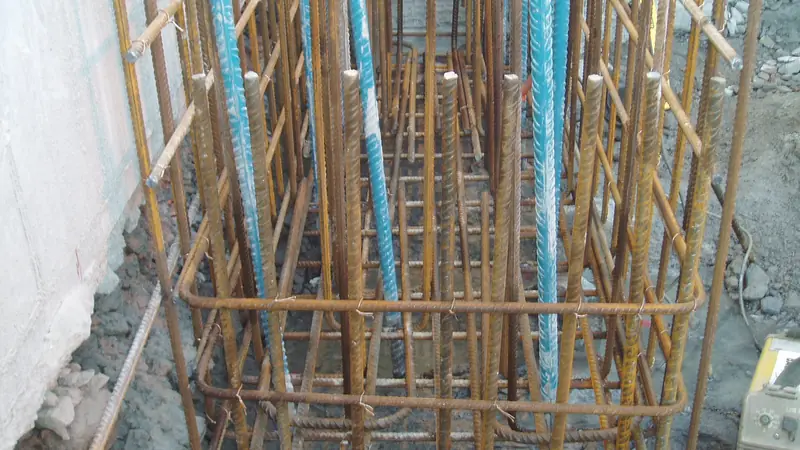
A GFRP bar is a composite. Continuous glass fibers run along the length of the bar and carry the tension; a hardened resin binds them together and transfers force between fibers. The surface is given a texture, such as a sand coating or a helical wrap, so the bar can bond to concrete the way deformations do on a steel bar.
The result is a bar that is a fraction of the weight of steel and immune to the electrochemical corrosion that destroys steel bars in salty or wet environments. It also has properties the designer has to respect:
| Property | Steel rebar | GFRP bar |
|---|---|---|
| Corrosion | Rusts when chlorides or carbonation reach it | Does not rust |
| Electrical / magnetic | Conductive and magnetic | Nonconductive and nonmagnetic |
| Stiffness (modulus) | About 29,000 ksi | Much lower: ACI 440.1R lists about 5,100 to 7,400 ksi, roughly a fifth to a quarter of steel |
| Behavior in tension | Yields, then stretches before breaking | Elastic up to rupture, no yielding |
| Bending | Can be bent by a fabricator, and in limited cases on site | Bends made only during manufacture |
| Weight | 0.376 lb/ft for #3 up to 13.60 lb/ft for #18 | Much lighter; steel weight tables do not apply |
Because GFRP is less stiff, a GFRP-reinforced slab deflects and cracks more than the same slab with steel, so the engineer often needs more bars or closer spacing. That is a design matter, but it is why a GFRP drawing can look heavily reinforced compared with a steel version of the same element.
Where fiberglass rebar is used
GFRP is a specialty product, chosen for a reason. The common reasons are:
- Corrosion: bridge decks and barriers exposed to deicing salts, seawalls, docks and other marine work, and structures in contact with chemicals.
- Nonmagnetic: floors and walls around MRI rooms and other magnetically sensitive equipment.
- Nonconductive: areas near high-voltage electrical equipment, where steel would carry induced currents.
- Cuttable by machines: tunnel "soft-eyes," where a tunnel boring machine has to cut through a reinforced shaft wall, because the machine can cut through glass fiber bars.
In routine buildings and houses you will rarely see it. When you do, expect it on part of the job, such as one deck or one room, not the whole structure.
The ACI 440 family
GFRP has its own documents, separate from ACI 318:
- ACI 440.1R: the long-standing design guide for concrete reinforced with FRP bars.
- ACI CODE-440.11-22: the building code for structural concrete reinforced with GFRP bars. It follows the layout of ACI 318-19 with provisions for beams, slabs, columns, walls and foundations.
- ACI SPEC-440.5-22: the construction specification for GFRP bars, written to be referenced in the contract documents.
- ASTM D7957: the material specification for solid round GFRP bars, referenced by ACI 440.11.
For the estimator, the important consequence is that the steel rules do not carry over. Development lengths, lap lengths, cover, bend geometry and minimum reinforcement come from the GFRP documents and the manufacturer's data. Do not use a steel lap table or the steel hook dimensions in rebar hooks and development length for GFRP bars.
How GFRP bars appear on drawings
There is no single industry symbol, so the general notes are the first place to look. Typical things you will see:
- A note in the reinforcing section such as "Reinforcement in deck slab shall be GFRP bars conforming to ASTM D7957" or a reference to ACI 440.11.
- A legend or line type that separates GFRP bars from steel bars on the same sheet, since one drawing can show both.
- A bar designation with a prefix, suffix or note to mark GFRP. Read how this project does it before counting.
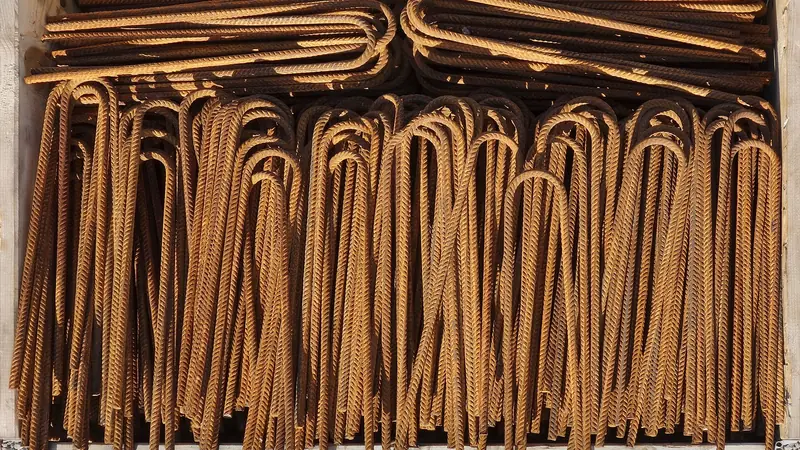
- Bent bar details drawn as shapes with dimensions, often with a note that bends are made by the manufacturer.
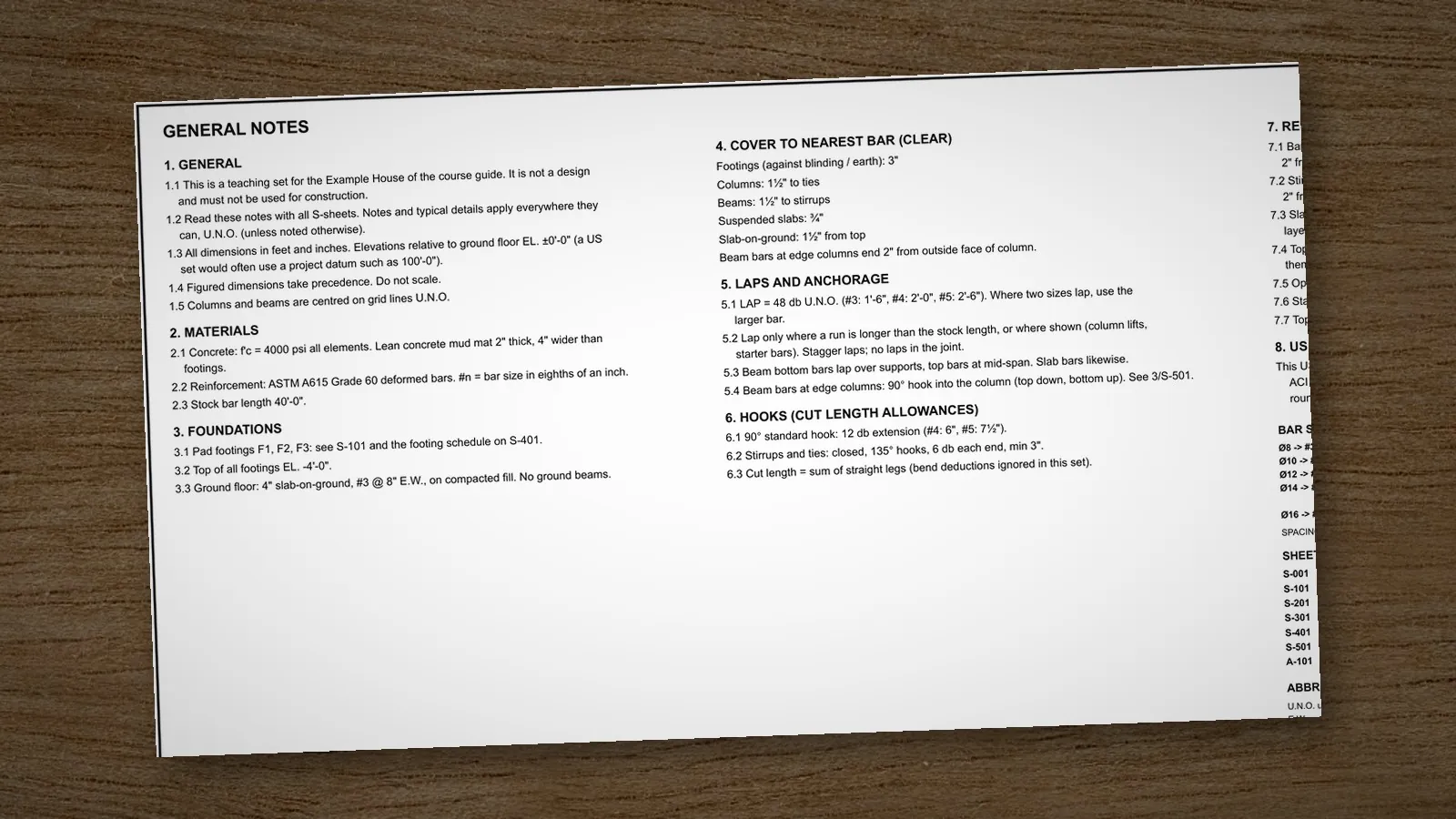
The general notes article covers where to find the material requirements on a set.
Why GFRP cannot be bent on site
A steel bar can be bent cold because steel yields: it deforms permanently and keeps its strength. A finished GFRP bar does not yield. Its resin is already hardened, and forcing a tight bend into a cured bar damages the fibers and the resin at the bend. Bends in GFRP are formed during manufacture, before the resin has fully cured, so bent bars and stirrups are made at the factory and finished bars are not bent in the field.
What this means in practice:
- Every bent piece is a separate manufactured shape. You cannot order straight stock and bend what you need.
- Shapes are made to order, so the bar list has to be right before production. Late changes to bent bars are harder to absorb than with steel.
- Field fixes are limited. A bar that does not fit cannot be re-bent. A missing hook cannot be added on site.
Cutting is different too: GFRP bars are cut with a saw, following the manufacturer's guidance, rather than with shears or a torch.
Worked example: GFRP slab with wall dowels
A small slab at a seawall is 16 ft x 24 ft, reinforced with GFRP #5 at 8 in each way, one mat, with 2 in edge cover. Along one 24 ft edge, GFRP L-bars at 12 in tie the slab to a wall: each L-bar has legs of 3'-0" and 1'-6", made as a factory shape. Assume the straight bars come in single pieces, with no laps.
Step 1: bars running the 24 ft way (spaced across 16 ft). The counting method is in rebar spacing.
- Count: (192 - 2 x 2) / 8 + 1 = 23.5 + 1 = 24.5, round up to 25 bars
- Length: 24 ft - 2 x 2 in = 23'-8" = 23.67 ft
- Total: 25 x 23.67 = 591.7 ft
Step 2: bars running the 16 ft way (spaced across 24 ft).
- Count: (288 - 2 x 2) / 8 + 1 = 35.5 + 1 = 36.5, round up to 37 bars
- Length: 16 ft - 2 x 2 in = 15'-8" = 15.67 ft
- Total: 37 x 15.67 = 579.7 ft
Step 3: L-bars along the 24 ft edge.
- Count: (288 - 2 x 2) / 12 + 1 = 23.67 + 1 = 24.67, round up to 25 pieces
- Length out to out: 3.0 + 1.5 = 4.5 ft each, 25 x 4.5 = 112.5 ft
Step 4: the takeoff as it goes to the supplier.
| Mark | Qty | Size | Shape | Length |
|---|---|---|---|---|
| S1 | 25 | #5 GFRP | Straight | 23'-8" |
| S2 | 37 | #5 GFRP | Straight | 15'-8" |
| L1 | 25 | #5 GFRP | L, 3'-0" x 1'-6" | Factory shape |
Total length: 591.7 + 579.7 + 112.5 = 1,283.9 ft.
Step 5: why weight is the wrong unit. If this were steel #5, the weight would be 1,283.9 x 1.043 = 1,339 lb. For GFRP that number tells the supplier nothing. Carry GFRP as pieces and lengths by mark and shape, and price it the way the supplier quotes it. Keep the L-bars as their own line: they are made to order, and a wrong dimension cannot be fixed on site. The mark-by-mark format is the same as a steel bar bending schedule.
Takeoff and site notes for GFRP
- Separate it from steel. On a job with both, keep GFRP on its own sheet of the takeoff so it is never priced by the ton.
- Laps and anchorage. Take lap and embedment lengths from the GFRP notes and details; they are not the steel values.
- Accessories. Chairs and ties must suit the bar and the reason it was chosen. On a nonmagnetic or nonconductive job, steel chairs and plain wire can defeat the purpose. The specification states what is allowed. See rebar chairs and accessories.
- Handling and storage. Follow the manufacturer's requirements, which can include support spacing, avoiding surface damage and protection from long exposure to sunlight.
For the other corrosion-resistant options, such as epoxy-coated, galvanized and stainless bars, see coated rebar types.
Frequently asked questions
Is fiberglass rebar as strong as steel?
GFRP bars can have high tensile strength, but they are much less stiff than steel and they do not yield. The design method accounts for this, usually leading to different bar sizes or spacing than a steel design. Strength alone is not the right comparison.
Can you bend fiberglass rebar?
Not on site. Bends in GFRP bars are formed during manufacture, and finished bars should not be bent in the field. Every bent piece is ordered as a shape.
What code covers GFRP reinforcement?
In the US, ACI CODE-440.11-22 is the building code for concrete reinforced with GFRP bars, ACI SPEC-440.5-22 is the construction specification, and ASTM D7957 is the material specification for the bars. ACI 440.1R is the design guide.
Where is fiberglass rebar used?
It is used where steel would corrode or interfere: bridge decks and barriers exposed to deicing salts, marine structures, MRI rooms, areas near high-voltage equipment, and tunnel soft-eyes that a boring machine has to cut through.
How do you estimate GFRP rebar?
Take it off by mark, size, shape, quantity and length, like a steel bar list, but do not convert to weight using steel tables. Keep factory-bent shapes as separate lines and use the GFRP lap and anchorage lengths from the drawings.
This article explains general practice for learning purposes. On a real project, the drawings, the general notes and the governing code always win.