Rebar Grades Explained: ASTM A615, A706, BS 4449, IS 1786 and AS/NZS 4671
Rebar grades tell you the minimum yield strength of the steel. In the US, Grade 60 under ASTM A615 means 60,000 psi (420 MPa) yield and is the everyday bar; Grade 40, 75, 80 and 100 also exist, and ASTM A706 is the low-alloy, weldable bar. Outside the US, the common grades are B500B (BS 4449, UK and many other markets), Fe500 and Fe500D (IS 1786, India) and D500N (AS/NZS 4671, Australia), all with a 500 MPa characteristic yield.
Rebar grades explained: what the number means
Every rebar standard defines grades by a few properties:
- Yield strength: the stress at which the steel starts to stretch permanently. This is the number in the grade name in almost every standard.
- Tensile strength: the highest stress before the bar breaks.
- Ductility: how much the bar stretches before it breaks, measured as elongation, and the ratio of tensile to yield strength.
- Bendability: the bar must bend around a set pin diameter without cracking.
- Chemistry: limits on carbon and other elements, which control weldability.
Rebar grades matter to two people. For the designer, the grade sets how much force each bar carries. For the estimator, the grade sets the price line and sometimes the supplier. The weight of a bar does not change with grade: a #5 weighs 1.043 lb/ft in any grade (see the rebar sizes chart).
Where the grade is on the drawings
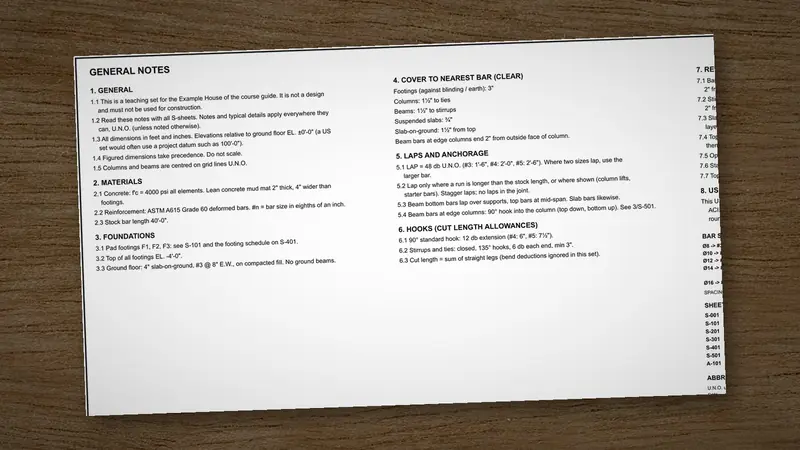
The grade is almost never in the bar callout (see how to read rebar callouts). On the drawing you will see #5 @ 12" O.C. and the grade sits in the general notes: "Reinforcing steel: ASTM A615 Grade 60 unless noted otherwise. Bars to be welded: ASTM A706 Grade 60." If a project uses two rebar grades, the notes or schedules say which members get which.
US grades: ASTM A615
ASTM A615 covers carbon-steel deformed and plain bars. The grade number is the minimum yield in ksi; the metric name in A615M is the yield in MPa.
| A615 grade | Metric grade | Min. yield | Min. tensile |
|---|---|---|---|
| Grade 40 | 280 | 40 ksi (280 MPa) | 60 ksi (420 MPa) |
| Grade 60 | 420 | 60 ksi (420 MPa) | 90 ksi (620 MPa) |
| Grade 75 | 520 | 75 ksi (520 MPa) | 100 ksi (690 MPa) |
| Grade 80 | 550 | 80 ksi (550 MPa) | 105 ksi (725 MPa) |
| Grade 100 | 690 | 100 ksi (690 MPa) | 115 ksi (790 MPa) |
Grade 60 is the default on most US building drawings. Grade 40 is limited to smaller sizes. Grades 80 and 100 are used to reduce congestion in heavily reinforced members. Note in the table that the margin between yield and tensile strength shrinks as the grade goes up (Grade 100: 115/100 = 1.15, against 1.5 for Grade 60). A smaller margin means less reserve strength beyond yield, which is one reason the governing code limits where high grades may be used.
Weldable rebar: ASTM A706
ASTM A706 is a low-alloy steel bar with controlled chemistry for welding and with tighter limits for ductility. Unlike A615, it sets a maximum yield strength as well as a minimum, so the bar cannot be much stronger than the designer assumed. That matters in seismic design, where the bar must yield before something else fails.
A706 is made in Grade 60 [420], Grade 80 [550] and Grade 100 [690]. You will see it called up for:
- Bars that will be welded, such as embeds and welded splices.
- Special moment frames and special structural walls in seismic regions, where the governing code requires it.
- Some bridge and transportation work, depending on the owner's specification.
On a takeoff, keep A706 bars on separate lines. They are priced and sometimes stocked differently from A615.
UK and many other markets: BS 4449 B500A, B500B, B500C
BS 4449 has one strength level, 500 MPa characteristic yield, and three ductility classes:
| Grade | Yield (characteristic) | Tensile/yield ratio | Elongation at max force |
|---|---|---|---|
| B500A | 500 MPa | at least 1.05 | at least 2.5% |
| B500B | 500 MPa | at least 1.08 | at least 5.0% |
| B500C | 500 MPa | 1.15 to less than 1.35 | at least 7.5% |
B500B is the general-purpose bar. B500A has low ductility and is common in small-diameter bars and mesh. B500C has the highest ductility and is used where the design needs it, for example under seismic or high-ductility requirements. On UK drawings the steel letter H covers more than one of these (see international rebar notation).
India: IS 1786 Fe415, Fe500, Fe500D
IS 1786 grades are named "Fe" (iron) plus the minimum yield (0.2% proof stress) in MPa. The grades include Fe415, Fe415D, Fe500, Fe500D, Fe550, Fe550D and Fe600.
The D grades have tighter limits on carbon, sulphur and phosphorus and a higher minimum elongation than the plain grade of the same strength, so they are more ductile. Fe500D is widely specified for buildings in seismic zones; Fe500 is the general-purpose bar. If the notes say "Fe500D", Fe500 is not an acceptable substitute without the engineer's approval.
Australia and New Zealand: AS/NZS 4671 D500N
AS/NZS 4671 names the grade with three parts: the surface (D = deformed, R = round), the yield in MPa, and the ductility class:
- L: low ductility (mainly mesh)
- N: normal ductility
- E: earthquake (high) ductility
So D500N is a deformed 500 MPa bar with normal ductility, the standard bar in Australia, written N on drawings (N16). D500L is used in mesh and R250N is a plain round 250 MPa bar.
Grade marks rolled on the bar
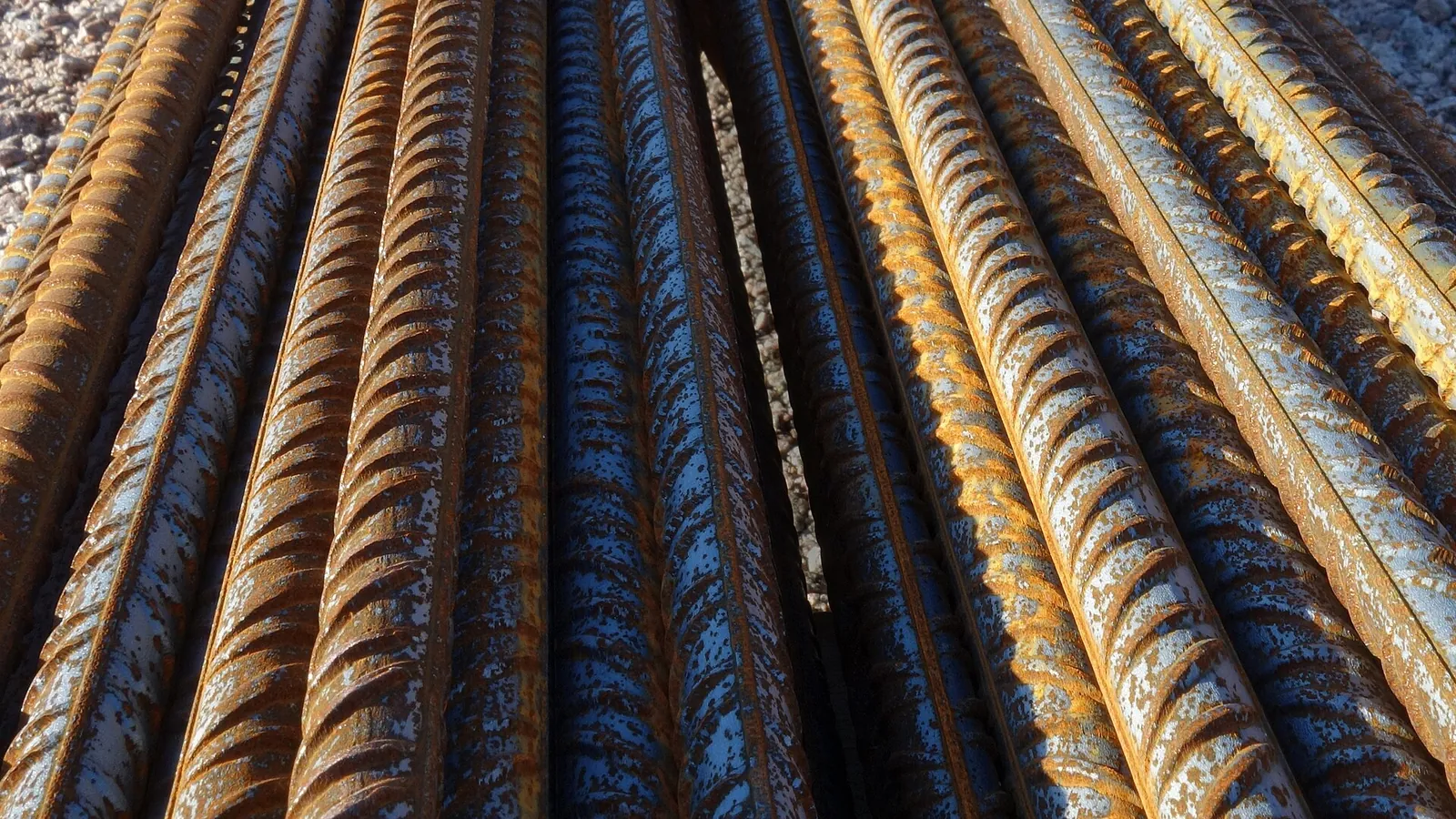
US bars carry rolled-on marks, in this order along the bar:
- Mill: a letter or symbol for the producing mill.
- Size: the bar number (inch) or the soft metric size.
- Type of steel: S for carbon steel to ASTM A615, W for low-alloy A706.
- Grade: the grade number (60, 75, 80, 100), or grade lines along the bar.
Grade 40 bars carry no grade mark. Grade 60 can be shown by one line and Grade 75 by two lines. For the higher grades, references describe the line convention differently, so read the rolled number, or the mill certificate, rather than counting lines.
Outside the US, bars are identified by rib patterns and rolled mill marks defined in the national standard, and by the certificate that comes with the delivery. Check the certificate against the grade in the notes.
Worked example: what a higher grade does to bar force
The estimator does not choose the grade, but it helps to see why an engineer might switch. Take one #5 bar (0.31 in²):
Step 1: yield force in Grade 60. 0.31 in² x 60 ksi = 18.6 kips (82.7 kN)
Step 2: yield force in Grade 80. 0.31 x 80 = 24.8 kips (110.3 kN)
Step 3: bars needed for the same force. Say a footing needs 186 kips of bar force in one direction. - Grade 60: 186 / 18.6 = 10 bars of #5 - Grade 80: 186 / 24.8 = 7.5, so 8 bars of #5
Step 4: what that does to the weight. Bar length 9.5 ft, 1.043 lb/ft: - 10 bars: 10 x 9.5 x 1.043 = 99.1 lb - 8 bars: 8 x 9.5 x 1.043 = 79.3 lb
The steel weight drops by about 20 percent, but every pound now has a Grade 80 price. This is a simplified strength check to show the ratio; real design also checks cracking, spacing, development and code limits on the grade. For comparison, one 16 mm B500B bar at yield carries 201 mm² x 500 MPa = 100.5 kN.
Frequently asked questions
What is the most common rebar grade?
In the US it is ASTM A615 Grade 60 (420 MPa yield). In the UK and many markets that follow British or European standards it is B500B, in India Fe500 or Fe500D, and in Australia D500N.
What is the difference between A615 and A706 rebar?
A615 is carbon-steel rebar for general use. A706 is low-alloy rebar with controlled chemistry for welding, a maximum as well as minimum yield strength, and tighter ductility requirements. It is specified for welded bars and for seismic members where the code requires it.
What is the difference between Fe500 and Fe500D?
Both have a 500 MPa minimum yield under IS 1786. Fe500D has tighter limits on carbon, sulphur and phosphorus and a higher minimum elongation, so it is more ductile and is preferred in seismic zones.
How can you tell the grade of rebar?
US bars carry a rolled grade number (60, 75, 80, 100) or grade lines; Grade 40 has no grade mark. The type letter shows the standard: S for A615 and W for A706. The mill certificate delivered with the steel confirms the grade.
Is Grade 60 rebar the same as Grade 420?
Yes. Grade 420 is the metric name in ASTM A615M for the same steel as Grade 60: 60 ksi is about 414 MPa, rounded in the standard to 420 MPa.
This article explains general practice for learning purposes. On a real project, the drawings, the general notes and the governing code always win.