Rebar Sizes Chart: Diameters, Areas and Weights for US and Metric Bars
This rebar sizes chart gives every standard US bar from #3 to #18 under ASTM A615, with nominal diameter, cross-sectional area and weight in both inch-pound and metric units, plus the common metric bars from 8 to 40 mm. For US bars #3 to #8, the bar number is the diameter in eighths of an inch, so a #5 bar is 5/8 in (15.9 mm) and weighs 1.043 lb/ft. For metric bars, weight in kg/m is close to d²/162.
How bar sizes are defined
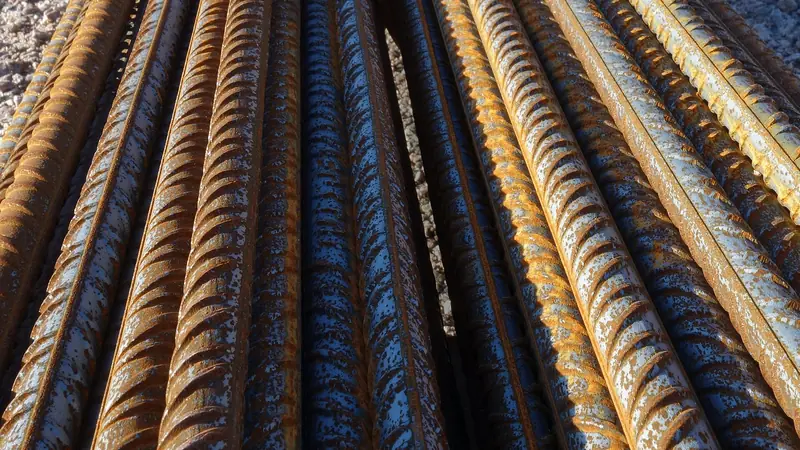
A deformed bar has ribs, so its real diameter changes along its length. The nominal diameter in the tables is the diameter of a plain round bar that has the same weight per foot as the deformed bar. Area and weight are calculated from that nominal diameter.
That matters for two reasons. First, if you measure a bar with calipers across the ribs you will get more than the nominal diameter. Second, all design areas and all takeoff weights use the nominal values, so those are the numbers to use.
Rebar sizes chart: ASTM A615 US bars
These are the standard nominal values for ASTM A615 (and A706) bars. The soft metric name is the size used in ASTM A615M for the same physical bar.
| Bar size | Soft metric size | Nominal diameter in | Nominal diameter mm | Area in² | Area mm² | Weight lb/ft | Mass kg/m |
|---|---|---|---|---|---|---|---|
| #3 | #10 | 0.375 | 9.5 | 0.11 | 71 | 0.376 | 0.560 |
| #4 | #13 | 0.500 | 12.7 | 0.20 | 129 | 0.668 | 0.994 |
| #5 | #16 | 0.625 | 15.9 | 0.31 | 199 | 1.043 | 1.552 |
| #6 | #19 | 0.750 | 19.1 | 0.44 | 284 | 1.502 | 2.235 |
| #7 | #22 | 0.875 | 22.2 | 0.60 | 387 | 2.044 | 3.042 |
| #8 | #25 | 1.000 | 25.4 | 0.79 | 510 | 2.670 | 3.973 |
| #9 | #29 | 1.128 | 28.7 | 1.00 | 645 | 3.400 | 5.060 |
| #10 | #32 | 1.270 | 32.3 | 1.27 | 819 | 4.303 | 6.404 |
| #11 | #36 | 1.410 | 35.8 | 1.56 | 1006 | 5.313 | 7.907 |
| #14 | #43 | 1.693 | 43.0 | 2.25 | 1452 | 7.650 | 11.38 |
| #18 | #57 | 2.257 | 57.3 | 4.00 | 2581 | 13.600 | 20.24 |
A few things to notice in this rebar sizes chart:
- From #9 up, the bar number no longer equals eighths of an inch. #9 is 1.128 in, which gives an area of 1.00 in².
- There is no #12, #13, #15, #16 or #17. After #11 the series jumps to #14 and #18, which are used mainly in heavy columns and foundations.
- Weight in lb/ft is very close to d² x 2.67, with d in inches. For #5: 0.625² x 2.67 = 1.043. The rebar weight calculation article shows where that factor comes from.
Weight of one stock-length bar
US bars are commonly stocked in 20 ft, 40 ft and 60 ft lengths. Weight of one 40 ft bar:
| Bar | lb per 40 ft bar |
|---|---|
| #3 | 15.0 |
| #4 | 26.7 |
| #5 | 41.7 |
| #6 | 60.1 |
| #7 | 81.8 |
| #8 | 106.8 |
| #9 | 136.0 |
| #10 | 172.1 |
| #11 | 212.5 |
| #14 | 306.0 |
| #18 | 544.0 |
Metric rebar sizes chart: 8 mm to 40 mm
Metric bars are named by their nominal diameter in millimeters. Mass per meter comes from the steel density of 7850 kg/m³, which works out to d²/162.2. Published tables (for example in BS 4449) use the density value directly, so they can differ from d²/162 in the third decimal. Both columns are given.
| Diameter mm | Area mm² | Mass kg/m (d²/162) | Mass kg/m (standard table) | Mass of 12 m bar kg |
|---|---|---|---|---|
| 8 | 50.3 | 0.395 | 0.395 | 4.74 |
| 10 | 78.5 | 0.617 | 0.617 | 7.40 |
| 12 | 113.1 | 0.889 | 0.888 | 10.66 |
| 14 | 153.9 | 1.210 | 1.208 | 14.50 |
| 16 | 201.1 | 1.580 | 1.579 | 18.95 |
| 20 | 314.2 | 2.469 | 2.466 | 29.59 |
| 25 | 490.9 | 3.858 | 3.854 | 46.25 |
| 28 | 615.8 | 4.840 | 4.834 | 58.01 |
| 32 | 804.2 | 6.321 | 6.313 | 75.76 |
| 40 | 1256.6 | 9.877 | 9.864 | 118.37 |
The 12 m column uses the standard table value. Metric bars are commonly stocked in 6 m and 12 m lengths. Not every market stocks 14 mm or 28 mm, so check what local suppliers carry before planning around them.
For a side-by-side of US and metric bars, and why #4 and 12 mm are not interchangeable, see metric vs imperial rebar. A quick-lookup version of these tables is in the rebar sizes reference.
Worked example: weight of a footing's bars
A square spread footing is 6 ft x 6 ft (1.83 m) with 7 #5 EW BOT, meaning 7 bars of #5 each way at the bottom. Cover is 3 in at each end, so each bar is 6 ft minus 2 x 3 in = 5 ft 6 in (5.5 ft) long.
Step 1: count the bars. 7 bars each way x 2 directions = 14 bars.
Step 2: total length. 14 x 5.5 ft = 77 ft.
Step 3: weight from the chart.
5 weighs 1.043 lb/ft.
77 x 1.043 = 80.3 lb per footing.
Step 4: in metric. 77 ft = 23.47 m. 23.47 x 1.552 kg/m = 36.4 kg. Check: 80.3 lb x 0.4536 = 36.4 kg.
Step 5: for a building. With 24 of these footings: 80.3 x 24 = 1,927 lb, a little under one short ton (2,000 lb).
The same footing designed in metric with 7 Ø16 EW B would use 16 mm bars at 1.579 kg/m: 23.47 m x 1.579 = 37.1 kg per footing. Close to the #5 result, because #5 and 16 mm are nearly the same bar. The rebar weight calculator does this per bar mark, and the concrete cover article explains why we took 3 in off each end.
How to use the chart without mistakes
- Use nominal values only. Never measure across ribs to decide the size; read the size from the drawing or the rolled marks on the bar.
- Keep units with the number. "1.043" is lb/ft; "1.552" is kg/m. Mixing them gives an error of about 49 percent.
- Do not round across sizes. If the drawing says #6, use 1.502 lb/ft, not a rounded 1.5 for one bar and 1.502 for the next. Rounding errors grow on a big bar list.
- Grade does not change weight. A Grade 60 and a Grade 80 #5 bar weigh the same. Grade matters for price and for design, not for the weight calculation.
Frequently asked questions
How much does #4 rebar weigh per foot?
A #4 bar weighs 0.668 lb/ft (0.994 kg/m). Its nominal diameter is 0.500 in (12.7 mm) and its area is 0.20 in². A 20 ft #4 bar weighs about 13.4 lb.
What is the diameter of #5 rebar?
5 rebar has a nominal diameter of 0.625 in, which is 5/8 in or 15.9 mm. The outside diameter over the ribs is a little larger. Its area is 0.31 in² and it weighs 1.043 lb/ft.
What are the most common rebar sizes?
In US residential and light commercial work, #3, #4 and #5 are the most common, with #6 to #8 used in heavier beams, columns and footings. In metric countries, 8, 10, 12 and 16 mm are the everyday sizes, with 20 to 32 mm in heavier members.
Why is there no #12 rebar?
The ASTM series stops at #11 and then continues with #14 and #18 only. These two large sizes cover heavy columns and foundations, and intermediate sizes are not part of the standard series.
How do you calculate metric rebar weight?
Square the diameter in millimeters and divide by 162 to get kg per meter. For a 16 mm bar: 16 x 16 / 162 = 1.58 kg/m. Multiply by total length to get the weight.
This article explains general practice for learning purposes. On a real project, the drawings, the general notes and the governing code always win.