Metric Rebar Sizes vs Imperial: Soft Metric, True Metric and Why Areas Differ
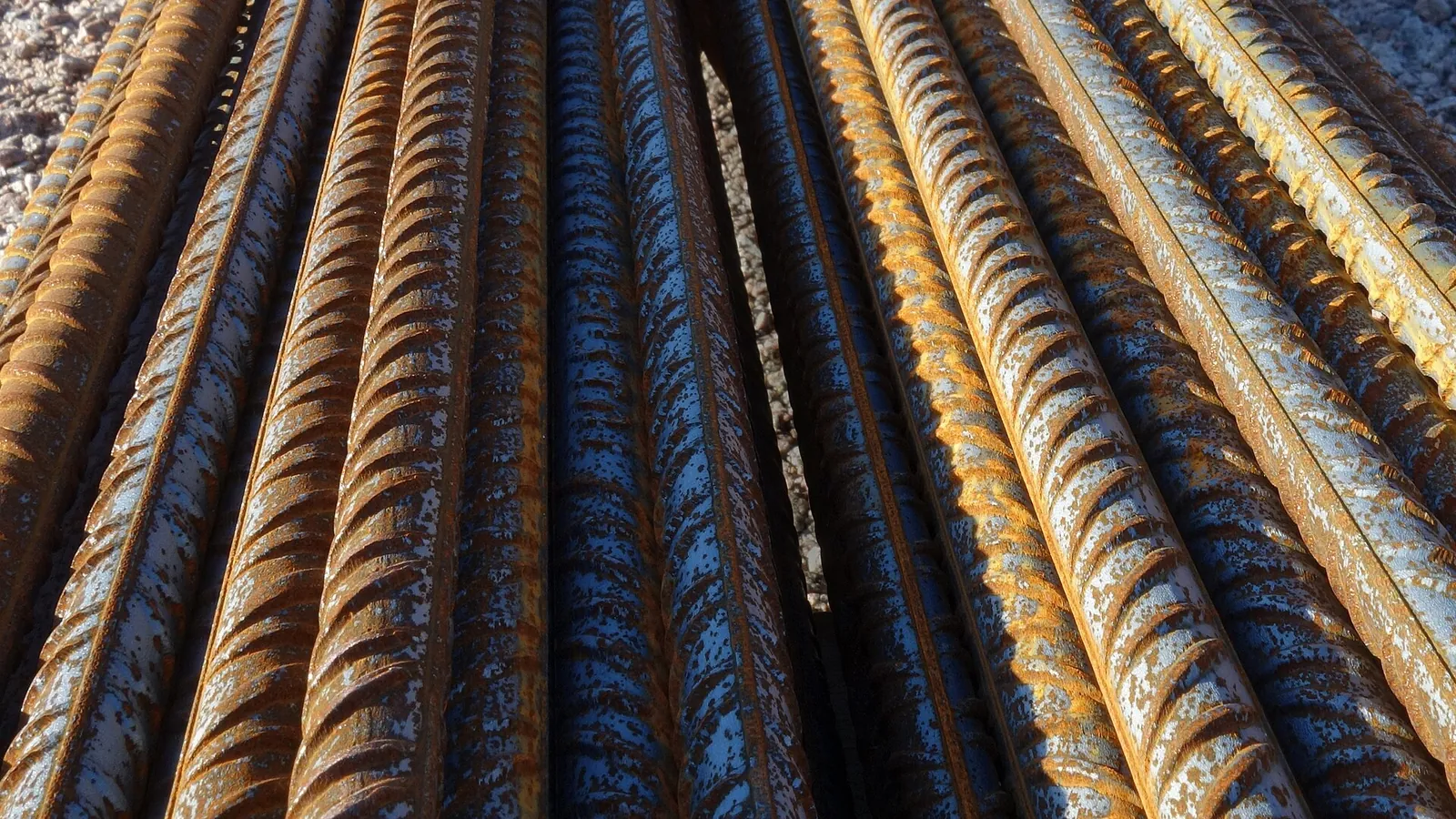
When you compare metric rebar sizes vs imperial sizes, there are two kinds of metric. Soft metric is the US bar renamed in millimeters: a #4 bar is the same bar as a #13 under ASTM A615M. True metric bars (10, 12, 16, 20, 25, 32 mm) are different bars with different areas, so a 12 mm bar has about 12 percent less steel than a #4. Never assume a metric bar and the nearest imperial bar are equal.
Soft metric: the same bar with a new name
ASTM also publishes metric designations for the same physical bars. ASTM A615M names each inch bar by its nominal diameter rounded to whole millimeters:
-
3 became #10
-
4 became #13
-
5 became #16
-
6 became #19
-
8 became #25
Nothing changed in the steel. A #16 soft metric bar has the same 15.9 mm diameter, 199 mm² area and 1.552 kg/m mass as a #5. Grades were renamed the same way: Grade 60 is Grade 420 (MPa), Grade 40 is Grade 280.
This is where confusion starts. On a US drawing in metric, "#16" is a #5 bar (15.9 mm). On a European drawing, "16" is a true 16 mm bar. The numbers match, but the bars are not the same. The international rebar notation article goes through how each country writes them.
True metric: the bars the rest of the world uses
Most of the world rolls bars in whole millimeter diameters. The common series under BS 4449 and EN 10080 is 6, 8, 10, 12, 16, 20, 25, 32 and 40 mm, with some markets adding 14, 28 or 50 mm. These sizes have no inch equivalent. Their mass per meter follows d²/162 (see rebar weight calculation).
Canada uses its own metric series under CSA G30.18: 10M, 15M, 20M, 25M, 30M, 35M, 45M and 55M. The number is a rounded name, not the diameter: a 15M bar is 16.0 mm with 200 mm².
Metric rebar sizes vs imperial: conversion table
The left half is the US bar and its exact soft metric data. The right half is the nearest true metric bar and how its area compares.
| US bar | Soft metric | Diameter in (mm) | Area in² (mm²) | Nearest true metric | True metric area mm² | Area difference vs US bar |
|---|---|---|---|---|---|---|
| #3 | #10 | 0.375 (9.5) | 0.11 (71) | 10 mm | 78.5 | +11% |
| #4 | #13 | 0.500 (12.7) | 0.20 (129) | 12 mm | 113.1 | -12% |
| #5 | #16 | 0.625 (15.9) | 0.31 (199) | 16 mm | 201.1 | +1% |
| #6 | #19 | 0.750 (19.1) | 0.44 (284) | 20 mm | 314.2 | +11% |
| #7 | #22 | 0.875 (22.2) | 0.60 (387) | 22 mm | 380.1 | -2% |
| #8 | #25 | 1.000 (25.4) | 0.79 (510) | 25 mm | 490.9 | -4% |
| #9 | #29 | 1.128 (28.7) | 1.00 (645) | 28 mm | 615.8 | -5% |
| #10 | #32 | 1.270 (32.3) | 1.27 (819) | 32 mm | 804.2 | -2% |
| #11 | #36 | 1.410 (35.8) | 1.56 (1006) | 36 mm | 1017.9 | +1% |
| #14 | #43 | 1.693 (43.0) | 2.25 (1452) | 40 mm | 1256.6 | -13% |
| #18 | #57 | 2.257 (57.3) | 4.00 (2581) | 50 mm | 1963.5 | -24% |
Read the last column carefully. Going from #4 to 12 mm loses 12 percent of the area (so #4 carries about 14 percent more than 12 mm, which is how the same gap is often quoted). Going from #6 to 20 mm gains 11 percent. Only #5 vs 16 mm and #11 vs 36 mm are within about 1 percent. Note that 22 mm and 36 mm are not stocked in every market. The full imperial data, with weights, is in the rebar sizes chart and the rebar sizes reference.
Metric rebar sizes vs imperial: why a small diameter difference matters
Area grows with the square of the diameter. A #4 bar is 12.7 mm against 12 mm, only 6 percent larger in diameter, but (12.7/12)² = 1.12, so about 12 percent more area. The same squaring applies to weight, because weight is area times length times the density of steel.
For an estimator that means two things. Weight per foot changes when the bar changes, so a converted takeoff needs the new unit weight. And if the bar size changes, the engineer may change the spacing to keep the same steel area, so the count changes too.
Worked example: substituting bars in a slab
A slab was designed in metric with 12 mm @ 150 mm bottom bars. The contractor can only get US bars and asks whether #4 at the same spacing works. Here is the check the engineer will look at, and what it does to the estimate.
Step 1: steel area per meter of the original design. 12 mm bar area = 113.1 mm². Bars per meter at 150 mm = 1000 / 150 = 6.67. Area = 113.1 x 6.67 = 754 mm²/m.
Step 2: #4 at the same spacing.
4 area = 129 mm².
Area = 129 x 6.67 = 860 mm²/m, 14 percent more than designed. In strength terms this is more steel, but the engineer still has to approve it (it changes the steel ratio and the weight).
Step 3: #4 at a wider spacing for the same area. Spacing = 129 / 754 x 1000 = 171 mm. A practical spacing would be 170 mm (about 6-3/4 in), if the engineer accepts it.
Step 4: what it does to the weight per square meter, one direction. - 12 mm @ 150: 6.67 bars/m x 0.888 kg/m = 5.92 kg/m². - #4 @ 150: 6.67 x 0.994 kg/m = 6.63 kg/m². - #4 @ 170: (1000/170 = 5.88) x 0.994 = 5.85 kg/m².
So the "same size" swap at the same spacing adds 12 percent to the steel weight. Now the dangerous direction: a slab designed with #6 @ 12" that someone builds with 20 mm at 12 in gains area, but one designed with 20 mm @ 300 built with #6 at 300 mm loses about 10 percent of its steel (284 vs 314 mm²). That is a design change, and only the engineer of record can approve it.
How to handle mixed units on a project
- Keep the design unit. If the drawings are metric, take off in metric and convert the total at the end, not bar by bar.
- Name the bar standard. Write "16 mm (BS 4449)" or "#5 (A615)" in your takeoff, not just "16".
- Never round a conversion into a substitution. Converting 16 mm to "about #5" for a weight check is fine; ordering #5 for a 16 mm design is a substitution that needs approval.
- Recalculate counts. 200 mm is 7.87 in, not 8 in. Over a long slab that difference adds or removes bars.
- Check stock lengths. US bars are stocked in 20 ft, 40 ft and 60 ft lengths; metric markets usually stock 6 m and 12 m. A 40 ft bar is 12.19 m, so lap positions and waste change.
Frequently asked questions
What is #4 rebar in mm?
A #4 bar has a nominal diameter of 0.500 in, which is 12.7 mm, and an area of 0.20 in² (129 mm²). Its soft metric name under ASTM A615M is #13. It is not the same as a true 12 mm bar, which has about 12 percent less area.
Is 16 mm rebar the same as #5?
They are close but not identical. #5 is 15.9 mm with 199 mm²; a true 16 mm bar has 201 mm². The difference is about 1 percent, the closest of any common pair, but a substitution still needs the engineer's approval.
What is soft metric rebar?
Soft metric rebar is a US inch bar labeled with a metric designation, such as #13 for #4 or #16 for #5, under ASTM A615M. The steel and dimensions are unchanged; only the name and the grade label (420 instead of 60) are metric.
Can I substitute metric rebar for imperial rebar?
Only with the approval of the engineer of record. Areas differ by up to about 12 percent between common pairs, and some swaps reduce the steel below the design. The engineer may accept a substitution with a change in spacing.
What sizes does metric rebar come in?
Common true metric sizes are 6, 8, 10, 12, 16, 20, 25, 32 and 40 mm, with 14, 28 and 50 mm in some markets. Canada uses 10M to 55M under CSA G30.18.
This article explains general practice for learning purposes. On a real project, the drawings, the general notes and the governing code always win.