How to Calculate Rebar Weight: Formulas, Worked Examples and Converting to Tons
Here is how to calculate rebar weight: multiply the total length of each bar size by its unit weight, then add up all sizes. For metric bars the unit weight is d²/162 kg/m, with d in millimeters; for US bars use the lb/ft from the ASTM chart (#5 = 1.043 lb/ft), or d² x 2.67 with d in inches. Divide the total by 2,000 for short tons or by 1,000 kg for metric tonnes.
The three rebar weight formulas
1. Metric: d²/162
Steel weighs about 7,850 kg per cubic meter. A bar 1 m long with diameter d (mm) has a volume of π x d² / 4 x 1 m, so:
mass per meter = π/4 x d² x 10⁻⁶ m² x 7,850 kg/m³ = 0.006165 x d² = d² / 162.2
Rounded, that gives the field formula d²/162 kg/m. For a 12 mm bar: 144 / 162 = 0.889 kg/m. For 20 mm: 400 / 162 = 2.47 kg/m.
2. US bars: use the chart
For US bars, the reliable way is to use the standard weight per foot from ASTM A615, which is in the rebar sizes chart:
| Bar | lb/ft | Bar | lb/ft |
|---|---|---|---|
| #3 | 0.376 | #8 | 2.670 |
| #4 | 0.668 | #9 | 3.400 |
| #5 | 1.043 | #10 | 4.303 |
| #6 | 1.502 | #11 | 5.313 |
| #7 | 2.044 | #14 | 7.650 |
| #18 | 13.600 |
3. US bars by formula: d² x 2.67
If you have no chart, steel at about 490 lb/ft³ gives:
weight per foot = π/4 x d² (in²) x 12 in x 490/1,728 lb/in³ = 2.67 x d²
with d in inches. For #6 (0.75 in): 0.5625 x 2.67 = 1.502 lb/ft, the same as the chart. For #4 (0.5 in): 0.25 x 2.67 = 0.668 lb/ft.
All three give the same weight for the same bar. When you calculate rebar weight on a real estimate, use the chart values, so your numbers match the supplier's and the reviewer's.
How to calculate rebar weight step by step
- List every bar mark from the plans, sections, schedules and typical details.
- Find the length of one bar: the dimension it spans, minus cover at each end, plus hooks and laps.
- Count the bars: from the callout ("7 #5") or from spacing: spaces = run / spacing, round up, plus one.
- Total length per mark = number of bars x length of one bar.
- Group by size and add the lengths.
- Multiply each size's total length by its unit weight.
- Add the sizes, then convert to tons.
Waste, laps not shown on the drawings and accessories are handled after this; see the rebar waste factor article.
Worked example 1: a US beam
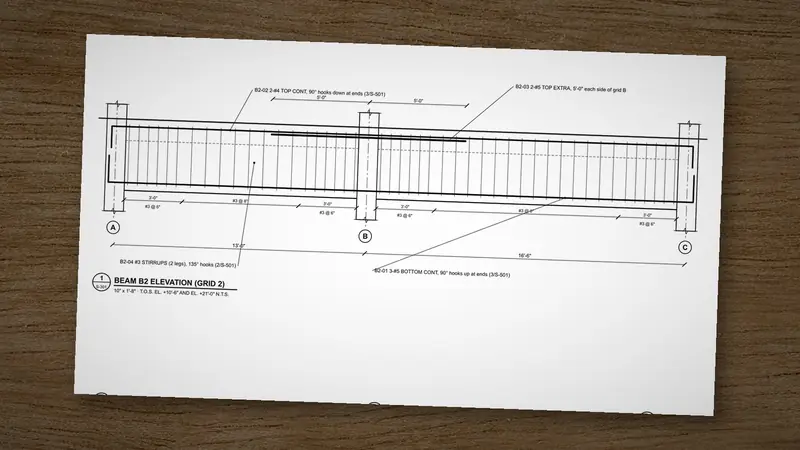
A 24 ft concrete beam, repeated 10 times on the floor. From the beam schedule and section:
- Bottom bars: 4 #8, each 24 ft long
- Top bars: 2 #6, each 24 ft long
- Stirrups: #4, 46 per beam, each 6 ft 6 in (6.5 ft) developed length per the bar schedule
Step 1: total length per size, one beam. - #8: 4 x 24 = 96 ft - #6: 2 x 24 = 48 ft - #4: 46 x 6.5 = 299 ft
Step 2: weight per size, one beam. - #8: 96 x 2.670 = 256.3 lb - #6: 48 x 1.502 = 72.1 lb - #4: 299 x 0.668 = 199.7 lb
Step 3: one beam total. 256.3 + 72.1 + 199.7 = 528.1 lb
Step 4: ten beams. 528.1 x 10 = 5,281 lb
Step 5: convert to tons. - Short tons: 5,281 / 2,000 = 2.64 tons - Kilograms: 5,281 x 0.4536 = 2,395 kg = 2.40 metric tonnes
Notice that the stirrups are almost 40 percent of this beam's weight (199.7 of 528.1 lb). A common mistake is to treat stirrups as small change; on beams with closely spaced ties they are a large part of the steel.
Worked example 2: a metric slab
A slab panel 5.0 m x 4.0 m with Ø12 @ 200 bottom bars each way, 25 mm cover at the edges.
Step 1: bar lengths. - Bars spanning the 5.0 m direction: 5.0 - 2 x 0.025 = 4.95 m - Bars spanning the 4.0 m direction: 4.0 - 2 x 0.025 = 3.95 m
Step 2: count the bars. - Bars spanning 5.0 m are spread across 3.95 m: 3.95 / 0.20 = 19.75, round up to 20 spaces, plus 1 = 21 bars - Bars spanning 4.0 m are spread across 4.95 m: 4.95 / 0.20 = 24.75, round up to 25 spaces, plus 1 = 26 bars
Step 3: total length. 21 x 4.95 = 103.95 m 26 x 3.95 = 102.70 m Total = 206.65 m
Step 4: unit weight. 12² / 162 = 0.889 kg/m (standard tables give 0.888; use 0.888 to match the supplier)
Step 5: weight. 206.65 x 0.888 = 183.5 kg
For twelve identical panels: 183.5 x 12 = 2,202 kg = 2.20 tonnes.
The rebar weight calculator runs the same arithmetic if you want to check a line quickly.
Converting a bar list to tons
On a real job you will have dozens of bar marks. Keep the calculation in a table so anyone can check it:
| Bar mark | Size | No. | Length ft | Total ft | lb/ft | Weight lb |
|---|---|---|---|---|---|---|
| B1 | #8 | 40 | 24.0 | 960 | 2.670 | 2,563 |
| B2 | #6 | 20 | 24.0 | 480 | 1.502 | 721 |
| S1 | #4 | 460 | 6.5 | 2,990 | 0.668 | 1,997 |
| Total | 5,281 |
This is the beam example above as a bar list (10 beams). 5,281 lb = 2.64 short tons. Note the small rounding differences: totaling by size first and then multiplying gives the most consistent answer.
Which ton?
- Short ton (US): 2,000 lb. This is what "ton" means on most US rebar quotes.
- Metric tonne: 1,000 kg = 2,204.6 lb.
- Long ton (UK, older usage): 2,240 lb. Rare in modern rebar pricing, but it shows up in old documents.
A 10 percent error is easy to make by mixing these. Write the unit in every total.
For the full process from drawing to bar list, see how to do a rebar takeoff.
Frequently asked questions
What is the formula for rebar weight?
For metric bars, weight in kg per meter is d²/162, with d the diameter in millimeters. For US bars, weight in lb per foot is about 2.67 x d², with d in inches, or you take the value from the ASTM chart. Multiply by total length for the bar weight.
Where does the 162 in d²/162 come from?
It comes from the density of steel, about 7,850 kg/m³. The area of a bar in square meters times 7,850 gives kg per meter, and that simplifies to d² x 0.006165, which is d² divided by about 162.
How many feet of #4 rebar are in a ton?
A short ton is 2,000 lb and #4 weighs 0.668 lb/ft, so a ton is 2,000 / 0.668 = about 2,994 ft. For #5 it is 2,000 / 1.043 = about 1,918 ft.
Does rebar grade affect its weight?
No. Weight depends only on the bar size and length, because all grades have the same nominal diameter and practically the same density. Grade affects strength and price, not weight per foot.
How do I convert rebar weight from lb to kg?
Multiply pounds by 0.4536 to get kilograms. For unit weights, multiply lb/ft by 1.488 to get kg/m: #5 at 1.043 lb/ft is 1.552 kg/m.
This article explains general practice for learning purposes. On a real project, the drawings, the general notes and the governing code always win.