Rebar Waste Factor: Where Waste Comes From and How to State It
A rebar waste factor is an allowance added on top of the net rebar weight to cover steel that is bought but does not end up in the concrete: mainly offcuts left when cut lengths do not divide evenly into stock bars. It is not a fixed number. It depends on the stock lengths available, the mix of cut lengths, whether bars are fabricated off site or cut on site, and how well offcuts are reused, so each company sets its own figure and states it in the estimate.
The useful skill is not memorising a percentage. It is understanding what drives waste so you can tell when a job needs more or less allowance than usual, and writing the assumption so nobody mistakes it for drawing quantity.
What waste is, and what it is not
Three things often get mixed together on a takeoff sheet:
| Item | Is it waste? | Where it belongs |
|---|---|---|
| Lap splices shown or required by the drawings | No | Net quantity, inside the cut length |
| Hooks and bends | No | Net quantity, inside the cut length |
| Extra bars added by the detailer for constructability | No, if shown on shop drawings | Net quantity |
| Offcuts from cutting stock bars | Yes | Waste allowance |
| Bars damaged, lost or cut wrong on site | Yes | Waste allowance |
| Leftover stock at the end of the job | Often treated as waste | Waste allowance, unless it is reused elsewhere |
Laps are the most common confusion. A lap is steel the drawings require; it goes in the net quantity. If you count laps inside a "waste" percentage, the net takeoff is understated and the allowance is doing two jobs. See lap splice length for how laps are taken off.
Stock lengths and offcuts
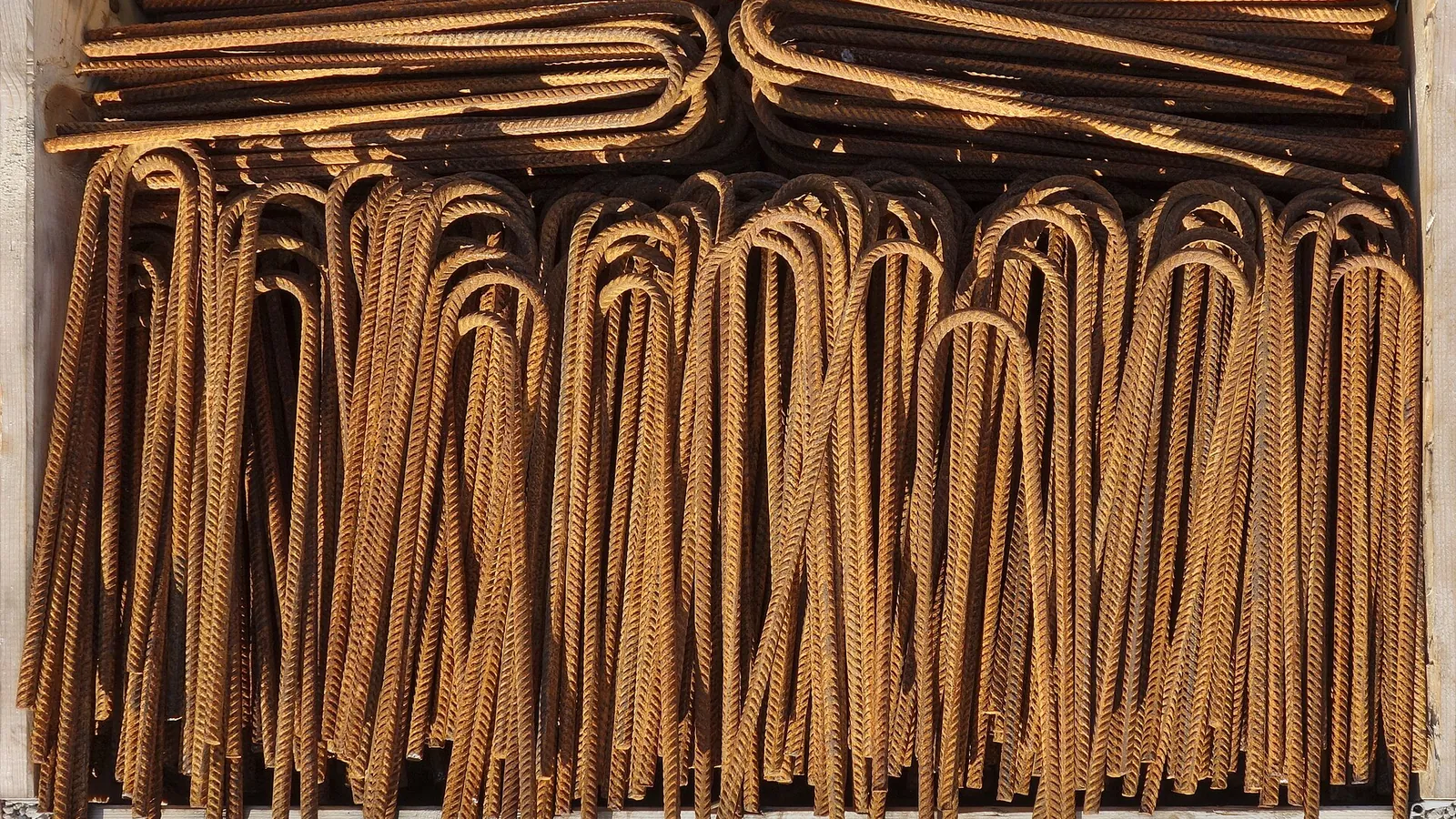
Rebar is rolled and sold in stock lengths. In the US the common stock lengths are 20 ft, 40 ft and 60 ft; in metric markets 6 m and 12 m are common. Availability by bar size varies by supplier, so check what you can actually buy.
Every cut length that does not divide evenly into a stock bar leaves an offcut. A 23'-8" bar cut from a 40 ft stock bar leaves 16'-4". Whether that 16'-4" becomes waste depends entirely on whether something else on the job can use it.
That is the idea behind cutting optimisation: grouping cut lengths so that the pieces taken from each stock bar add up as close as possible to the stock length. Fabricators and detailing software do this across a whole job, and sometimes across several jobs at once. You do not need to optimise cutting to produce an estimate, but you need to understand it to judge the rebar waste factor.
Worked example: one bar size, three cutting plans
A job needs these #5 bars:
- 30 pieces at 23'-8" (23.667 ft), for example beam bottom bars
- 40 pieces at 12'-0"
Net length needed = 30 × 23.667 + 40 × 12.0 = 710.0 + 480.0 = 1,190.0 ft.
Plan A: 40 ft stock, each length cut separately
- 23'-8" pieces: one per 40 ft bar → 30 stock bars, offcut 16.333 ft each.
- 12'-0" pieces: three per 40 ft bar → 40 ÷ 3 = 13.3 → 14 stock bars, giving 42 pieces (2 spare) and a 4 ft offcut each.
- Stock bought = 44 × 40 = 1,760 ft.
Plan B: 40 ft stock, pairing one long and one short piece
- Each bar gives 23.667 + 12.0 = 35.667 ft, offcut 4.333 ft. 30 bars → all 30 long pieces and 30 short pieces.
- Remaining 10 short pieces: 3 per bar → 4 more stock bars (2 spare pieces).
- Stock bought = 34 × 40 = 1,360 ft.
Plan C: 60 ft stock, two long and one short piece
- Each bar gives 2 × 23.667 + 12.0 = 59.333 ft, offcut 0.667 ft (8 in). 15 bars → all 30 long pieces and 15 short pieces.
- Remaining 25 short pieces: 5 per 60 ft bar, no offcut → 5 more stock bars.
- Stock bought = 20 × 60 = 1,200 ft.
| Plan | Stock bars | Bought | Needed | Left over | Left over ÷ needed |
|---|---|---|---|---|---|
| A | 44 × 40 ft | 1,760 ft | 1,190 ft | 570 ft | 47.9% |
| B | 34 × 40 ft | 1,360 ft | 1,190 ft | 170 ft | 14.3% |
| C | 20 × 60 ft | 1,200 ft | 1,190 ft | 10 ft | 0.8% |
Check Plan A: 30 × 16.333 = 490 ft of long-bar offcuts, plus 14 × 4 = 56 ft of short-bar offcuts, plus 2 spare 12 ft pieces = 24 ft. 490 + 56 + 24 = 570 ft, and 1,760 − 1,190 = 570 ft.
The same drawings, the same net quantity, and the leftover steel ranges from almost half to under one percent. On a real job, Plan A's offcuts would not all be scrap: some would become short bars, dowels or corner bars elsewhere. That reuse is exactly what a cutting plan, or an experienced shop, achieves. The example is small on purpose; it shows the mechanism, not a typical percentage.
Why the waste factor varies from job to job
The example shows the main driver. The others:
- How the rebar is bought. If a fabricator supplies cut and bent bars to your schedule and charges by the scheduled weight, the cutting offcuts stay in the fabricator's yard and in its price. If you buy stock bars and cut on site, the offcuts are yours.
- Mix of cut lengths. Many different lengths give more chances to fit pieces together. One awkward length repeated hundreds of times can waste a lot.
- Bar size. Waste in a heavy size costs more weight per foot than the same offcut length in a light size.
- Job size. On a small job there is less to reuse offcuts on, and minimum purchase quantities can leave stock unused.
- Revisions. Bars cut to an old revision may not be reusable.
- Site conditions. Damage, loss and cutting errors happen more where bars are handled and cut on site.
How to state the waste factor in an estimate
Whatever number your company uses, the estimate should make three things clear:
- What the net quantity includes. For example: "Net weights calculated from nominal ASTM A615 bar weights, including laps and hooks as shown on the drawings and typical details."
- The allowance and what it covers. For example: "Waste allowance of X% added to net weight, all sizes, covering cutting offcuts and site losses (company standard)."
- What is excluded. For example: "Chairs and supports, tie wire and mechanical couplers priced separately."
On the summary sheet, show net weight, allowance and total as separate lines, by bar size. Here is how that looks with an illustrative 5% allowance on the net weight from the step-by-step takeoff example:
| Size | Net weight | Allowance (5%, illustrative) | Total |
|---|---|---|---|
| #5 | 321.2 lb | 16.1 lb | 337.3 lb |
| #6 | 120.2 lb | 6.0 lb | 126.2 lb |
| Total | 441.4 lb | 22.1 lb | 463.5 lb |
The 5% is there only to show the arithmetic. Your company's practice, the way the job is bought and the cutting plan decide the real figure. If you track bought versus placed quantities on finished jobs, your own history is the best evidence for the number. Weights can be checked with the rebar weight calculator.
Frequently asked questions
What is a typical rebar waste factor?
There is no single correct figure. Companies set their own allowance based on how they buy rebar (fabricated or stock), the type of work and their own records of bought versus placed steel. Whatever figure is used should be written in the estimate as an assumption, separate from the net quantity.
Should laps be included in the waste factor?
No. Laps are required by the drawings and the governing code, so they are part of the net quantity and belong in the cut lengths. Putting them in the waste allowance understates the net takeoff and makes the estimate harder to check.
What are the standard rebar stock lengths?
In the US, 20 ft, 40 ft and 60 ft are the common stock lengths. In metric markets, 6 m and 12 m are common. Availability varies by bar size and supplier, so confirm with the supplier before planning cuts around a particular length.
How can rebar waste be reduced?
Group cut lengths so pieces from each stock bar add up close to the stock length, use the longest practical stock length, reuse offcuts for short bars such as dowels and corner bars, and avoid cutting before the drawings are final. Detailing software and fabricators do this optimisation routinely; an Excel takeoff can do a simple version, as discussed in rebar takeoff: Excel vs software.
This article explains general practice for learning purposes. On a real project, the drawings, the general notes and the governing code always win.