Epoxy Coated Rebar vs Galvanized, Stainless and GFRP: A Guide for Estimators
In the comparison of epoxy coated rebar vs galvanized rebar, both are carbon steel bars with a protective coating, used where chlorides from deicing salt or seawater would corrode plain steel. Epoxy coated bars (ASTM A775 or A934) have a fused plastic coating; galvanized bars (ASTM A767 or A1094) have a zinc coating. Stainless steel bars (ASTM A955) and glass fiber reinforced polymer bars (GFRP, ASTM D7957) go further and replace the material itself. In a takeoff, each type is a separate line item, and epoxy coated bars usually need longer laps.
Why coated and corrosion-resistant bars exist
Plain ("black") reinforcing steel is protected by the alkaline concrete around it. Chlorides from road salt, seawater or some soils can break down that protection, and once the steel rusts it expands and cracks the concrete. Bridge decks, parking structures, marine works and water structures are the usual places where the engineer specifies something better than plain bar.
When you compare epoxy coated rebar vs galvanized or stainless as an estimator, the reason for the choice matters less than the consequences: a different material, a different price, different laps, different accessories and different handling rules. These show up as notes and marks on the drawings.
Epoxy coated rebar vs galvanized, stainless and GFRP
| Type | ASTM standard | What it is | Takeoff notes |
|---|---|---|---|
| Epoxy coated, coated before bending | A775 | Straight bars coated, then cut and bent | Longer laps (ACI); coating repair at cut ends and damage |
| Epoxy coated, coated after fabrication | A934 | Bars cut and bent first, then coated | Longer laps (ACI); shapes must be final before coating |
| Galvanized, batch hot-dip | A767 | Bars dipped in molten zinc | Laps as plain bar in ACI 318; zinc-coated accessories |
| Galvanized, continuous | A1094 | Bars galvanized in a continuous line | As above |
| Zinc and epoxy dual-coated | A1055 | Zinc layer, then epoxy | Treated like epoxy for development in ACI 318 |
| Stainless steel | A955 | Solid stainless steel bar | Separate price line; compatible accessories |
| GFRP | D7957 | Glass fibers in a resin, not steel | Bends made at the factory; designed to separate rules |
Plain carbon steel bars are ASTM A615, and low-alloy weldable bars ASTM A706. Grades are covered in rebar grades.
Epoxy coated rebar
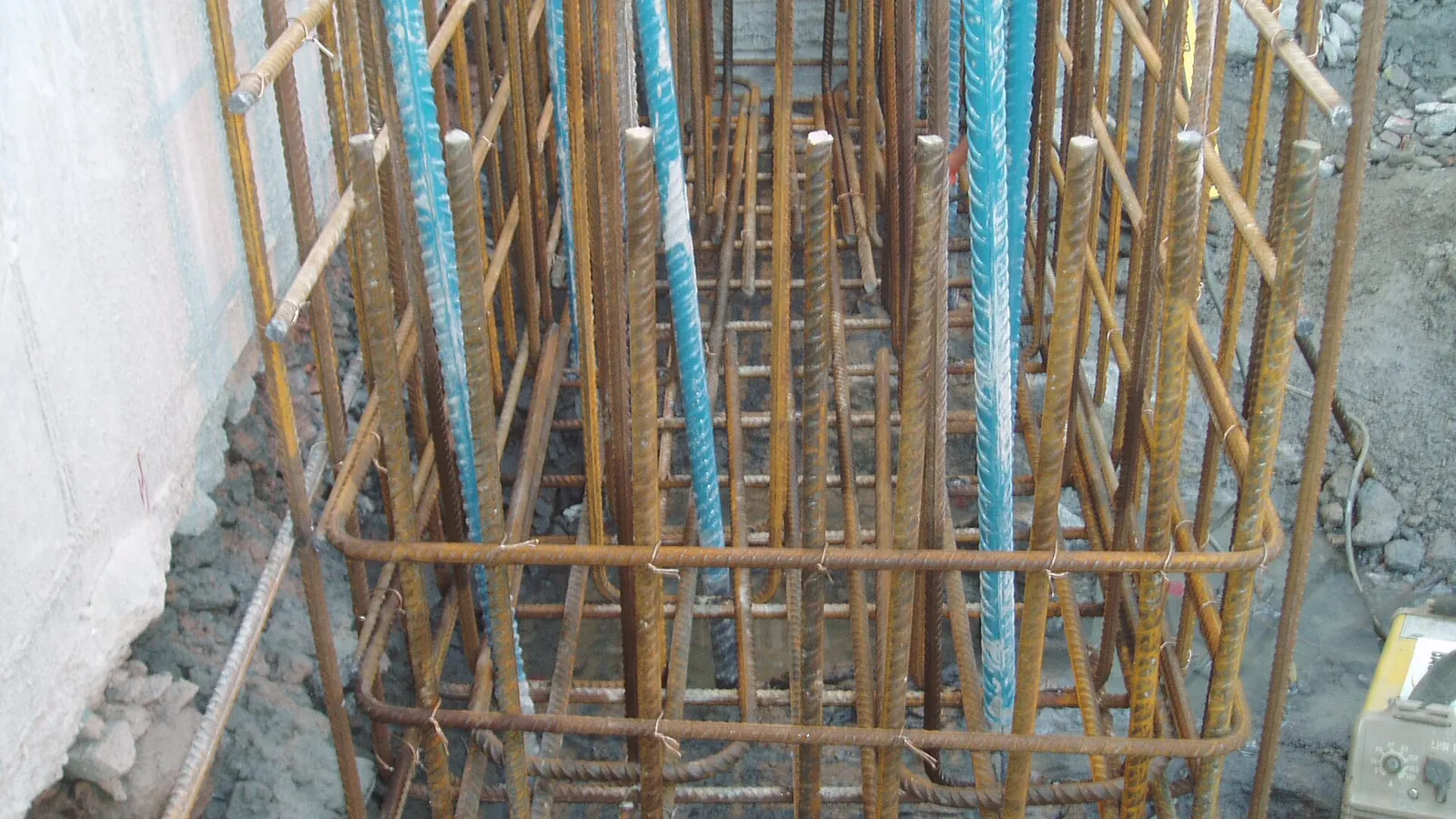
Epoxy coated bars are the most common corrosion-resistant bar in many US bridge and parking structure specifications. Under A775 the straight bar is coated in the mill or coating plant, then cut and bent. Cut ends and any damage from handling and bending have to be repaired with a patching material, as the specification requires. Under A934 the bars are fabricated first and coated afterward, so the shapes on the bar list must be final before coating.
Epoxy is a smooth plastic surface, and it reduces the bond between bar and concrete. This is why ACI 318 increases development and lap length for epoxy coated bars, covered below.
Galvanized rebar
Galvanized bars carry a zinc coating that protects the steel even where the coating is scratched. Batch galvanizing (A767) dips fabricated or straight bars into molten zinc. Continuous galvanizing (A1094) coats straight bar in a production line before fabrication. In ACI 318, galvanized bars use the same development length factor as plain bars, so laps do not increase for the coating.
Stainless steel rebar
Stainless bars (A955) are solid stainless steel, so there is no coating to damage. They are specified where long service life matters most or the exposure is severe. In a takeoff, stainless is always its own line item, and it should never be mixed into the plain bar weight.
GFRP bars
GFRP bars are not steel. They do not corrode, they are much lighter than steel, and they cannot be bent on site: bends are made at the factory. Their design follows separate rules (in the US, ACI 440 documents), and their laps and details come from the engineer. Treat GFRP as a separate scope with its own schedule. Supplier data and the project documents govern quantities and lengths.
How coated bars show on the drawings
On the drawings you will see coated bars marked in one or more of these ways:
- A general note, such as "All reinforcing steel in the deck slab shall be epoxy coated per ASTM A775."
- A suffix on the bar callout, such as "#5E @ 12"" or "#5 @ 12" (EPOXY)," with a legend explaining the suffix.
- A separate line type or a hatch on sections, with a legend.
- The bar schedule, with a column for coating.
Very often only part of the steel is coated: the top mat of a parking deck, all steel in a bridge deck, the bars in a splash zone. Read the note carefully for where the coating stops. A section that shows top bars in a heavier line with "E" and bottom bars plain is telling you there are two line items in that slab.
How coatings change development and lap length
ACI 318 applies a coating factor (ψe) to development length, and lap splices are multiples of development length:
| Bar surface | ACI 318 coating factor ψe |
|---|---|
| Epoxy or zinc and epoxy dual-coated, clear cover less than 3 db or clear spacing less than 6 db | 1.5 |
| Epoxy or zinc and epoxy dual-coated, all other cases | 1.2 |
| Uncoated or galvanized (zinc-coated) | 1.0 |
The product of the top-bar factor and the coating factor need not exceed 1.7. In practice, the lap schedule on the drawings will usually have separate columns or a separate table for epoxy coated bars. Take the laps from there, not from the plain bar column. The full explanation of laps is in lap splice length, and development length in rebar hooks and development length. These are typical ACI 318 values; the project's general notes and governing code win.
Worked example: a parking deck with an epoxy coated top mat
A deck panel is 60 ft x 40 ft. The drawings show a top mat of #5E @ 12 in E.W. (epoxy coated, A775) and a bottom mat of #5 @ 12 in E.W. (plain). Edge cover is 2 in. Stock bars are 40 ft. For this example, the lap schedule gives a lap of 30 in for plain #5 and 45 in for epoxy coated #5 top bars (example values, not a recommendation).
Bars running the 60 ft direction, spread across 40 ft
- Count: (480 - 4) / 12 = 39.67, round up to 40, plus 1 = 41 bars per mat
- Run length: 60 ft - 4 in = 59.67 ft, longer than a 40 ft stock bar, so one lap per line
- Check: roundup((59.67 - 3.75) / (40 - 3.75)) = roundup(1.54) = 2 bars, 1 lap
Bars running the 40 ft direction, spread across 60 ft
- Count: (720 - 4) / 12 = 59.67, round up to 60, plus 1 = 61 bars per mat
- Length: 40 ft - 4 in = 39.67 ft, fits a 40 ft bar, no lap
Top mat, epoxy coated (lap 3.75 ft)
- 41 x (59.67 + 3.75) = 41 x 63.42 = 2,600 ft
- 61 x 39.67 = 2,420 ft
- Total 5,020 ft x 1.043 lb/ft = 5,236 lb of #5 epoxy coated
Bottom mat, plain (lap 2.5 ft)
- 41 x (59.67 + 2.5) = 41 x 62.17 = 2,549 ft
- 61 x 39.67 = 2,420 ft
- Total 4,969 ft x 1.043 lb/ft = 5,183 lb of #5 plain
Two things to notice. First, the longer epoxy laps add only about 53 lb here, because there are only 41 laps. On a deck with many laps, or on larger bars, the difference grows. Second, and more important for the price: the deck has two line items of almost equal weight at different unit costs. Putting the whole deck at the plain bar rate, or the epoxy rate, would be wrong by the price difference on more than 5,000 lb. Check your weights with the rebar weight calculator.
Accessories and handling for coated bars
Coated bars change the accessories too. Chairs and bolsters that touch epoxy coated bars are normally plastic, plastic-coated or epoxy-coated, and tie wire is normally coated as well, so that bare steel does not damage the coating. Galvanized work usually calls for zinc-coated or compatible accessories. The specification section on reinforcing will say what is required. See rebar chairs and accessories for how accessories are counted.
Coated bars also need careful handling: padded slings, no dragging, and repair of damaged coating. These are site costs rather than takeoff quantities, but an estimator should know they exist when the bid includes placing.
Frequently asked questions
Which is better: epoxy coated rebar vs galvanized?
It depends on the exposure, the owner's specification and the engineer's design. Epoxy coating is a barrier that must stay intact, while zinc protects the steel even at small scratches. For a takeoff, the choice is not the estimator's: use what the drawings and specification call for.
Does epoxy coated rebar need longer lap splices?
Yes, under ACI 318. The development length, and so the lap, is multiplied by 1.5 when cover or spacing is small and 1.2 otherwise. Galvanized bars do not get this increase. Take the actual laps from the project's lap schedule.
What is the difference between ASTM A775 and A934?
Both are epoxy coated bars. A775 bars are coated straight and then cut and bent, so cut ends and damage are repaired. A934 bars are cut and bent first and then coated.
How is coated rebar shown on drawings?
Usually by a general note saying which members are coated, by a suffix such as "E" on the bar callout, or by a separate line type with a legend. Often only part of the steel, such as the top mat of a deck, is coated.
Can GFRP rebar be bent on site?
No. GFRP bars are made of glass fibers in a hardened resin, so bends are formed at the factory. Bent GFRP shapes are ordered as shapes from the schedule.
This article explains general practice for learning purposes. On a real project, the drawings, the general notes and the governing code always win.