Rebar Hook Dimensions and Development Length, Explained for Estimators
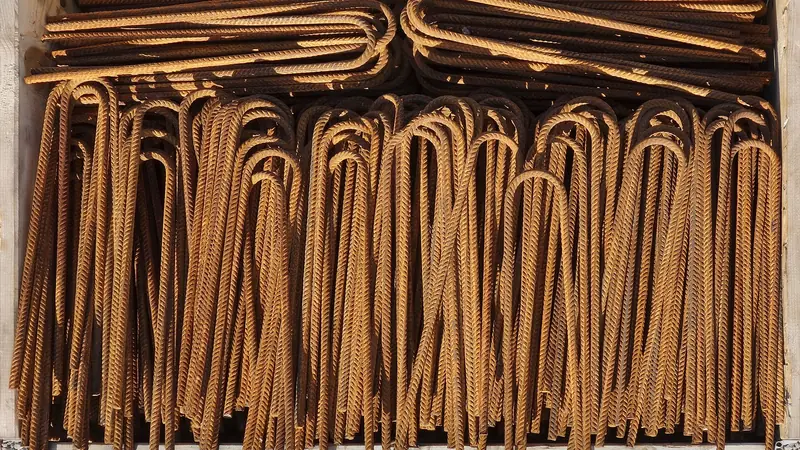
Rebar hook dimensions are set by the code: in ACI 318, a standard 90 degree hook on a main bar has a straight extension of 12 bar diameters, and a 180 degree hook has an extension of 4 bar diameters but not less than 2.5 in. Stirrups and ties use shorter extensions, and 135 degree seismic hooks need at least 6 bar diameters and 3 in. A hook exists to anchor a bar where there is no room for a straight development length, and every hook adds steel to the bar's cut length.
Development length: the idea behind every hook
A bar in tension can only carry force if it is gripped by enough concrete. The length of straight embedment needed for the bar to reach its yield strength is the development length, written ld on drawings and in the code.
Development length grows with bar size and steel grade, and shrinks with stronger concrete. It also changes with bar position (top bars need more), coating (epoxy needs more) and cover and spacing. The same factors drive lap length, which is why a lap splice is defined as a multiple of ld. See lap splice length for that side of the story.
An illustration with real numbers
ACI 318 gives a simplified formula for bars #6 and smaller when clear spacing and cover are at least one bar diameter and minimum stirrups are present (or clear spacing is at least two bar diameters):
ld = (fy x ψt x ψe x ψg) / (25 x λ x √f'c) x db, and not less than 12 in.
For a bottom #5 (16 mm) bar, Grade 60 (fy = 60,000 psi), uncoated, normal-weight concrete with f'c = 4,000 psi, all factors are 1.0:
- √4000 = 63.2
- 60,000 / (25 x 63.2) = 38.0 bar diameters
- 38.0 x 0.625 in = 23.7 in, round to 24 in
This is an illustration of how the formula behaves, not a value to use on a project. If cover or spacing is tighter, ACI uses a longer formula. The project's general notes and the governing code always win.
Where a hook comes in
Often there is not 24 in of straight concrete available. A footing bar ends 3 in from the edge, a beam bar ends inside a column, a cantilever bar ends at the slab edge. In those places the bar is bent into a hook. The hook gives mechanical anchorage, so the required embedment (called ldh for a hooked bar) is shorter than the straight ld. ACI 318 sets a minimum ldh of the greater of 8 bar diameters and 6 in.
For the estimator, the consequence is simple: the drawing shows a hook, so the bar has a bent leg, and that leg is steel you must count.
Rebar hook dimensions for main bars
ACI 318-19 Table 25.3.1 covers standard hooks used to develop main bars in tension. The typical values are:
| Hook | Straight extension | Minimum inside bend diameter |
|---|---|---|
| 90 degree | 12 db | #3 to #8: 6 db |
| 180 degree | 4 db, not less than 2.5 in | #9 to #11: 8 db |
| (both) | #14 and #18: 10 db |
db is the nominal bar diameter. The extension is measured from the end of the bend to the end of the bar.
Hook leg length out to out
Drawings and bar lists usually dimension a 90 degree hook by its leg measured out to out: from the outside face of the horizontal bar to the tip of the hook. For #3 to #8 bars, that is the 12 db extension plus the bend radius (3 db for a 6 db bend diameter) plus one bar diameter: 16 db in total.
| Bar | Diameter | 90 degree hook leg, out to out (16 db) |
|---|---|---|
| #3 (10 mm) | 0.375 in | 6 in |
| #4 (13 mm) | 0.500 in | 8 in |
| #5 (16 mm) | 0.625 in | 10 in |
| #6 (19 mm) | 0.750 in | 12 in |
| #8 (25 mm) | 1.000 in | 16 in |
These rebar hook dimensions are geometry from the code minimums. A drawing may show a longer leg on purpose, for example a footing bar turned up to the full depth. If the leg is dimensioned on the detail, the detail wins.
Rebar hook dimensions for stirrups and ties
Stirrups, ties and hoops follow ACI 318-19 Table 25.3.2, which allows shorter extensions and tighter bends because the bars are small and wrap around main bars:
| Hook | Bar size | Straight extension | Minimum inside bend diameter |
|---|---|---|---|
| 90 degree | #3 to #5 | greater of 6 db and 3 in | 4 db |
| 90 degree | #6 to #8 | 12 db | 6 db |
| 135 degree | #3 to #8 | greater of 6 db and 3 in | #3 to #5: 4 db, #6 to #8: 6 db |
| 180 degree | #3 to #8 | greater of 4 db and 2.5 in | as above |
For a #3 or #4 stirrup, the 3 in minimum controls the 135 degree hook: 6 x 0.375 = 2.25 in and 6 x 0.5 = 3.0 in. For a #5, 6 x 0.625 = 3.75 in controls. The full picture of stirrups is in stirrups and ties.
Seismic hooks
A seismic hook, in ACI 318, is a hook on a stirrup, hoop or crosstie with a bend of at least 135 degrees (90 degrees is allowed for circular hoops) and an extension of at least 6 db and not less than 3 in. The extension must project into the core of the member. On drawings for buildings in higher seismic categories you will see "135 DEG HOOKS" or a typical detail of a closed hoop with both ends bent at 135 degrees.
A crosstie is a straight bar across a column or beam with a seismic hook at one end and a hook of at least 90 degrees at the other. Each crosstie is a separate piece in the takeoff.
How hooks add to cut length
The cut length is the length of straight bar the fabricator cuts before bending. For an estimate, the standard approach is to add the hook legs (out to out) to the straight length between hooks. The true cut length is slightly shorter because the bar follows a curve at the bend, but for weight the difference is small and detailers use their own bending tables when they make the bar list. If you want the full method for bar lists, see bar bending schedule.
Worked example: hooked footing bars
An isolated footing is 8 ft x 8 ft and 18 in deep. The section shows #5 bars at 12 in on center each way, bottom, with a standard 90 degree hook at each end. Cover is 3 in at the sides and bottom.
Step 1: straight length. 8 ft = 96 in. Less cover at both ends: 96 - 2 x 3 = 90 in.
Step 2: hook legs. For a #5 standard 90 degree hook, the leg out to out is 16 db = 10 in. Check it fits: footing depth 18 in, minus 3 in bottom cover, leaves 15 in, so a 10 in leg fits. Two hooks: 2 x 10 = 20 in.
Step 3: length per bar. 90 + 20 = 110 in = 9.17 ft.
Step 4: number of bars one way. (96 - 2 x 3) / 12 + 1 = 7.5 + 1 = 8.5, round up to 9 bars. The method is in rebar spacing.
Step 5: both ways. 9 x 2 = 18 bars.
Step 6: total length and weight. 18 x 9.17 = 165.1 ft. #5 weighs 1.043 lb/ft, so 165.1 x 1.043 = 172 lb (about 78 kg).
If you had forgotten the hooks, you would have 18 x 7.5 ft = 135 ft, or 141 lb. The hooks are 18% of the steel in this footing. On small footings and short bars, hooks are a large share of the weight, which is why they are one of the most common takeoff misses. More on that in rebar takeoff mistakes.
Reading hooks on the drawings
On plans and sections, hooks show as a short line turned at the end of a bar. A few things to watch:
- "STD HOOK" or "STANDARD HOOK" means the code geometry above, unless the general notes define it differently.
- A hook drawn at one end only is common on cantilever and edge bars. Count one hook, not two.
- Typical details often hide hooks: a typical beam-column joint detail may say "hook all top bars into column." Those hooks apply to every beam on the plan.
- Bend diameter and extension in metric follow the local code (for example BS 8666 shape codes in the UK). The method of counting the leg is the same.
Frequently asked questions
What is the length of a 90 degree hook on rebar?
Under ACI 318, a standard 90 degree hook on a main bar has a straight extension of 12 bar diameters after the bend. Measured out to out, the leg is about 16 bar diameters for #3 to #8 bars, for example 10 in for a #5. Stirrup hooks are shorter.
What is a 135 degree seismic hook?
It is a hook on a stirrup, hoop or crosstie bent at least 135 degrees, with an extension of at least 6 bar diameters and not less than 3 in, projecting into the core. It keeps the tie anchored after the cover concrete spalls in an earthquake.
Is development length the same as lap length?
No. Development length is the embedment a single bar needs to reach yield. A tension lap splice in ACI 318 is a multiple of it: 1.0 times for Class A and 1.3 times for Class B, with a 12 in minimum.
Do I add hooks to the cut length in a takeoff?
Yes. Add the hook leg length, usually taken out to out, to the straight length between hooks. On short bars such as footing bars, hooks can be a large share of the total weight.
Why do hooks reduce the required embedment?
A hook bears against the concrete inside the bend, which gives anchorage that a straight bar has to get from bond alone. So a hooked bar needs a shorter embedment (ldh) than a straight bar (ld).
This article explains general practice for learning purposes. On a real project, the drawings, the general notes and the governing code always win.