Rebar Bend Diameter: ACI Minimums, Why They Exist and How They Change Cut Length
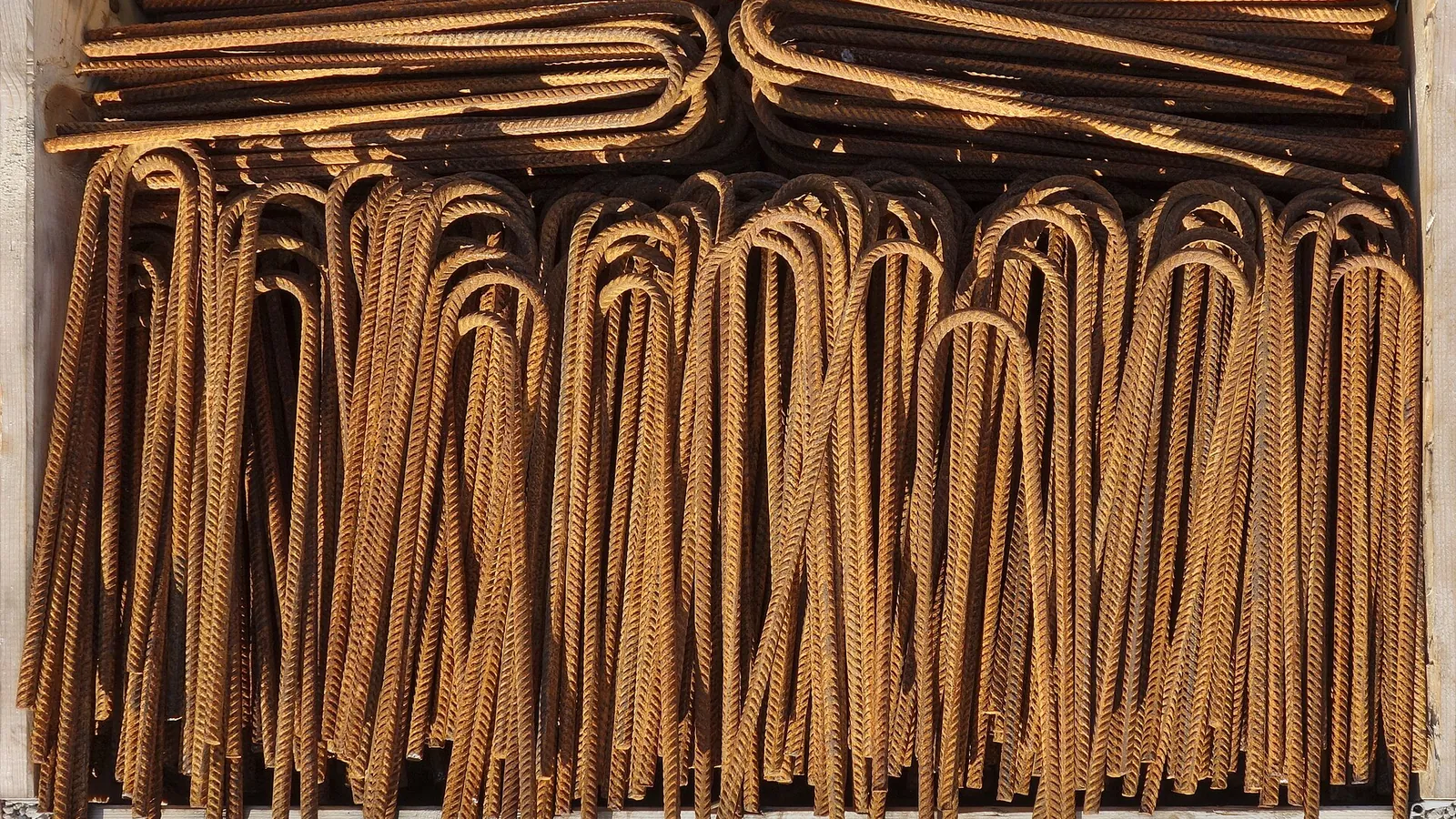
The rebar bend diameter is the inside diameter of a bend, the size of the pin the bar is bent around. In ACI 318, standard hooks on main bars need a minimum inside bend diameter of 6 bar diameters (6db) for #3 to #8, 8db for #9 to #11 and 10db for #14 and #18, while stirrups and ties of #3 to #5 may be bent at 4db. The bend diameter sets the hook leg length and changes the cut length of every bent bar.
What the bend diameter measures
When a fabricator bends a bar, the bar is pulled around a round pin (also called a mandrel). The bar wraps the pin, so the inside face of the bend takes the shape of the pin. The inside bend diameter is the diameter of that pin, measured to the inside face of the bar.
Three related radii come up in bending tables, and mixing them up is the usual source of error:
- Inside radius: half the bend diameter, to the inside face of the bar.
- Centerline radius: inside radius plus half a bar diameter. The cut length follows this line.
- Outside radius: inside radius plus one full bar diameter. Out-to-out dimensions on a bar list are measured to this face.
All three are usually written as multiples of db, the nominal bar diameter. A #5 bar has db = 0.625 in (16 mm), so a 6db bend is a pin of 3.75 in.
ACI 318 minimum rebar bend diameter
These are typical ACI 318-19 values. The project's general notes, the specification and the governing code edition always win, and some notes ask for larger bends than the minimum.
Standard hooks on main bars
For standard hooks that develop main bars in tension (ACI 318-19 Table 25.3.1):
| Bar size | db (in) | Minimum inside bend diameter | Pin size (in) | 90 degree hook leg, out to out |
|---|---|---|---|---|
| #3 (10 mm) | 0.375 | 6db | 2.25 | 16db = 6.0 in |
| #4 (13 mm) | 0.500 | 6db | 3.00 | 16db = 8.0 in |
| #5 (16 mm) | 0.625 | 6db | 3.75 | 16db = 10.0 in |
| #6 (19 mm) | 0.750 | 6db | 4.50 | 16db = 12.0 in |
| #7 (22 mm) | 0.875 | 6db | 5.25 | 16db = 14.0 in |
| #8 (25 mm) | 1.000 | 6db | 6.00 | 16db = 16.0 in |
| #9 (29 mm) | 1.128 | 8db | 9.02 | 17db = 19.2 in |
| #10 (32 mm) | 1.270 | 8db | 10.16 | 17db = 21.6 in |
| #11 (36 mm) | 1.410 | 8db | 11.28 | 17db = 24.0 in |
| #14 (43 mm) | 1.693 | 10db | 16.93 | 18db = 30.5 in |
| #18 (57 mm) | 2.257 | 10db | 22.57 | 18db = 40.6 in |
The last column is pure geometry: the 12db straight extension of a 90 degree hook, plus the inside radius, plus one bar diameter to reach the outside face. With a 6db bend that is 12 + 3 + 1 = 16db. With an 8db bend it becomes 12 + 4 + 1 = 17db, and with 10db it is 12 + 5 + 1 = 18db. So the larger bend diameter on #9 and up also makes the hook leg longer.
For a 180 degree hook, the overall width across the bend is the bend diameter plus two bar diameters: 6db + 2db = 8db for #3 to #8.
Stirrups, ties and hoops
Transverse bars wrap tightly around the main bars, so ACI 318-19 Table 25.3.2 allows a tighter bend on the small sizes:
| Bar size | Minimum inside bend diameter | Example |
|---|---|---|
| #3 to #5 | 4db | #4 stirrup: 2.0 in pin |
| #6 to #8 | 6db | #6 tie: 4.5 in pin |
A 4db bend is what lets a #4 stirrup hug a corner bar. The full detail of stirrup hooks and extensions is in stirrups and ties, and hook extensions for main bars are in rebar hooks and development length.
Why there is a minimum bend diameter
Bending stretches the outside of the bar and compresses the inside. The tighter the pin, the larger that strain, and past a point the steel on the outside of the bend can crack. Bending without breakage is one of the two main factors behind the code minimums (the other is the concrete, below), and the code sets a larger minimum ratio for larger bars: 6db, then 8db, then 10db.
The concrete has a stake in it too. When a hooked bar is pulled, it bears on the concrete inside the bend. A very tight bend concentrates that bearing on a small area and can crush or split the concrete. A rounder bend spreads it out.
That is also why a bar should not be bent on site around whatever is at hand, such as a pipe that happens to be lying nearby. If field bending is allowed at all, it has to respect the bend diameter. More on that in can you bend rebar on site.
How the bend diameter changes cut length
On a bar list, bent bars are dimensioned out to out: each leg runs to the outside face of the bar. If you add the legs, you count the corner twice, because the real bar cuts the corner along a curve. The fabricator cuts the bar to its centerline length, which is shorter than the sum of the out-to-out legs.
For a 90 degree bend, the difference (the bend deduction) is:
deduction = 2 x (r + db/2) - (pi/2) x r, where r is the centerline radius.
Simplified, that is 0.429 r + db. In bar diameters:
| Inside bend diameter | Centerline radius r | Deduction per 90 degree bend |
|---|---|---|
| 4db | 2.5db | 2.07db |
| 6db | 3.5db | 2.50db |
| 8db | 4.5db | 2.93db |
| 10db | 5.5db | 3.36db |
Detailers and fabricators use their own bending tables (the CRSI Manual of Standard Practice has standard tables for hooks and bends), and those may round differently. The method is what matters here. The formula approach for whole shapes is in rebar cut length formula.
Worked example: #5 L-bars, out to out versus cut length
A wall detail shows 40 L-bars, #5, with legs A = 4'-0" and B = 10" out to out (a standard 90 degree hook). Bend diameter 6db.
Step 1: sum of legs. 48 + 10 = 58 in per bar.
Step 2: deduction. For a 6db bend, the deduction is 2.50db. With db = 0.625 in: 2.50 x 0.625 = 1.56 in.
Step 3: cut length. 58 - 1.56 = 56.44 in = 4.70 ft.
Step 4: weight both ways. #5 weighs 1.043 lb/ft.
- Out to out: 40 x 58 = 2,320 in = 193.33 ft, x 1.043 = 201.6 lb.
- Cut length: 40 x 56.44 = 2,257.6 in = 188.13 ft, x 1.043 = 196.2 lb.
The difference is 5.4 lb, about 2.7%. For an estimate, many estimators simply take the out-to-out lengths, which is slightly conservative and covers part of the bend. The fabricator's bar list will use the cut length. Either way, be consistent across the takeoff, and do not then add a separate allowance for bends on top. The weight per foot for every size is in the rebar sizes reference.
Worked example: a #10 hook that does not fit
A footing is 24 in deep with 3 in clear cover top and bottom. The bottom bars are #10 with standard 90 degree hooks turned up at each end.
Step 1: hook leg. #10 is in the 8db group, so the leg out to out is 17db = 17 x 1.27 = 21.6 in.
Step 2: room available. 24 - 3 - 3 = 18 in.
Step 3: compare. 21.6 in is more than 18 in. The standard hook does not fit vertically.
If you had used the 16db leg from the smaller bars, you would get 20.3 in, still too long, and you would also undercount steel on every hook. This is a question for the engineer (an RFI), not something to solve in the takeoff. The same check catches hooks in thin slabs and shallow beams.
Where bend diameters show up on drawings
Most drawings do not repeat the rebar bend diameter on every bar. You will find it in a few places:
- General notes: "Bends and hooks shall conform to ACI 318" or "All bends per CRSI standard." That sends you to the tables above.
- Typical detail sheets: a standard hook detail with "D" or "INSIDE DIA" next to the bend, sometimes with a table by bar size.
- Bar bending schedules: shape codes with a radius or pin column, especially for large bars and special shapes. See bar bending schedule.
- Metric drawings: under BS 8666 and similar standards, the minimum is given as a mandrel diameter by bar size. The method is the same; the values come from that standard.
A larger-than-minimum bend is common for bars bent into curves, for coated bars when the specification asks for it, and where the engineer wants a gentler bend in a congested joint. When the detail gives a radius, the detail wins.
Frequently asked questions
What is the minimum bend diameter for #4 rebar?
For a standard hook on a #4 main bar, ACI 318 gives 6db, which is 3.0 in. For a #4 stirrup or tie, the minimum is 4db, which is 2.0 in. Always check the project's general notes for anything larger.
Is the bend diameter measured inside or outside the bar?
The code minimum is an inside bend diameter: the diameter of the pin, measured to the inside face of the bar. Bar lists measure legs to the outside face, which is why the two numbers should not be mixed.
Why do bigger bars need a bigger bend diameter?
The minimums exist so the bar can be bent without cracking and so the bar does not crush or split the concrete inside the bend. For larger bars the code asks for a larger pin relative to the bar size, so the minimum rises from 6db to 8db to 10db.
Does the rebar bend diameter affect weight in a takeoff?
Slightly. A larger bend makes the hook leg longer out to out (17db instead of 16db for #9 to #11), while the curve itself makes the cut length a little shorter than the sum of the legs. On short hooked bars both effects are worth getting right.
Can I bend rebar tighter than the minimum on site?
No. The minimum exists to protect the bar and the concrete. Field bending, where the engineer allows it at all, has to follow the same bend diameters and any limits in the specification.
This article explains general practice for learning purposes. On a real project, the drawings, the general notes and the governing code always win.