Rebar Cut Length Formula: Straight Bars, Hooks and Stirrups
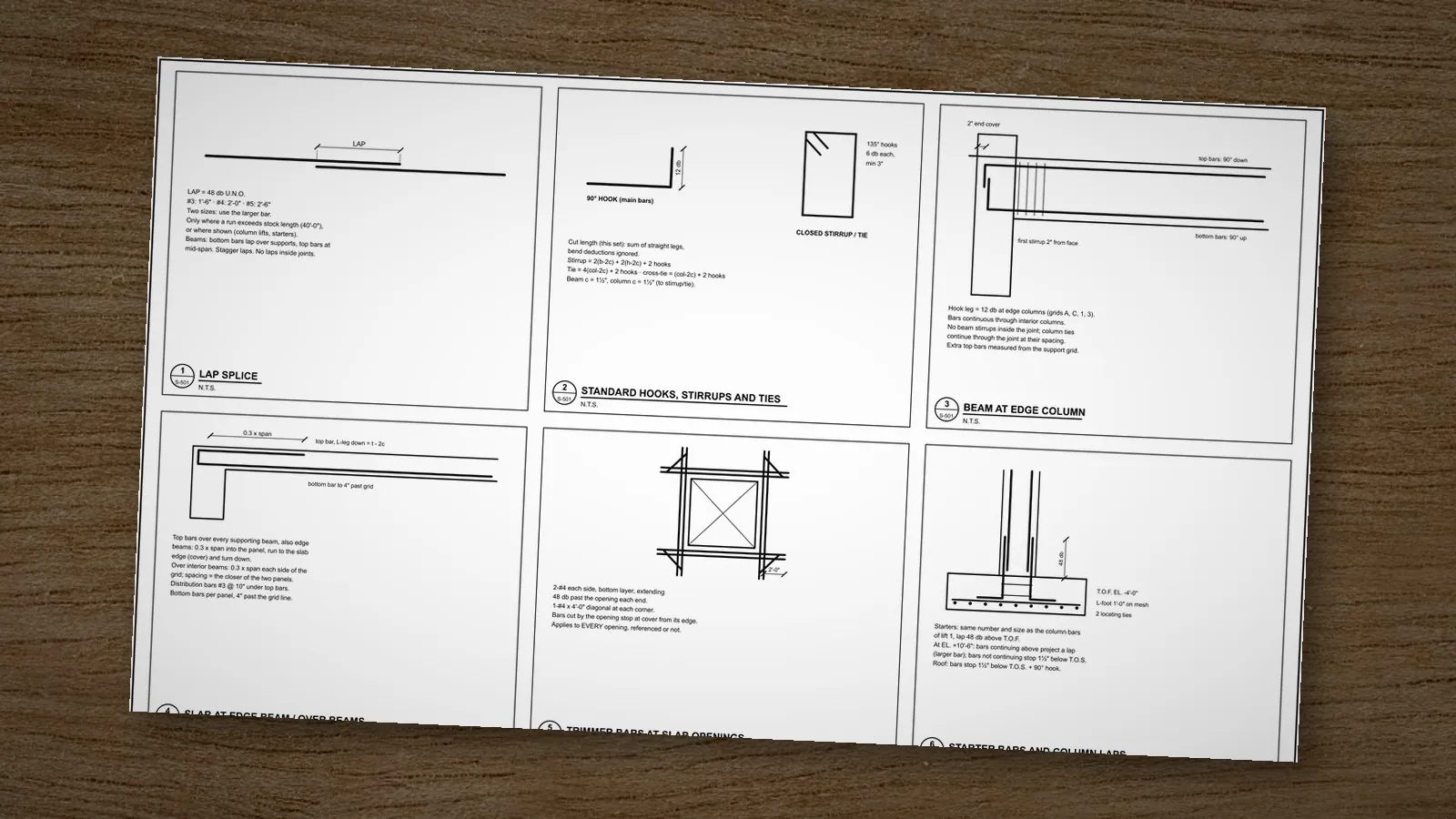
The rebar cut length formula is: cut length = the sum of the bar's straight segments + the length of the bar around each bend. For a straight bar that is simply the member length minus cover at both ends. For bent bars, the dimensions on a schedule are usually measured to the outside of the bends, and a bent bar is a little shorter than the sum of those outside dimensions; the difference at each bend is called the bend deduction.
Estimators often use outside dimensions directly, which is slightly conservative. Detailers and fabricators work closer to the true length. This guide shows both, with worked numbers.
Straight bars
Cut length = member length − 2 × end cover
Example: a bottom bar in a beam 20'-0" long, with 1.5 in end cover (this example's value).
240 − 2 × 1.5 = 237 in = 19'-9".
If the bar is longer than stock (20, 40 or 60 ft in the US; 6 or 12 m in metric markets), it is split into pieces with a lap at each joint, and each lap adds its length. See lap splice length.
Bars with hooks
A hook adds length at the bar end. Its size comes from the hook rules in the project's general notes or the governing code. Typical ACI 318 values, which the project's notes and code always override:
| Hook | Bars | Inside bend diameter | Straight extension after the bend |
|---|---|---|---|
| 90° standard hook | #3 to #8 | 6db | 12db |
| 180° standard hook | #3 to #8 | 6db | 4db, not less than 2.5 in |
| 90° stirrup/tie hook | #3 to #5 | 4db | 6db, not less than 3 in |
| 135° stirrup/tie hook | #3 to #5 | 4db | 6db, not less than 3 in |
(db = bar diameter.) For more on hooks, see rebar hooks and development length.
For estimating, a common approach is:
Cut length ≈ sum of outside (out-to-out) dimensions
That is quick and on the safe side, because it ignores the fact that the bar cuts the corner at each bend.
The bend deduction concept
When a bar is bent, it follows an arc, not a sharp corner. If the two legs are measured to the outside faces of the bar (as most schedules do), the sum of the legs overstates the real length.
For a 90° bend with inside radius r and bar diameter d:
- Each leg, measured to the outside, includes (r + d) that is really part of the bend zone.
- The bar's centerline around the bend is a quarter circle of radius (r + d/2), length (π/2)(r + d/2).
So the deduction per 90° bend is:
Deduction = 2(r + d) − (π/2)(r + d/2)
The answer depends on the bend radius, which depends on the bar size and the code or standard in use. That is why different detailers, fabricators and countries use different deduction tables, and why you should not treat any single table as universal.
To see how much it matters, here is the formula worked for two radii. This is a clearly labelled illustration, not a table for any particular code:
| Inside bend radius r | Deduction per 90° bend |
|---|---|
| 2d (inside bend diameter 4d) | 6d − 3.93d = about 2.1d |
| 3d (inside bend diameter 6d) | 8d − 5.50d = about 2.5d |
You will see round figures such as "2d for a 90° bend" quoted online. Those come from one particular bend radius. If your fabricator or standard uses a different radius, the deduction changes. In the UK and related markets, BS 8666 gives a length formula for each shape code, which builds this in; in the US, detailers follow CRSI and ACI practice. Use whatever method your project's detailer or fabricator uses.
Worked example 1: footing bar with two 90° hooks
A #5 bar (d = 0.625 in) across an 8'-0" footing, 3 in cover, hooked up 90° at both ends. Using the typical ACI values above: inside bend diameter 6d = 3.75 in, so r = 1.875 in; extension 12d = 7.5 in. The footing depth is enough for the hooks.
Outside dimensions:
- A (horizontal) = 96 − 2 × 3 = 90 in.
- B and C (hook legs, out-to-out) = extension + r + d = 7.5 + 1.875 + 0.625 = 10 in each.
- Sum = 90 + 10 + 10 = 110 in.
Bend deduction (r = 3d): 2(1.875 + 0.625) − (π/2)(1.875 + 0.3125) = 5.000 − 3.436 = 1.564 in per bend. Two bends: 3.13 in.
Cut length = 110 − 3.13 = 106.87 in, rounded up to 107 in = 8'-11".
Check by the centerline, adding the pieces directly:
- Straight bottom: 90 − 2 × (1.875 + 0.625) = 85.0 in.
- Two arcs: 2 × (π/2) × 2.1875 = 6.87 in.
- Two straight hook legs: 2 × (10 − 2.5) = 15.0 in.
- Total = 85.0 + 6.87 + 15.0 = 106.87 in. Same answer.
For estimating weight, using 110 in instead of 107 in overstates this bar by 3 in, under 3%. That is why many estimators simply add the outside dimensions; just know which one you are doing.
Worked example 2: stirrup cut length
A closed #3 stirrup (d = 0.375 in) in a 12 in × 24 in beam, 1.5 in clear cover to the stirrup, with 135° hooks at one corner. Typical ACI values from the table: inside bend diameter 4d = 1.5 in, so r = 0.75 in; hook extension 6d = 2.25 in, but not less than 3 in, so 3 in.
Outside dimensions of the stirrup:
- Width: 12 − 2 × 1.5 = 9 in.
- Height: 24 − 2 × 1.5 = 21 in.
Quick estimating method:
Cut length ≈ out-to-out perimeter + 2 hook extensions = 2 × (9 + 21) + 2 × 3 = 60 + 6 = 66 in (5'-6").
Centerline method:
- Centerline radius = r + d/2 = 0.75 + 0.1875 = 0.9375 in.
- Straight sides: each side is the out-to-out dimension minus d, minus 2 × 0.9375 for the two bends: 9 − 0.375 − 1.875 = 6.75 in and 21 − 0.375 − 1.875 = 18.75 in. Two of each: 2 × 6.75 + 2 × 18.75 = 51.0 in.
- Three 90° corners: 3 × (π/2) × 0.9375 = 4.42 in.
- Two 135° hook bends: 2 × (3π/4) × 0.9375 = 4.42 in.
- Two extensions: 2 × 3 = 6.0 in.
- Total = 51.0 + 4.42 + 4.42 + 6.0 = 65.84 in, rounded up to 66 in.
The two methods agree here because the length lost at the corners is about the same as the length the hooks gain in their bends. That will not always be true. With larger bars, larger bend radii, or longer hook extensions, the methods drift apart, so for a bar list the detailer's method governs. For more on stirrup shapes, see stirrups and ties.
Summary of the formulas
| Bar | Cut length |
|---|---|
| Straight bar | Member length − 2 × cover (+ laps if over stock length) |
| Bar with hooks (estimating) | Out-to-out horizontal + out-to-out hook legs |
| Bar with hooks (detailing) | Sum of out-to-out dimensions − one bend deduction per bend |
| Closed stirrup (estimating) | Out-to-out perimeter + 2 hook extensions |
| Closed stirrup (detailing) | Centerline straights + bend arcs + hook extensions |
Once you have the cut length, weight = cut length × weight per foot for the bar size. The rebar weight calculator does that step, and the cut length goes in the length column of the bar bending schedule.
Frequently asked questions
What is the formula for the cut length of a bar?
For a straight bar, cut length is the member length minus cover at both ends, plus any laps. For a bent bar, it is the sum of the straight segments plus the length around each bend. Using outside dimensions, that equals the sum of the out-to-out dimensions minus a bend deduction at each bend.
What is a bend deduction in rebar?
It is the amount by which a bent bar is shorter than the sum of its outside leg dimensions. The bar follows an arc at each bend rather than a sharp corner. The size of the deduction depends on the bend radius and bar size, so different standards and fabricators use different values.
How do you calculate the cut length of a stirrup?
A quick estimating method is the out-to-out perimeter plus two hook extensions. A detailed method adds the centerline straight sides, the length of the bend arcs and the hook extensions. Take the hook extension and bend diameter from the project's notes or governing code.
Should estimators deduct for bends?
Many estimators do not, because adding outside dimensions is faster and slightly conservative. The difference is usually small per bar but adds up over many bent bars. Whichever you use, apply it consistently and state it in your assumptions.
This article explains general practice for learning purposes. On a real project, the drawings, the general notes and the governing code always win.