#4 vs #5 Rebar: Size, Area, Weight and Where Each Shows Up on Drawings
The difference between #4 vs #5 rebar is one eighth of an inch in diameter, but more than 50% in steel area. A #4 bar is 1/2 in (13 mm) in diameter with 0.20 in² of area and weighs 0.668 lb/ft; a #5 bar is 5/8 in (16 mm) with 0.31 in² and weighs 1.043 lb/ft. In the same grade, a #5 bar carries about 1.55 times the force of a #4.
Which one goes where is decided by the engineer and written on the drawings. This article explains what the numbers mean and where you will usually see each size, so you can read and count them correctly.
How the bar numbers work
In US (inch-pound) sizes, the bar number is the nominal diameter in eighths of an inch. A #4 is 4/8 = 1/2 in, a #5 is 5/8 in. The metric "soft conversion" names used in ASTM A615 are #13 and #16, which match the nominal diameter in millimeters. You will see both on drawings, sometimes on the same project. The rebar sizes and weights article lists every size, and metric vs imperial rebar explains the naming.
Side-by-side comparison
Values are the standard ASTM A615 nominal properties.
| Property | #4 (#13) | #5 (#16) | Ratio #5 / #4 |
|---|---|---|---|
| Nominal diameter | 0.500 in (12.7 mm) | 0.625 in (15.9 mm) | 1.25 |
| Nominal area | 0.20 in² (129 mm²) | 0.31 in² (199 mm²) | 1.55 |
| Weight | 0.668 lb/ft (0.994 kg/m) | 1.043 lb/ft (1.552 kg/m) | 1.56 |
| Weight of a 20 ft bar | 13.4 lb | 20.9 lb | |
| Weight of a 40 ft bar | 26.7 lb | 41.7 lb | |
| Yield force, Grade 60 | 0.20 x 60 = 12.0 kips (53 kN) | 0.31 x 60 = 18.6 kips (83 kN) | 1.55 |
Area grows with the square of the diameter, which is why a 25% bigger diameter gives about 55% more steel. Weight follows area. You can check any of these with the rebar weight calculator.
The yield force row is the force at which the bar starts to yield in tension (area times yield strength). Grade 60 means a minimum yield strength of 60 ksi (about 420 MPa). It is a property of the bar, not a design capacity of a slab or beam; see rebar grades.
Steel per foot: why spacing matters as much as size
In slabs and walls the drawing gives a bar size and a spacing, so what matters is the steel area per foot of width:
Area per ft = bar area x 12 / spacing (in)
| Spacing | #4 (in²/ft) | #5 (in²/ft) | #4 (lb/ft² per layer) | #5 (lb/ft² per layer) |
|---|---|---|---|---|
| 12 in | 0.200 | 0.310 | 0.668 | 1.043 |
| 16 in | 0.150 | 0.233 | 0.501 | 0.782 |
| 18 in | 0.133 | 0.207 | 0.445 | 0.695 |
Note that #5 @ 18" gives about the same steel per foot as #4 @ 12" (0.207 vs 0.200 in²/ft) with fewer bars. That is useful when you are reading drawings or comparing estimates. It is not permission to change bars on site: spacing limits, bar development, crack control and cover all depend on bar size, so any change goes through the engineer. The rebar spacing article covers how spacing is shown.
Where each size usually appears on drawings
This is descriptive: it is what you will commonly see on residential and light commercial drawings, not a rule for choosing bars.
Where you will often see #4
- Slabs on grade, as
#4 @ 12"or#4 @ 18" O.C. E.W. - Temperature and shrinkage steel in suspended slabs and walls.
- Horizontal bars in foundation walls and stem walls.
- Ties and stirrups in heavier columns and beams.
- Trim bars around small slab openings.
Where you will often see #5
- Footings: continuous footing bars and spread footing mats.
- Vertical bars in foundation and retaining walls.
- Main bottom and top bars in beams and grade beams.
- Continuous bars in thickened slab edges.
- Dowels from footings into walls or columns.
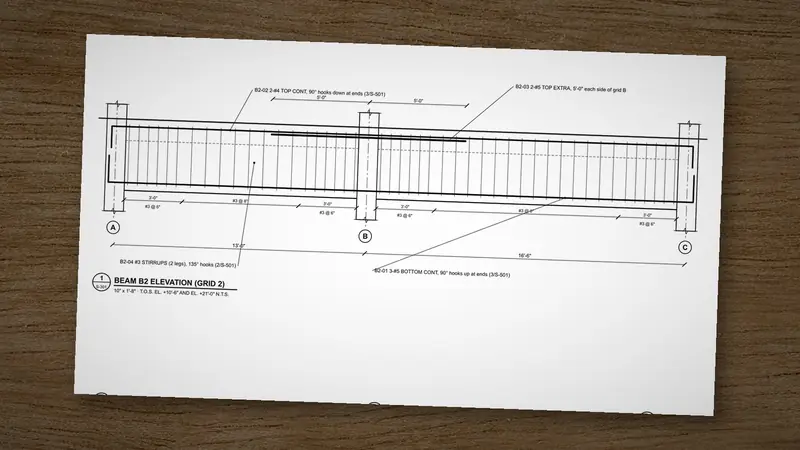
Both sizes show up almost everywhere, and heavier members move to #6 and up. The only reliable source for your project is the drawing: the plan callout, the schedule or the typical detail. If you are working on a house or a driveway without drawings, ask a local engineer or the building department rather than choosing a size from a list. For reading the callouts themselves, see how to read rebar callouts.
Worked example: the same slab strip in #4 and #5
A 20 ft (6.1 m) wide strip of slab, bars running 30 ft (9.1 m) across it, one layer, 3 in edge distance. Compare three callouts you might meet on drawings.
Count of bars = roundup((240 - 6) / spacing) + 1. Run length = 30 - 0.5 = 29.5 ft (laps ignored to keep the comparison clean).
#4 @ 12"
Spaces = 234 / 12 = 19.5, round up to 20. Bars = 21.
Length = 21 x 29.5 = 619.5 ft. Weight = 619.5 x 0.668 = 414 lb.
Steel area = 0.200 in²/ft.
#5 @ 18"
Spaces = 234 / 18 = 13. Bars = 14.
Length = 14 x 29.5 = 413 ft. Weight = 413 x 1.043 = 431 lb.
Steel area = 0.207 in²/ft.
#5 @ 12"
Bars = 21, length 619.5 ft. Weight = 619.5 x 1.043 = 646 lb.
Steel area = 0.310 in²/ft.
Reading the result. The first two callouts weigh about the same and give about the same steel area, but #5 @ 18" has 7 fewer bars to place and tie. The third has 55% more steel than the first. When an estimate seems off, check the bar size against the callout first: misreading a 4 as a 5 changes the weight by more than half.
Bending: a practical difference
Bigger bars need bigger bends. Typical ACI 318 values for the minimum inside bend diameter of a standard hook are 6 bar diameters for #3 through #8, so 3 in for a #4 and 3.75 in for a #5. For stirrups and ties of #5 and smaller the typical minimum is 4 bar diameters. Your project's general notes and the governing code win over these typical values, and the rebar hooks and development length article explains how hooks are drawn.
A #5 bar is also noticeably harder to bend by hand on site, which matters for field-bent dowels and corner bars.
Frequently asked questions
What size is #5 rebar?
A #5 bar has a nominal diameter of 5/8 in (0.625 in, 15.9 mm) and an area of 0.31 in². It weighs 1.043 lb per foot, so a 20 ft bar weighs about 20.9 lb. Its soft-metric name is #16.
Is #4 rebar 1/2 inch?
Yes. #4 rebar has a nominal diameter of 1/2 in (12.7 mm) and an area of 0.20 in². The nominal diameter is for calculation; the ribs make the actual outside dimension slightly larger.
How much stronger is #5 than #4 rebar?
In the same grade, a #5 bar has 1.55 times the area of a #4, so it carries 1.55 times the tension force at yield. In Grade 60 that is 18.6 kips against 12.0 kips. Whether that matters for a particular slab or footing is a design question for the engineer.
Can I use #5 instead of #4 rebar?
Only with approval from the engineer of record or, on a small project without one, the building official. Bar size, spacing, cover and lap length are designed together, so a bigger bar is not automatically an acceptable change.
How much does a 20 ft #4 bar weigh?
About 13.4 lb (0.668 lb/ft x 20 ft), or about 6.1 kg. A 20 ft #5 bar weighs about 20.9 lb (9.5 kg).
This article explains general practice for learning purposes. On a real project, the drawings, the general notes and the governing code always win.