Concrete Cylinder Test: How 28-Day Breaks Work and How Results Compare to f'c
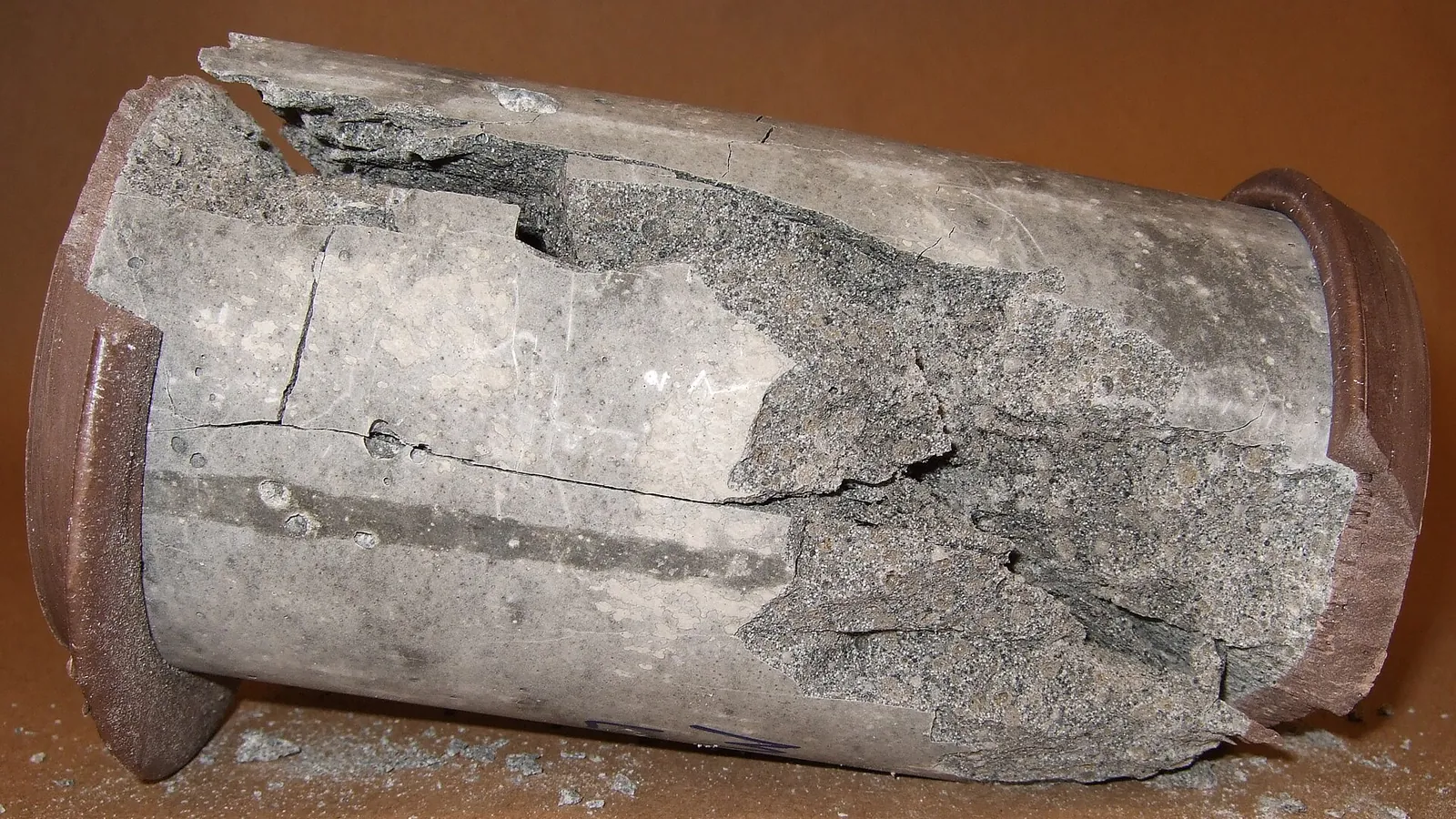
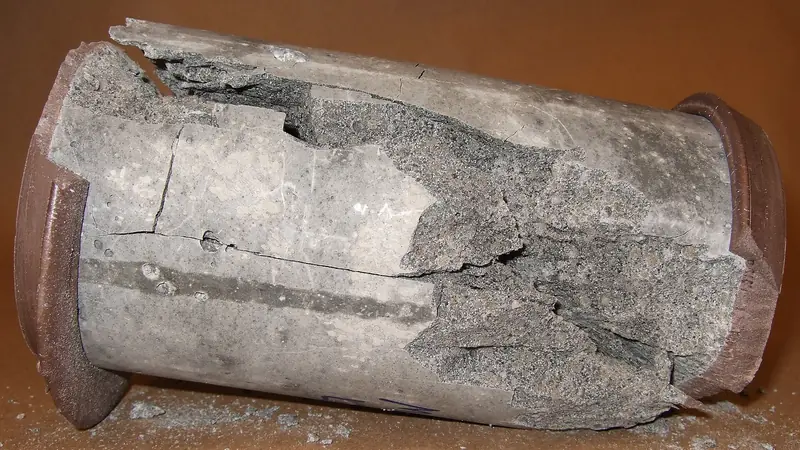
A concrete cylinder test measures the compressive strength of the concrete actually delivered to a job: cylinders are cast from the truck, cured under standard conditions, and crushed in a testing machine, usually at 28 days. Under ACI 318, one strength test is the average of at least two 6 x 12 in (150 x 300 mm) cylinders or at least three 4 x 8 in (100 x 200 mm) cylinders, and the results are compared with the specified strength f'c on the drawings. A single result below f'c does not automatically mean the concrete failed; the code checks running averages and a lower limit for individual tests.
Estimators rarely make cylinders, but they do price testing allowances, read specifications that set the testing frequency, and get asked what a low break means for the schedule. This article covers what you need for that.
What the concrete cylinder test is
The test has three parts, each with its own ASTM standard:
| Step | What happens | Standard |
|---|---|---|
| Sampling | A sample is taken from the delivered concrete, at the truck or point of placement | ASTM C172 |
| Making and curing in the field | Cylinders are cast in molds, rodded or vibrated, protected, then sent to the lab | ASTM C31 |
| Compression test | The cured cylinder is capped or padded and loaded to failure | ASTM C39 |
The same sample is normally used for slump, air content, temperature and unit weight tests at the same time. See concrete slump for that part.
Making the cylinders
The technician fills plastic or steel molds in layers, consolidates each layer, finishes the top, and labels each cylinder. ASTM C31 then calls for initial curing on site, protected from disturbance, within a set temperature range (60 to 80 °F, about 16 to 27 °C, for ordinary concrete) for up to 48 hours. After that the cylinders go to the lab and are stored in a moist room or water tanks until the test day.
Rough handling at this stage, such as leaving cylinders in the sun, in a cold truck bed, or rattling them on the way to the lab, lowers the result. A low break caused by bad handling says nothing about the concrete in the structure, which is why the history of the cylinders gets checked before anyone starts coring.
Crushing the cylinders
In the lab, each cylinder is loaded in compression at a controlled rate until it breaks. The strength is the maximum load divided by the cross-sectional area:
strength (psi) = maximum load (lbf) / area (in²)
A 6 in cylinder has an area of 28.27 in²; a 4 in cylinder has 12.57 in². The lab report gives the load, the strength, and the type of fracture.
4x8 vs 6x12 cylinders
Both sizes are standard. The choice is usually the testing agency's, within what the specification allows.
| Item | 6 x 12 in (150 x 300 mm) | 4 x 8 in (100 x 200 mm) |
|---|---|---|
| Cross-sectional area | 28.27 in² | 12.57 in² |
| Cylinders per ACI 318 strength test | At least 2 | At least 3 |
| Handling | Heavier, more concrete per cylinder | Lighter, easier to carry and store |
| Aggregate limit | ASTM C31 requires the diameter to be at least 3 times the nominal maximum aggregate size | Same rule, so large aggregate may rule out 4 in molds |
| Machine capacity | Needs a larger load for the same strength | Needs less than half the load |
How results compare to f'c
The specified strength f'c on the general notes is a design value. Real concrete varies from truck to truck, so ready-mix producers proportion the mix to average more than f'c. The acceptance rules allow for that scatter. See what is f'c in concrete and concrete strength in psi and MPa for the background.
What counts as one "test"
This is the point new people miss. Under ACI 318 a strength test is the average strength of the cylinders made from one sample and tested at the same age: at least two 6x12 or at least three 4x8. One cylinder is not a test.
The test age is 28 days unless the construction documents specify another age, which is common for high-strength mixes and some mass concrete. Early breaks at 3 or 7 days are used to watch strength gain and decide on form stripping; they are not acceptance tests unless the documents set that earlier age.
ACI 318 acceptance criteria
ACI 318-19 considers the strength of a class of concrete satisfactory when both of these hold:
- Every average of three consecutive strength tests equals or exceeds f'c.
- No single strength test falls below f'c by more than 500 psi (3.5 MPa) when f'c is 5,000 psi (35 MPa) or less, or by more than 10 percent of f'c when f'c is above 5,000 psi.
So for f'c = 4,000 psi, a single test of 3,720 psi is acceptable as long as the running averages stay at or above 4,000 psi. A single test of 3,450 psi is not, because 4,000 − 500 = 3,500 psi is the floor.
How often tests are taken
ACI 318 sets minimum sampling for each class of concrete placed each day: at least once a day, at least once for each 150 yd³ (115 m³), and at least once for each 5,000 ft² (465 m²) of slab or wall surface. The one giving the most tests governs. Project specifications often ask for more, plus extra cylinders for early breaks and spares.
Worked example: a slab pour
This is an invented example. The general notes give f'c = 4,000 psi (27.6 MPa) at 28 days. One day's pour is an elevated slab of 420 yd³ (321 m³) with an area of 22,000 ft² (2,044 m²). The testing agency uses 6x12 cylinders.
Step 1: how many tests
- Once per day: 1 test.
- Once per 150 yd³: 420 / 150 = 2.8, round up to 3 tests.
- Once per 5,000 ft²: 22,000 / 5,000 = 4.4, round up to 5 tests.
The area rule governs: 5 strength tests. At two 6x12 cylinders per test, that is 10 cylinders for 28-day acceptance, before any extra cylinders the specification adds.
Step 2: one test from the lab report
Sample 1, two cylinders broken at 28 days:
- Cylinder A: 116,500 lbf / 28.27 in² = 4,121 psi
- Cylinder B: 119,800 lbf / 28.27 in² = 4,238 psi
Strength test = (4,121 + 4,238) / 2 = 4,180 psi (rounded, about 28.8 MPa).
Step 3: check a run of results
Over the following pours, five consecutive strength tests for this mix come back as 4,180, 3,720, 4,310, 4,050 and 3,950 psi.
| Tests | Average of three | Criterion 1 (at least 4,000) |
|---|---|---|
| 1, 2, 3 | (4,180 + 3,720 + 4,310) / 3 = 4,070 | Pass |
| 2, 3, 4 | (3,720 + 4,310 + 4,050) / 3 = 4,027 | Pass |
| 3, 4, 5 | (4,310 + 4,050 + 3,950) / 3 = 4,103 | Pass |
Criterion 2: the lowest single test is 3,720 psi, which is above the floor of 4,000 − 500 = 3,500 psi. Pass.
Two of the five tests are below 4,000 psi, and the concrete is still acceptable under both criteria. That is the code working as written: it judges the average and screens for very low individual results.
What happens after a low result
When a test fails either criterion, the usual order is:
- Check the cylinders. Sampling, initial curing, transport and lab records. Field-cured or mishandled cylinders often explain a low break.
- Engineer's review. The engineer of record checks whether the strength actually reached is enough for that member.
- Cores. If needed, cores are drilled from the structure and tested to ASTM C42. ACI 318 takes three cores for each strength test in question, and considers the concrete in that area adequate if the average of the three cores is at least 85 percent of f'c and no single core is below 75 percent of f'c.
- Load test or repair, in the rare cases where cores do not settle it.
For an estimator or foreman, a low break means time: waiting for the review, coring, patching core holes, and possibly holding the next activity on that area. Whether a contract carries an allowance for retesting is a question for the specification and the contract, not for this article.
Field-cured vs standard-cured cylinders
Acceptance cylinders are standard-cured: they spend their life in lab conditions, so they measure the potential of the mix. Field-cured cylinders are left beside the structure, under the same conditions as the concrete in place, and are used to decide when forms can be stripped, when post-tensioning can be stressed, or when a slab can take construction loads. They are not used to accept the mix. If the specification calls for both, both go in the testing count. Curing time itself is covered in concrete curing time.
Frequently asked questions
Why are concrete cylinders tested at 28 days?
Twenty-eight days is the standard age at which specified strength f'c is defined, unless the construction documents state another age. Most of the strength gain of ordinary concrete has happened by then, and a fixed age makes results comparable from job to job. Early breaks at 3 or 7 days are for tracking progress.
How many cylinders are in one strength test?
Under ACI 318, at least two 6x12 in cylinders or at least three 4x8 in cylinders, made from the same sample and tested at the same age. The strength test is their average. One cylinder on its own is not a strength test.
What if a concrete cylinder test comes back below f'c?
A single test below f'c can still be acceptable. ACI 318 requires every average of three consecutive tests to reach f'c, and no single test to fall more than 500 psi below f'c (for f'c up to 5,000 psi). If a test fails those checks, the cylinder records are reviewed and the engineer may call for cores.
What is the difference between 4x8 and 6x12 cylinders?
They are the two standard sizes, both with a height twice the diameter. A 4x8 cylinder is lighter and needs less machine capacity, but ACI 318 asks for three of them per strength test instead of two. ASTM C31 requires the cylinder diameter to be at least three times the nominal maximum aggregate size.
Who makes and tests concrete cylinders?
Usually a testing agency hired for the project, with field technicians who make the cylinders on site and a lab that cures and breaks them. Field technicians are commonly required to hold a certification, such as ACI Concrete Field Testing Technician Grade I; the specification states what is required.
This article explains general practice for learning purposes. On a real project, the drawings, the general notes and the governing code always win.