Concrete Slump Test: What It Measures and How to Read the Result
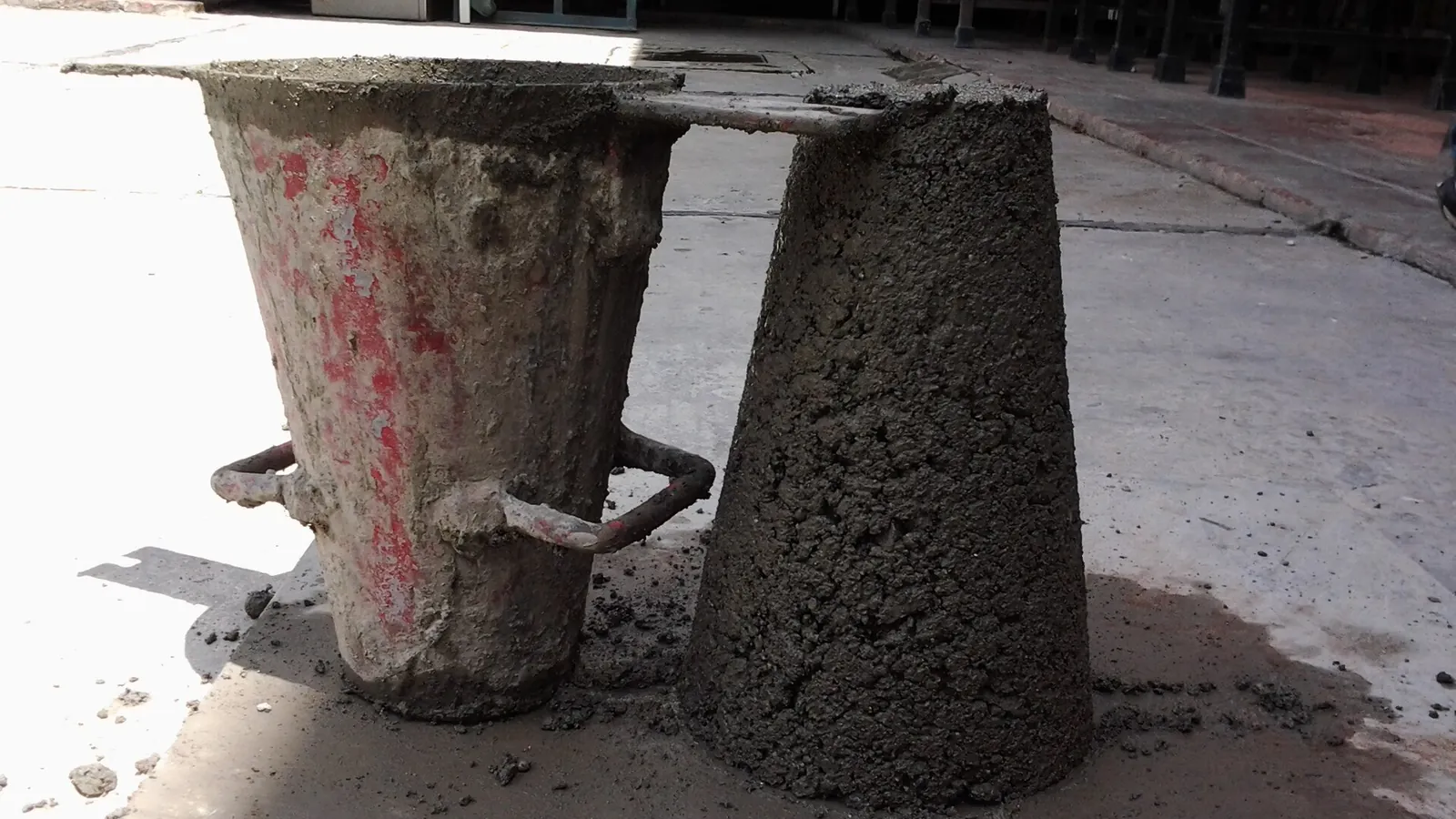
The concrete slump test measures how much a cone of fresh concrete sags when the mould is lifted away: the drop, in inches or millimetres, is the slump. It is a quick check of consistency, so a load that matches the approved mix should give a slump within the range the specification sets. Under ASTM C143 the cone is 12 in (300 mm) tall, 8 in (200 mm) across the base and 4 in (100 mm) across the top.
This guide covers the concrete slump test procedure, what the number does and does not tell you, where slump is specified on a job, and how admixtures change the picture.
What slump tells you, and what it does not
Slump is a measure of consistency, how stiff or fluid the fresh concrete is. Because it is fast and needs almost no equipment, it is the standard check at the truck.
What slump tells you:
- Whether this load is consistent with previous loads of the same mix.
- Whether water may have been added beyond the mix design, because extra water raises slump.
- Roughly how the concrete will place and consolidate.
What slump does not tell you:
- The strength. Strength is checked by cylinders (ASTM C39) or cubes. A slump inside the spec range does not prove the strength; a slump outside it is a warning sign.
- The water-cement ratio directly. A load with a water reducer can have a high slump and a low water-cement ratio. How w/c controls strength is covered in concrete mix ratio.
- Anything useful about very stiff or very fluid concrete. ASTM C143 notes the method is not applicable to non-plastic, non-cohesive concrete, and it is limited to coarse aggregate up to 1-1/2 in (37.5 mm). Self-consolidating concrete is tested by slump flow (ASTM C1611) instead.
The slump cone and equipment
| Item | ASTM C143 |
|---|---|
| Mould | Frustum of a cone, open both ends |
| Height | 12 in (300 mm) |
| Base diameter | 8 in (200 mm) |
| Top diameter | 4 in (100 mm) |
| Tamping rod | 5/8 in (16 mm) diameter, with a rounded end |
| Base | Flat, moist, non-absorbent, rigid surface |
| Measuring | Ruler or tape, to the nearest 1/4 in (5 mm) |
The European test (EN 12350-2) uses a cone of the same 300 / 200 / 100 mm geometry. The AASHTO equivalent is T 119.
How to do a slump test, step by step
- Sample correctly. The sample is taken following ASTM C172, which covers how to sample fresh concrete from a truck or other source.
- Set up. Dampen the cone and place it on a flat, moist, non-absorbent base. Stand on the foot pieces to hold it down.
- Fill in three layers. Each layer is about one third of the cone's volume (not one third of its height, so the bottom layer is shallower).
- Rod each layer 25 times. Spread the strokes over the cross-section. Rod the bottom layer through its full depth, and each upper layer so the rod just enters the layer below.
- Strike off. Before rodding the top layer, heap concrete above the rim and keep it heaped while rodding; then strike off level with the rod. Clean concrete off the base around the cone.
- Lift. Raise the cone straight up, without twisting, in 5 ± 2 seconds.
- Measure. Turn the cone upside down beside the concrete, lay the rod across it, and measure from the rod down to the displaced original center of the top surface. Record to the nearest 1/4 in (5 mm).
- Time. The whole test, from starting to fill to lifting the cone, should take no more than 2-1/2 minutes.
True, shear and collapse slumps
- True slump: the concrete subsides evenly and keeps roughly its shape. This is the valid result.
- Shear slump: one side shears off or falls away. ASTM C143 says to discard the test and run a new one on another portion of the sample. Repeated shearing suggests the concrete lacks the cohesion the test needs.
- Collapse: the concrete spreads out flat. The mix is too fluid for this test to mean much; slump flow is the better measure.
Worked example: reading two trucks against a spec
Suppose the specification for a wall says: slump 4 in, with a tolerance of ±1 in, measured at the point of discharge. That gives an acceptable range of 3 in to 5 in. (This is an example spec; your project's numbers come from its own specification.)
Truck 1. The inverted cone is 12 in tall. The rod sits across its top. The tape from the rod down to the center of the concrete reads 4-1/4 in.
- Slump = 4-1/4 in.
- 3 in ≤ 4-1/4 in ≤ 5 in. Accepted.
Truck 2. The tape reads 6-1/2 in.
- Slump = 6-1/2 in, which is 1-1/2 in above the upper limit of 5 in.
- The spec and ASTM C94 decide what happens next: a retest, rejection, or another action the spec allows. A common mistake is to accept a high-slump load because "it will be easier to place". High slump from extra water is exactly the condition the test is there to catch.
Truck 3, metric version. A spec gives 100 mm ± 25 mm, so 75 mm to 125 mm. The reading is 90 mm. Accepted.
Note that the reading is the drop, not the height of the remaining concrete. If someone measures the height of the slumped concrete itself (here 12 - 4-1/4 = 7-3/4 in), they have the complement, not the slump.
Where slump is specified
| Where | What you see |
|---|---|
| Project specification, Section 03 30 00 Cast-in-Place Concrete (MasterFormat) | Slump per element, tolerance, where it is measured, testing frequency |
| Structural general notes | Sometimes a slump per element; often "see specifications" |
| Mix design submittal | Target slump the supplier designed for, with and without admixtures |
| Delivery ticket | Mix ID, water added, admixtures, time batched |
| Field test reports | Measured slump, air, temperature, cylinders cast |
ASTM C94, the standard for ready-mixed concrete, covers slump tolerances and when water or admixtures may be added at the site. The governing numbers for your job come from the specification. For the strength side of the same notes, see concrete strength in psi and MPa.
Admixtures and slump
Admixtures let the supplier get workability without adding water.
| Admixture (ASTM C494 type) | Effect on slump |
|---|---|
| Type A, water-reducing | Higher slump at the same water, or the same slump with less water |
| Type F, high-range water-reducing (superplasticizer) | Large slump increase; can make concrete flowable |
| Type B, retarding / Type D, water-reducing and retarding | Slows setting, helps hold slump in hot weather or long hauls |
| Air-entraining (ASTM C260) | Adds small air bubbles for freeze-thaw resistance; also tends to improve workability |
When a high-range water reducer is used, specs often state a slump before it is added and a slump after. Read both. A high slump on a mix with superplasticizer can be perfectly correct; the same slump on a plain mix can mean water was added.
Slump also drops with time after batching, especially in hot weather, which is why tests are tied to the point of discharge. Curing after placement is a separate topic, covered in concrete curing time.
Why estimators care
Slump is a field test, but it shows up in pricing. Pumped concrete, congested reinforcement and tall walls usually need more workable mixes, often with admixtures that change the unit price. A rejected truck costs time on site. When you read the specification, note the slump requirements per element next to strength and w/cm, and check whether admixtures are required or only permitted. Volumes and mixes come together in concrete volume estimate.
Frequently asked questions
What are the dimensions of a slump cone?
Under ASTM C143 the cone is 12 in (300 mm) high, with an 8 in (200 mm) base diameter and a 4 in (100 mm) top diameter. It is open at both ends and has foot pieces and handles. EN 12350-2 uses the same 300 / 200 / 100 mm geometry.
What does a high slump mean in concrete?
It means the concrete is more fluid. That can come from a water reducer, which is fine, or from extra water, which lowers strength and raises the water-cement ratio. Compare the result with the specification and the delivery ticket.
Does slump tell you the strength of concrete?
No. Slump measures consistency of the fresh concrete. Strength is checked separately by testing cylinders or cubes, usually at 28 days. An out-of-range slump is a warning that the load may not match the approved mix.
How many times do you rod each layer in a slump test?
Each of the three layers is rodded 25 times with a 5/8 in (16 mm) rod, spread evenly over the cross-section. The bottom layer is rodded through its depth and each upper layer just into the layer below.
What slump test result is a shear slump?
A shear slump is when one side of the concrete shears off or falls away instead of subsiding evenly. Under ASTM C143 the result is discarded and the test is repeated on another portion of the sample.
This article explains general practice for learning purposes. On a real project, the drawings, the general notes and the governing code always win.