Concrete Mix Ratio: Nominal Mixes, Designed Mixes and Why f'c Wins

A concrete mix ratio such as 1:2:3 is a traditional, rule-of-thumb recipe: 1 part cement, 2 parts sand and 3 parts coarse aggregate, usually by volume, with water added to suit. Structural concrete is not ordered that way. It is specified by compressive strength (f'c, such as 4,000 psi at 28 days) plus limits like maximum water-cement ratio, and the supplier designs the proportions to meet them.
This guide explains the nominal concrete mix ratio and where it still makes sense, how designed mixes work, why the water-cement ratio matters more than the ratio of solids, and what you will actually see on a set of structural drawings.
What a concrete mix ratio means
The three numbers are always in the same order: cement : fine aggregate (sand) : coarse aggregate (gravel or crushed stone). Water is not in the ratio; it is controlled separately.
| Traditional nominal mix | Cement | Sand | Coarse aggregate |
|---|---|---|---|
| 1:1.5:3 | 1 | 1.5 | 3 |
| 1:2:3 | 1 | 2 | 3 |
| 1:2:4 | 1 | 2 | 4 |
| 1:3:6 | 1 | 3 | 6 |
The richer the mix (the more cement relative to aggregate), the stronger it tends to be, all else equal. A lean mix like 1:3:6 is traditionally used for blinding or mass fill, while richer mixes were used for reinforced work before designed mixes became standard. These are traditional proportions, not a guarantee of any strength.
Where nominal mixes are still written down
Some codes still allow nominal mixes for low-strength work. India's IS 456 is the best known example: it permits nominal mix concrete for grades up to M20, and M20 is commonly quoted as roughly 1:1.5:3. In the US, site-mixed nominal proportions mostly survive in small non-structural work, fence posts and similar jobs, and in bagged products.
Nominal mix vs designed mix
| Nominal mix | Designed mix | |
|---|---|---|
| Specified by | Proportions (1:2:4) | Performance: f'c, max w/cm, air, slump, aggregate size |
| Who sets the proportions | Recipe, by volume or weight | Concrete supplier, from trial batches or past test records |
| Strength | Not guaranteed, varies with materials and water | Verified by cylinder or cube tests |
| Typical use | Small, non-structural, site-mixed work | All structural concrete, ready-mix |
| Paperwork | None | Mix design submittal reviewed by the engineer |
A designed mix starts from the requirement, not the recipe. In the US, proportioning commonly follows ACI 211.1, ready-mixed concrete is ordered under ASTM C94, and strength is checked by testing cylinders under ASTM C39. Outside the US, EN 206 strength classes (such as C30/37) and Indian design mixes (such as M30 under IS 10262) work on the same principle.
Why structural concrete is ordered by f'c, not by ratio
A ratio of solids leaves out the things that control strength and durability:
- Water. The amount of water relative to cement has the strongest single effect on strength. Two batches at 1:2:3 with different water can end up with very different strengths.
- Volume measurement. Damp sand bulks up, so a "2 parts" shovel or bucket of wet sand holds less sand than a dry one.
- Materials. Cement type, supplementary materials (fly ash, slag), aggregate grading and shape all change the result.
- Admixtures. Water reducers, air entrainment and retarders change workability and durability without changing the ratio of solids.
- Accountability. An engineer can check a strength by testing. A ratio cannot be tested after the concrete is placed.
That is why the general notes on a structural set read something like "Concrete for footings: f'c = 3,000 psi at 28 days" and "Concrete for exposed slabs: f'c = 4,500 psi, max w/cm 0.45, air entrained". The strength side is explained in concrete strength in psi and MPa.
The water-cement ratio
The water-cement ratio (w/c) is the weight of water divided by the weight of cement. When supplementary materials like fly ash or slag are part of the binder, specs use w/cm, water to total cementitious materials.
The idea goes back to Duff Abrams' work in 1918: for workable, fully compacted concrete made with given materials, strength drops as the water-cement ratio rises. Lower w/c also means a less porous paste, which is why codes limit w/cm for concrete exposed to freezing, sulfates, chlorides or that must be watertight. ACI 318 sets these limits by exposure class; the project general notes and specs tell you which apply.
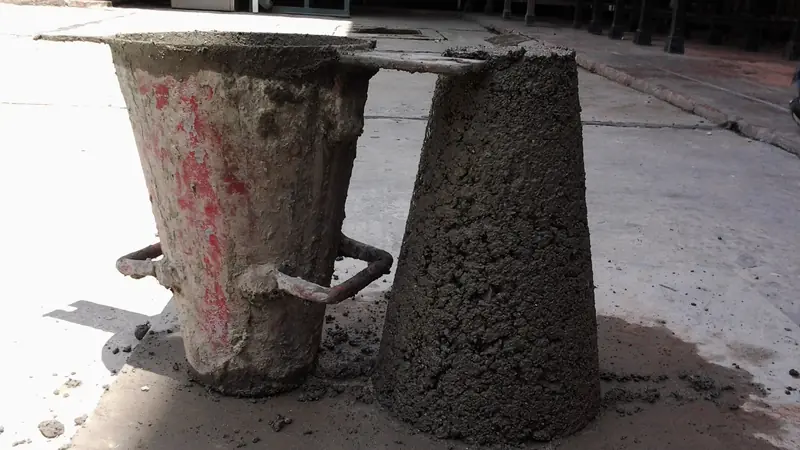
Water makes concrete easier to place, and that is the constant temptation on site. Adding water at the truck raises slump and lowers strength. Workability should come from the mix design, including admixtures, not from the hose. How workability is measured is covered in concrete slump.
Worked example: water added at the truck
A designed mix for an exterior slab has, per cubic yard:
- Cement: 564 lb (six 94-lb sacks)
- Design water-cement ratio: 0.45
- Spec: maximum w/cm 0.45
Step 1, design water. 564 x 0.45 = 253.8 lb. Water weighs about 8.34 lb per gallon, so 253.8 / 8.34 = 30.4 gallons per cubic yard.
Step 2, water added on site. The crew asks for 10 more gallons per yard to make placing easier. 10 x 8.34 = 83.4 lb.
Step 3, new ratio. (253.8 + 83.4) / 564 = 337.2 / 564 = 0.598, about 0.60.
Step 4, compare to the spec. The spec limit is 0.45. The delivered concrete is now well above it, regardless of what the ticket says about the mix. That is why specs and ASTM C94 control water added at the site, and why the truck ticket records it.
Step 5, the nominal-mix comparison. On a site-mixed 1:2:3 by volume, using one 94-lb sack (about 1 ft³ of cement in the US) per batch, you would measure 2 ft³ of sand and 3 ft³ of stone. If you aimed for w/c 0.50, the water would be 94 x 0.50 = 47 lb, about 5.6 gallons per sack. Without measuring the water, the ratio of solids tells you nothing about strength.
To size small site-mixed jobs in bags, see how many bags of concrete. For ready-mix volumes, use the concrete calculator.
What estimators see on drawings and specs
On a structural set, the concrete section of the general notes usually lists, per element:
| Item | Example note |
|---|---|
| Strength | f'c = 4,000 psi at 28 days |
| Max water-cementitious ratio | w/cm 0.45 max |
| Air content | Air entrained where exposed to freezing |
| Max aggregate size | 3/4" aggregate |
| Slump | As per spec Section 03 30 00 |
| Cement type | Type I/II, or Type V where sulfates are present |
You price the concrete by strength class and volume; the supplier prices the mix design. A higher f'c, lower w/cm or special cement usually changes the unit price, so read each line per element. More on the notes page is in general notes on structural drawings, and on volumes in concrete volume estimate.
Common mistakes
- Treating 1:2:3 as a strength. It is a recipe. Strength depends on water and materials.
- Mixing volume and weight ratios. A ratio by weight and one by volume are not the same mix.
- Ignoring w/cm limits when pricing exposed concrete. They can push the supplier to a richer mix.
- Adding water to fix workability. Use the admixture or the slump range in the mix design.
- Pricing all concrete at one strength. Footings, walls, slabs and exposed flatwork often have different specs.
Frequently asked questions
What is the mix ratio for 4,000 psi concrete?
There is no single ratio that guarantees 4,000 psi. The strength depends on the water-cement ratio, cement type and aggregates, so structural concrete at a given f'c is ordered from a ready-mix supplier, who designs and tests the proportions.
What does 1:2:3 mean in concrete?
It means 1 part cement, 2 parts sand and 3 parts coarse aggregate, usually by volume. It is a traditional rule-of-thumb mix. Water is added separately, and the amount of water strongly affects the final strength.
What is a good water-cement ratio for concrete?
It depends on the strength and exposure required, and the project specification sets the limit. ACI 318 gives maximum w/cm values by exposure class. Lower ratios give stronger, less porous concrete but need good mix design or admixtures to stay workable.
What is the difference between nominal mix and design mix concrete?
A nominal mix uses fixed proportions such as 1:2:4, without testing to prove strength. A design mix is proportioned by the supplier to meet a specified strength and other limits, and is verified by testing cylinders or cubes.
Can I use a nominal mix for structural concrete?
In most modern codes, structural concrete is specified by strength and supplied as a designed mix. Some codes allow nominal mixes for low grades only. Always follow the project specification and the engineer's notes.
This article explains general practice for learning purposes. On a real project, the drawings, the general notes and the governing code always win.