How Many Bags of Concrete Do I Need? Bag Yields, Worked Examples and When to Order Ready-Mix
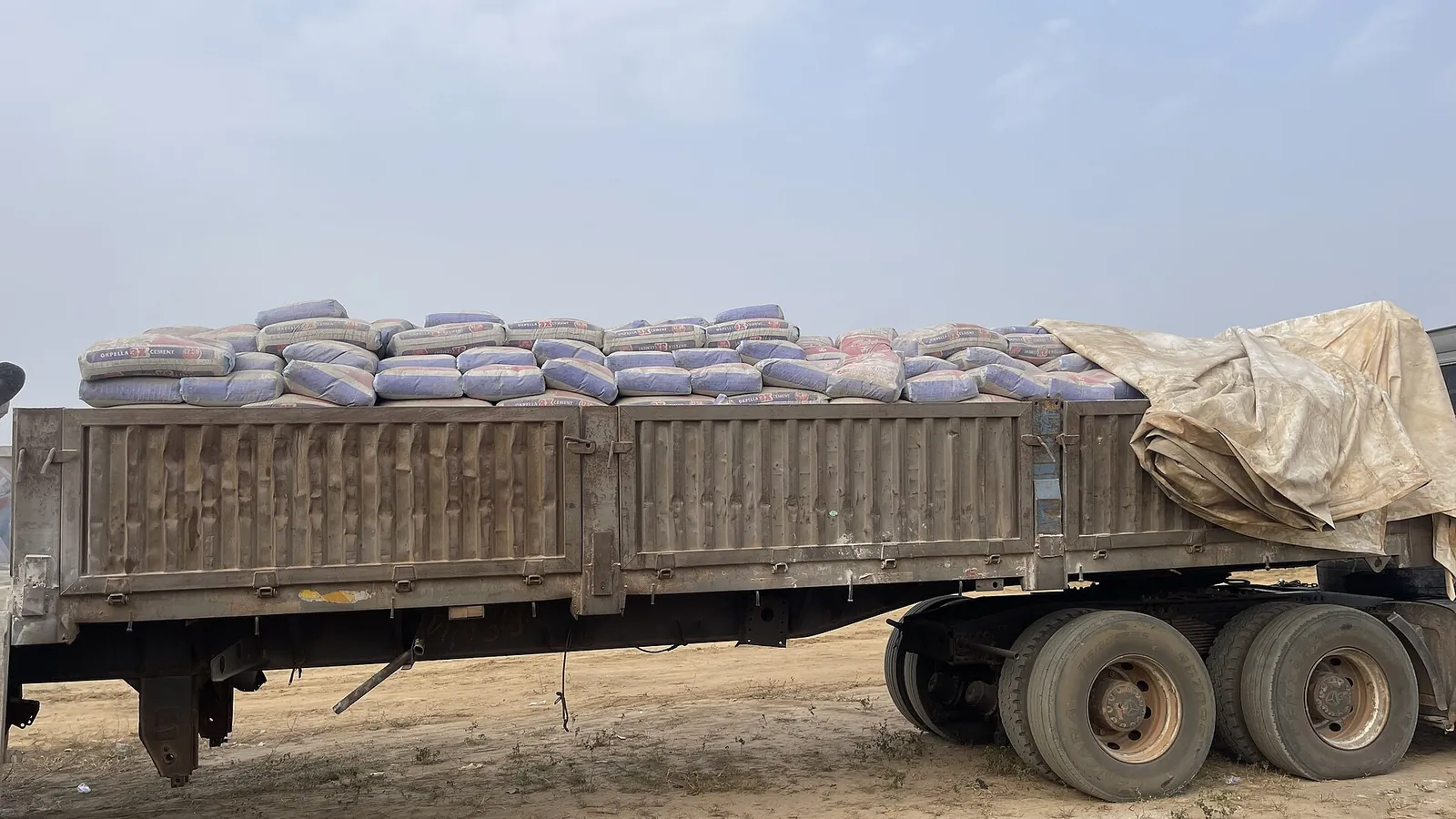
To find how many bags of concrete you need, calculate the volume in cubic feet, divide it by the yield of one bag, and round up. Using manufacturer data for standard concrete mix, an 80 lb bag yields about 0.60 ft³, a 60 lb bag about 0.45 ft³ and a 40 lb bag about 0.30 ft³. A 10 x 10 ft slab 4 in thick (33.3 ft³) therefore takes about 56 bags of 80 lb.
The arithmetic is simple. The mistakes come from units (inches vs feet), from forgetting to round up, and from not noticing when the job has grown too big for bags.
Bag yields
These figures are from Quikrete's data sheet for its standard Concrete Mix, and they are typical of standard bagged concrete. Other products (fast-setting, high-strength, "maximum yield" mixes) and other brands can yield differently, so read the yield printed on the bag you are buying.
| Bag size | Approx. yield | Bags per cubic yard (27 ft³) | Bags per cubic meter (35.3 ft³) |
|---|---|---|---|
| 80 lb (36.3 kg) | 0.60 ft³ (0.017 m³) | 45 | 59 |
| 60 lb (27.2 kg) | 0.45 ft³ (0.013 m³) | 60 | 79 |
| 40 lb (18.1 kg) | 0.30 ft³ (0.008 m³) | 90 | 118 |
The yields are approximate. Manufacturers note that actual yield varies with waste and with an uneven subgrade, which is why you round up and usually buy a few spare bags.
The method
Step 1: get every dimension in feet
Thickness is usually given in inches. Divide by 12: 4 in = 0.333 ft, 5 in = 0.417 ft, 6 in = 0.5 ft. Hole diameters in inches also get divided by 12.
Step 2: calculate the volume in cubic feet
- Slab or pad: length x width x thickness.
- Round hole or tube form: 3.1416 x radius² x depth.
- Footing or curb: width x depth x length.
The concrete volume estimate article covers more shapes, and the concrete calculator does the multiplication for you.
Step 3: divide by the bag yield and round up
Bags = volume (ft³) / yield per bag, rounded up to the next whole bag.
Step 4: decide on a margin
Subgrade is never perfectly flat, forms bow, and some concrete stays in the wheelbarrow. How much extra to buy depends on how accurate your excavation is. A few spare bags is common practice; unopened bags can often be returned, but check with the store.
Worked example 1: a 10 x 10 ft slab, 4 in thick
A small pad, say for a shed or an equipment base. The thickness and any reinforcement come from your plans or local code; 4 in is used here only for the arithmetic.
Volume: 10 x 10 x (4 / 12) = 10 x 10 x 0.333 = 33.3 ft³ (1.23 yd³, 0.94 m³).
Bags: - 80 lb: 33.3 / 0.60 = 55.6, round up to 56 bags. - 60 lb: 33.3 / 0.45 = 74.1, round up to 75 bags. - 40 lb: 33.3 / 0.30 = 111.1, round up to 112 bags.
Weight to move: 56 x 80 lb = 4,480 lb, about 2.2 tons, all lifted by hand at least twice (into the cart, into the mixer). That is worth knowing before you plan a weekend around it.
If the slab is 5 in thick instead, the volume becomes 41.7 ft³ and the count goes to 70 bags of 80 lb. One extra inch adds 25%. The concrete slab thickness article explains where thickness is set and why it changes volume so much.
Worked example 2: eight fence post holes
Eight holes, each 10 in (254 mm) in diameter and 36 in (914 mm) deep, each holding a 4x4 post (actual size 3.5 x 3.5 in). The hole size and depth for a real fence come from the fence design and local requirements (frost depth, wind, soil); these numbers are only for the calculation.
Volume of one hole: Radius = 5 in = 0.417 ft. Depth = 3 ft. 3.1416 x 0.417² x 3 = 3.1416 x 0.1736 x 3 = 1.636 ft³.
Volume taken by the post: (3.5 / 12) x (3.5 / 12) x 3 = 0.2917 x 0.2917 x 3 = 0.255 ft³.
Concrete per hole: 1.636 - 0.255 = 1.381 ft³.
Bags per hole (80 lb): 1.381 / 0.60 = 2.30. If you mix each hole separately with whole bags, that is 3 bags per hole, 24 bags in total.
Bags for all eight holes: 8 x 1.381 = 11.05 ft³, / 0.60 = 18.4, so 19 bags if you can carry part-bags from one hole to the next (for example, mixing in a wheelbarrow and splitting batches).
The difference, 19 vs 24 bags, comes purely from how you mix. If any gravel is placed in the bottom of the hole, reduce the concrete depth by that amount before you calculate.
Worked example 3: when bags stop making sense
A patio 12 x 20 ft, 4 in thick:
Volume: 12 x 20 x 0.333 = 80 ft³ = 2.96 yd³. 80 lb bags: 80 / 0.60 = 133.3, so 134 bags. Weight: 134 x 80 = 10,720 lb, more than 5 tons of material to lift, mix and place.
There is a second problem besides labor. A slab needs to be placed and finished while the concrete is still workable. Mixing 134 bags in a small mixer takes many batches, and the first batches will be stiffening while the last are still being mixed. That leaves cold joints and uneven finishes.
Signs that ready-mix is the better choice
- The volume is around a cubic yard or more and must be placed in one continuous pour.
- The pour is a slab you need to finish as a single surface.
- The concrete strength or mix is specified on drawings and must be tested or documented.
- You do not have the crew to mix and place continuously.
Ready-mix suppliers may have a minimum order or charge for small loads, and the truck needs access to the site or a pump. Ask your local supplier; this article does not cover prices. For a driveway-sized pour, the concrete driveway reinforcement article covers what usually goes inside the slab, and whichever way you supply the concrete, it still needs proper curing time afterwards.
When bags are the right tool
- Post holes, small footings for decks or sheds, steps, small pads.
- Repairs and patches.
- Places a truck cannot reach.
- Jobs that are naturally done in small separate batches.
Common mistakes
- Forgetting to convert inches to feet. 10 x 10 x 4 = 400 is not cubic feet. You need 10 x 10 x 0.333.
- Using the bag weight as the yield. An 80 lb bag does not make 0.8 ft³; it makes about 0.60 ft³.
- Ignoring the post. In small holes the post displaces a real share of the volume.
- Not checking the product. Specialty mixes can have a different yield than standard concrete mix; the bag tells you.
- Rounding down. Running out halfway through a pour is worse than one spare bag.
Frequently asked questions
How many 80 lb bags of concrete make a yard?
At about 0.60 ft³ per bag, 27 / 0.60 = 45 bags of 80 lb make one cubic yard. For 60 lb bags it is 60, and for 40 lb bags 90. Check the yield on the specific product you buy.
How many bags of concrete do I need for a 10x10 slab?
For a 10 x 10 ft slab 4 in thick, the volume is 33.3 ft³, which is 56 bags of 80 lb, 75 of 60 lb or 112 of 40 lb. At 6 in thick the volume is 50 ft³, or 84 bags of 80 lb. The required thickness depends on the use and on your plans or local code.
How many bags of concrete per fence post?
It depends on the hole size and the post. A 10 in hole 36 in deep with a 4x4 post needs about 1.4 ft³, which is just over two 80 lb bags. Calculate the hole volume, subtract the post, and divide by the bag yield.
Is it cheaper to mix concrete yourself or order ready-mix?
It depends on local prices, minimum load charges and access, so compare quotes for your job. For larger slabs, ready-mix is usually chosen for practical reasons as much as cost: one continuous pour and a consistent mix.
How much does an 80 lb bag of concrete cover?
About 0.60 ft³. That is 1.8 ft² at 4 in thick, or 1.2 ft² at 6 in thick. Divide the bag yield by the thickness in feet to get the area one bag covers.
This article explains general practice for learning purposes. On a real project, the drawings, the general notes and the governing code always win.