Concrete Strength psi and MPa: f'c, C25/30 and What the General Notes Mean
The concrete strength psi value on a US drawing is the specified compressive strength, written f'c: the strength the concrete must reach, usually at 28 days, measured by crushing standard test cylinders. Common values are 3,000, 4,000 and 5,000 psi, which are about 20.7, 27.6 and 34.5 MPa (1 MPa = 145 psi). European and UK drawings use classes such as C25/30, where the first number is the cylinder strength in MPa and the second the cube strength.
Here is how to read the number, convert it, and find it on a drawing set.
What f'c means
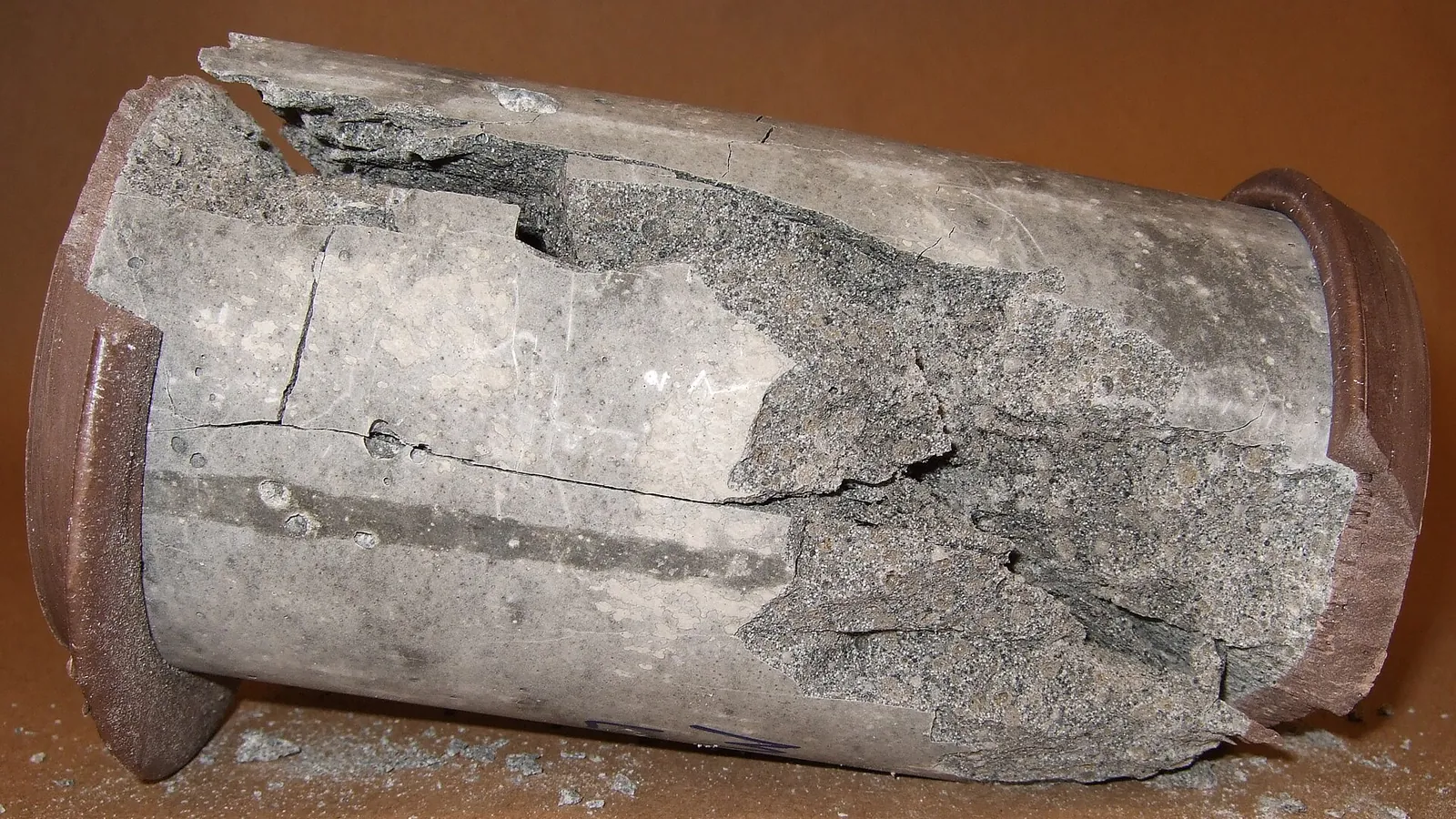
f'c ("f prime c") is the specified compressive strength of the concrete. The engineer chooses it in design, and the concrete supplier has to deliver a mix that meets it when tested. On US projects it is measured on cylinders made and cured under standard conditions (ASTM C31) and tested in compression (ASTM C39), normally at 28 days unless the drawings or specifications state a different age. Standard cylinders are 6 in × 12 in, and 4 in × 8 in cylinders are also widely used.
A few points that confuse people starting out:
- f'c is a specified minimum, not the average the mix will reach. Supplied mixes are designed to test above it, because of normal variation between batches.
- "4000 psi" and "4 ksi" are the same thing. Some drawings write f'c = 4 ksi.
- There is a code floor. ACI 318 sets a general minimum f'c of 2,500 psi for structural concrete, and exposure conditions (freezing and thawing, sulfates, chlorides) can require higher values. The project's drawings, specifications and governing code set the actual number.
- Concrete strength is not rebar grade. Grade 60 rebar refers to the steel's yield strength in ksi. It says nothing about the concrete. See rebar grades.
Concrete strength psi to MPa
The conversion is fixed: 1 MPa = 145.04 psi, and 1,000 psi = 6.895 MPa.
| psi | ksi | MPa |
|---|---|---|
| 2,500 | 2.5 | 17.2 |
| 3,000 | 3.0 | 20.7 |
| 4,000 | 4.0 | 27.6 |
| 5,000 | 5.0 | 34.5 |
| 6,000 | 6.0 | 41.4 |
| 8,000 | 8.0 | 55.2 |
Going the other way: 25 MPa × 145.04 = 3,626 psi, and 30 MPa × 145.04 = 4,351 psi.
MPa and N/mm² are the same unit, so a UK or Indian drawing that writes 30 N/mm² means 30 MPa. For the matching question on the steel side, see metric vs imperial rebar.
Cylinder vs cube: what C25/30 means
Outside North America you will often see two numbers. Under the European standards (EN 206 with Eurocode 2), a class such as C25/30 means:
- 25: characteristic compressive strength in MPa measured on cylinders 150 mm diameter × 300 mm high.
- 30: characteristic compressive strength in MPa measured on 150 mm cubes.
The same concrete tests higher as a cube than as a cylinder, mainly because of the specimen's shape: a squat cube is restrained more by the testing machine's plates than a tall cylinder. That is why both numbers are given for the same class.
Other systems you may meet:
| Notation | Where | What the number is |
|---|---|---|
| f'c = 4,000 psi | US (ACI 318) | Specified cylinder strength, psi |
| f'c = 28 MPa | Metric ACI projects, Canada, Australia and others | Specified cylinder strength, MPa |
| C25/30 | Europe, UK (EN 206) | Cylinder / cube characteristic strength, MPa |
| M25 | India (IS 456) | Characteristic cube strength, N/mm² (MPa) |
The practical rule: before comparing two strengths, check that both are cylinder values or both are cube values. A C25/30 concrete has a cylinder strength of 25 MPa (about 3,600 psi), so it is not equivalent to a 4,000 psi (27.6 MPa) specification, even though "30" looks bigger than "27.6".
Where concrete strength appears on the drawings
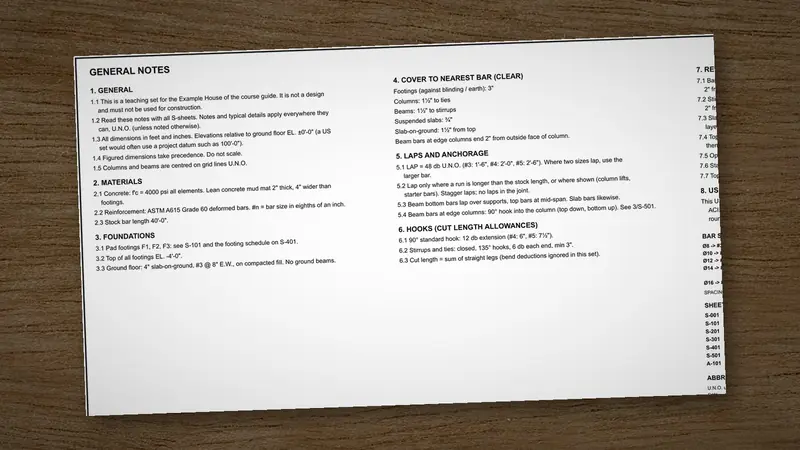
On most sets it is in the general notes on the first structural sheet, under a heading such as CONCRETE. It is often a short table by element. An example of how it might read:
| Element | f'c at 28 days |
|---|---|
| Footings | 3,000 psi |
| Foundation walls | 4,000 psi |
| Slabs on grade | 4,000 psi |
| Columns | 5,000 psi |
(Example only. Each project sets its own values.)
The same notes often give the maximum water-cement ratio, air entrainment for freeze-thaw exposure, aggregate size and the test age if it is not 28 days. The specifications carry the full mix requirements. If the strength is not in the notes, look for a concrete schedule on the foundation or framing sheets, or a note on the section itself. More on that sheet is in general notes on structural drawings, and the wider order for reading a set is in how to read structural drawings.
Why different elements have different strengths
A single building commonly uses two or more strengths. The usual reasons:
- Load. Columns in taller buildings carry large axial loads, and a higher f'c lets them stay smaller.
- Exposure and durability. Concrete exposed to freezing and thawing, de-icing salts, sulfates in soil or seawater may need a higher strength and a lower water-cement ratio, set by the code's exposure requirements.
- Early strength. Post-tensioned slabs typically require the concrete to reach a stated strength before the tendons are stressed, which drives the mix. See post-tensioned slabs on drawings.
- Lightly stressed elements. Many footings work well with a lower strength, since they are large and lightly stressed relative to their size.
Strength also affects other things on the drawings. Development and lap lengths in ACI 318 depend on f'c, so a lap schedule is usually given for a stated concrete strength.
Worked example: reading and converting the notes
The general notes of a small building say:
- Footings and stem walls: f'c = 3,000 psi
- Slab on grade: f'c = 4,000 psi
- Columns: f'c = 5,000 psi
The concrete takeoff (method in how to calculate concrete volume) gives:
- Footings and stem wall: 624 ft³
- Slab on grade, 30'-0" × 40'-0" × 5": 30 × 40 × 0.417 = 500 ft³
- Four columns 16" × 16" × 10'-0": 4 × 1.333 × 1.333 × 10 = 71.1 ft³
Step 1, convert strengths:
- 3,000 psi ÷ 145.04 = 20.7 MPa
- 4,000 psi ÷ 145.04 = 27.6 MPa
- 5,000 psi ÷ 145.04 = 34.5 MPa
Step 2, group volumes by strength (ft³ ÷ 27 = yd³, × 0.7646 = m³):
| Mix | ft³ | yd³ | m³ |
|---|---|---|---|
| 3,000 psi (20.7 MPa) | 624 | 23.11 | 17.67 |
| 4,000 psi (27.6 MPa) | 500 | 18.52 | 14.16 |
| 5,000 psi (34.5 MPa) | 71.1 | 2.63 | 2.01 |
Step 3, result: three separate mixes, each with its own quantity. They are ordered, delivered and priced separately, so a single combined total of 44.26 yd³ would not be usable for ordering.
Frequently asked questions
What does 4000 psi concrete mean?
It means the specified compressive strength, f'c, is 4,000 psi (about 27.6 MPa), normally measured on standard cylinders at 28 days. The mix supplied is designed to test above that value, so that the tested results meet the acceptance requirements in the specifications.
How do I convert concrete strength psi values to MPa?
Divide psi by 145.04. For example, 3,000 psi ÷ 145.04 = 20.7 MPa. To go from MPa to psi, multiply by 145.04.
What is the difference between C25/30 and 25 MPa concrete?
C25/30 is a European class with a characteristic cylinder strength of 25 MPa and a cube strength of 30 MPa. A specification of "25 MPa" on its own needs checking: on ACI-based metric drawings it is a cylinder value, while some other systems quote cube strength.
Why is concrete strength measured at 28 days?
Concrete keeps gaining strength over time, and 28 days is the standard reference age used in design and testing. Drawings or specifications can state a different age for particular elements or mixes.
Is higher strength concrete always better?
Not necessarily. The engineer picks the strength for the structural and durability needs of each element. Using a different strength than specified, higher or lower, is a change that should go through the engineer.
This article explains general practice for learning purposes. On a real project, the drawings, the general notes and the governing code always win.