Forces Explained · Why It Stands · No. 16
Wind on Tall Buildings
Why Height Changes Everything
 Video coming soon. Full article below
For a two-storey house the wind is a detail. For a tower of sixty floors it decides the shape, the structure and the cost. Why?
Against the wind a building is a cantilever fixed in the ground. Double its height and the moment at the base grows four times, and the sway at the top sixteen times. This video explains the wind profile, the premium for height, vortex shedding and swaying, why comfort often governs, and what engineers do about it.
The full story
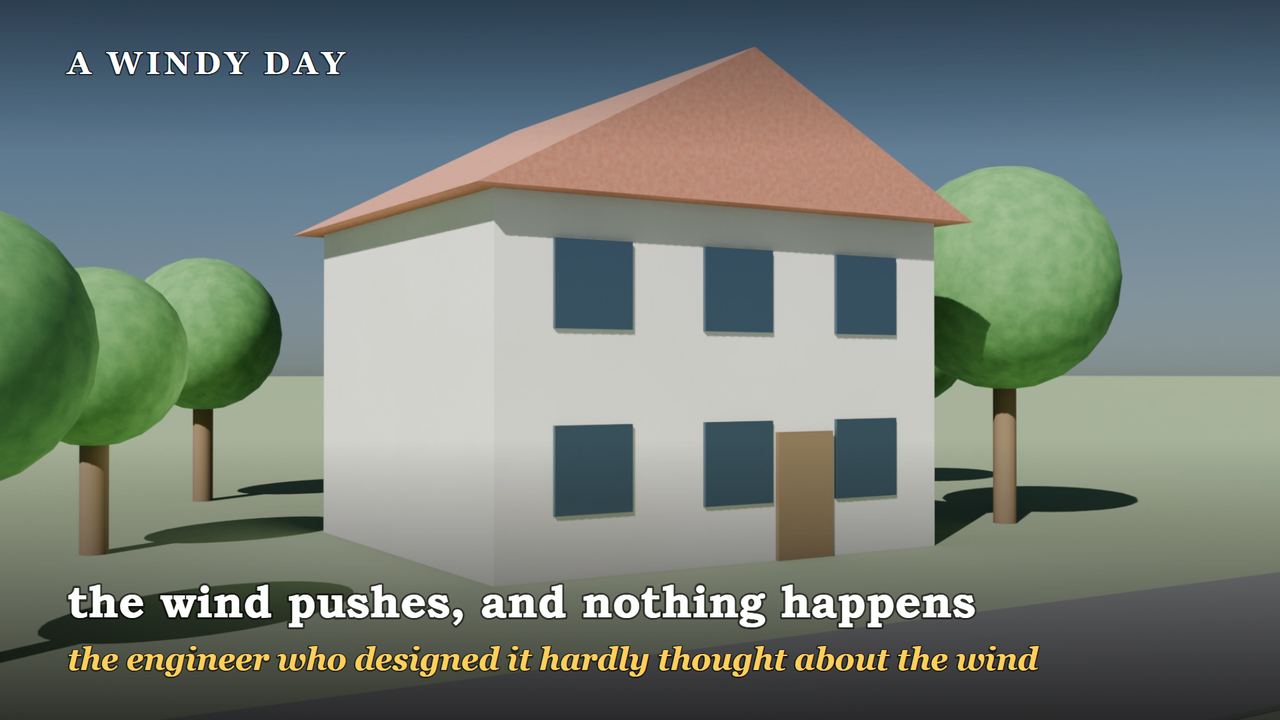
Stand next to a house with two floors on a windy day. The wind pushes on it, and nothing happens. The engineer who designed it hardly thought about the wind at all. Now stand under a tower of sixty floors. For that building, the wind decided almost everything: its shape, its structure, and its cost. Why such a difference?
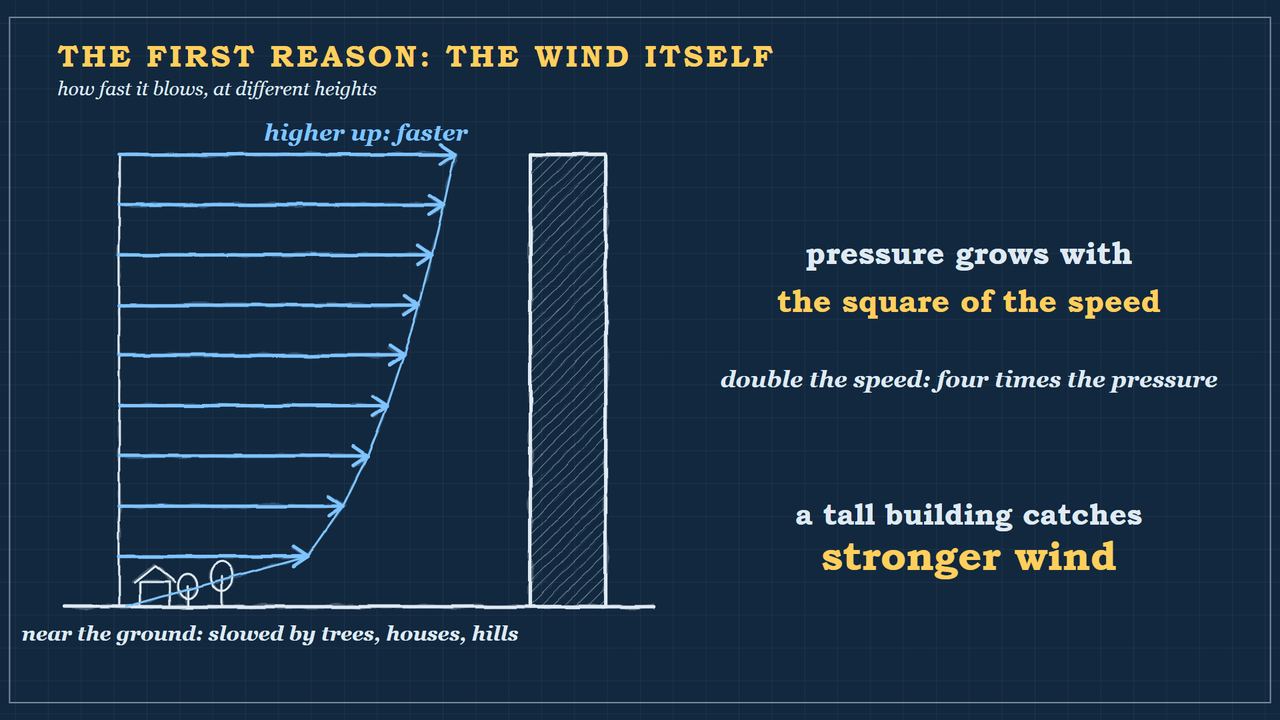
The first reason is the wind itself. Close to the ground, the wind is slowed down by trees, houses and hills. Higher up, it blows faster. And the pressure of the wind grows with the square of its speed. Double the speed, and the pressure is four times higher. So a tall building does not only catch more wind. It catches stronger wind.
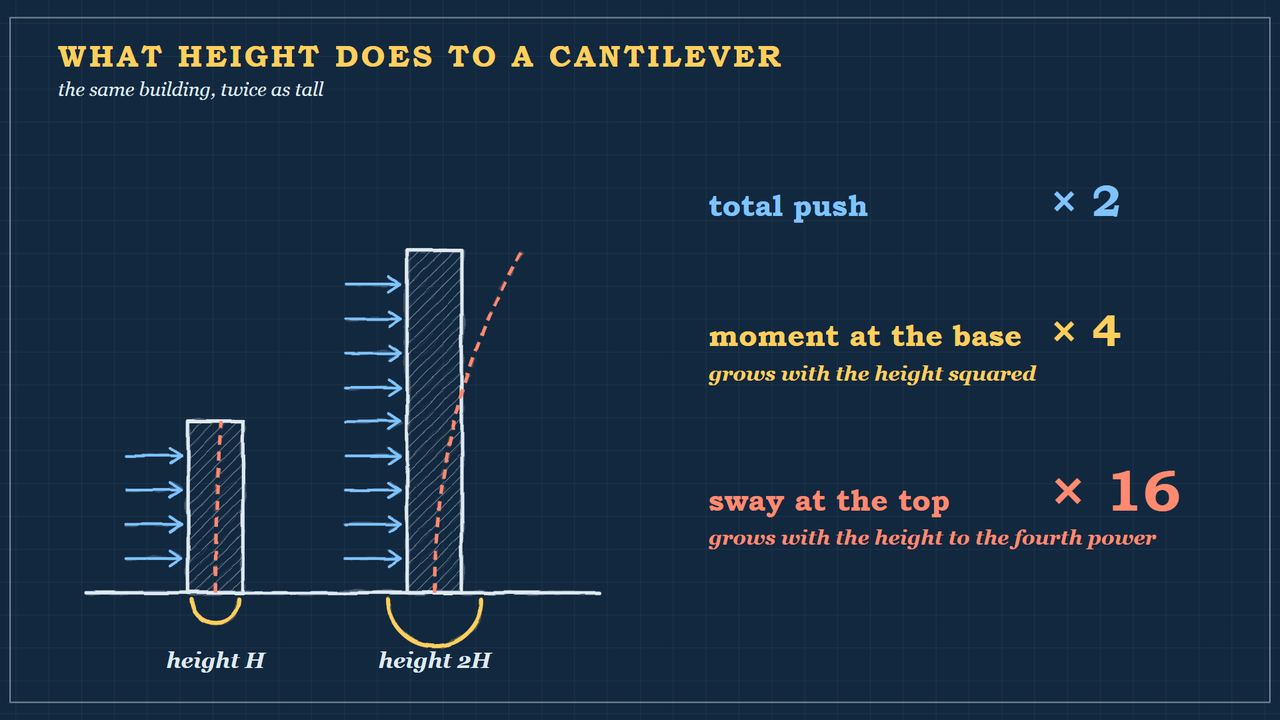
The second reason is the structure. Against the wind, a building works like a cantilever: a beam fixed in the ground, and free at the top. Think of a ruler held upright in your hand. The wind pushes along its whole height, and all of that push has to come down to the base.
Now look at what height does to a cantilever. The total push grows with the height. But the bending moment at the base grows with the height squared. A building twice as tall has about four times the overturning moment. And the sway at the top grows even faster: with the height to the fourth power. Twice as tall, sixteen times the sway, if nothing else changes.
That is why a low building does not care. Its walls and columns, which are there anyway to carry the weight, are far stronger than the wind needs. But as the building rises, the wind takes over. At some height, the structure is no longer designed to carry weight. It is designed to resist the sideways push. Engineers call this the premium for height.
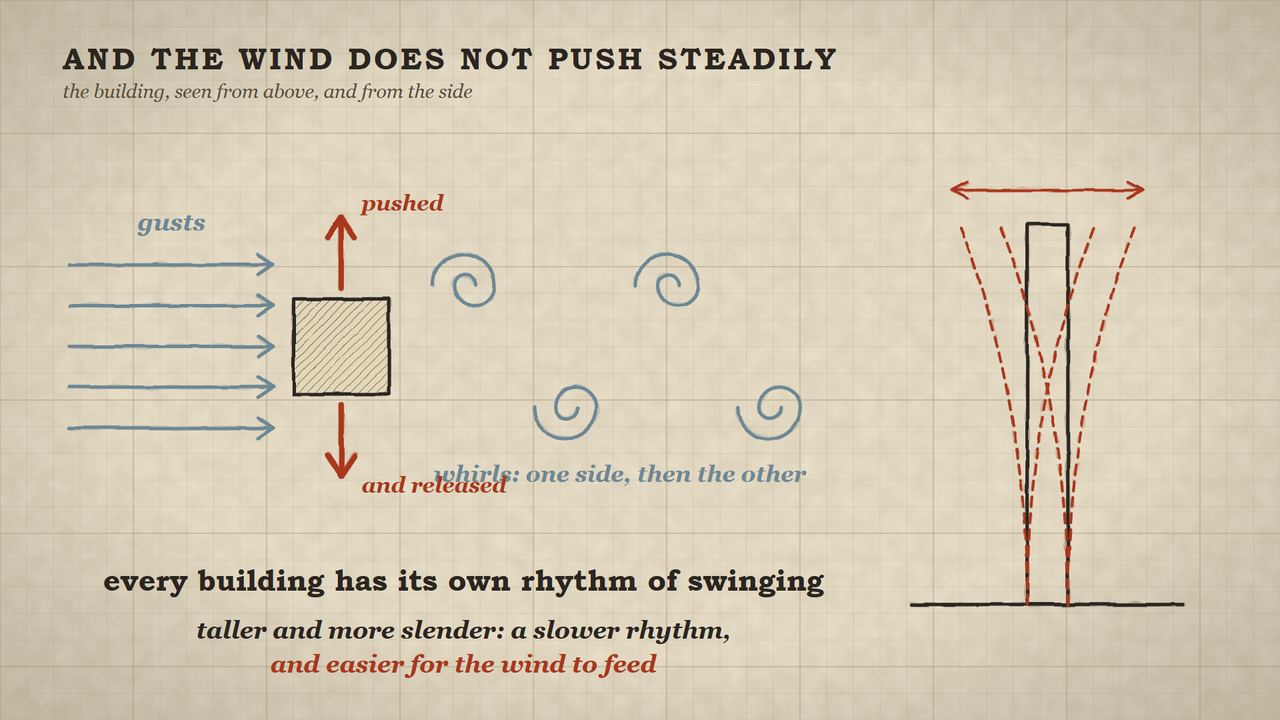
And the wind does not push steadily. It comes in gusts. And as it flows around the building, it breaks into whirls, which leave first from one side and then from the other. So a tall building is pushed and released, again and again, and it starts to swing. Every building has its own rhythm of swinging. The taller and the more slender the building, the slower that rhythm, and the easier it is for the wind to feed it.
This swinging is usually not dangerous for the structure. The problem is the people. On the top floors of a very tall tower, the building can move by a metre or more in a storm. It is not the distance that people feel. It is the acceleration. If it is too high, people feel seasick, in their own living room. So in very tall buildings, comfort, and not strength, often decides the design.
What can the engineer do? First, make the building stiffer. A core of concrete walls around the lifts. A tube of closely spaced columns around the outside. Or giant diagonal braces across the facade. Second, change the shape. Rounded or cut corners, a body that gets narrower towards the top, and openings that let the wind pass through. All of these break up the whirls.
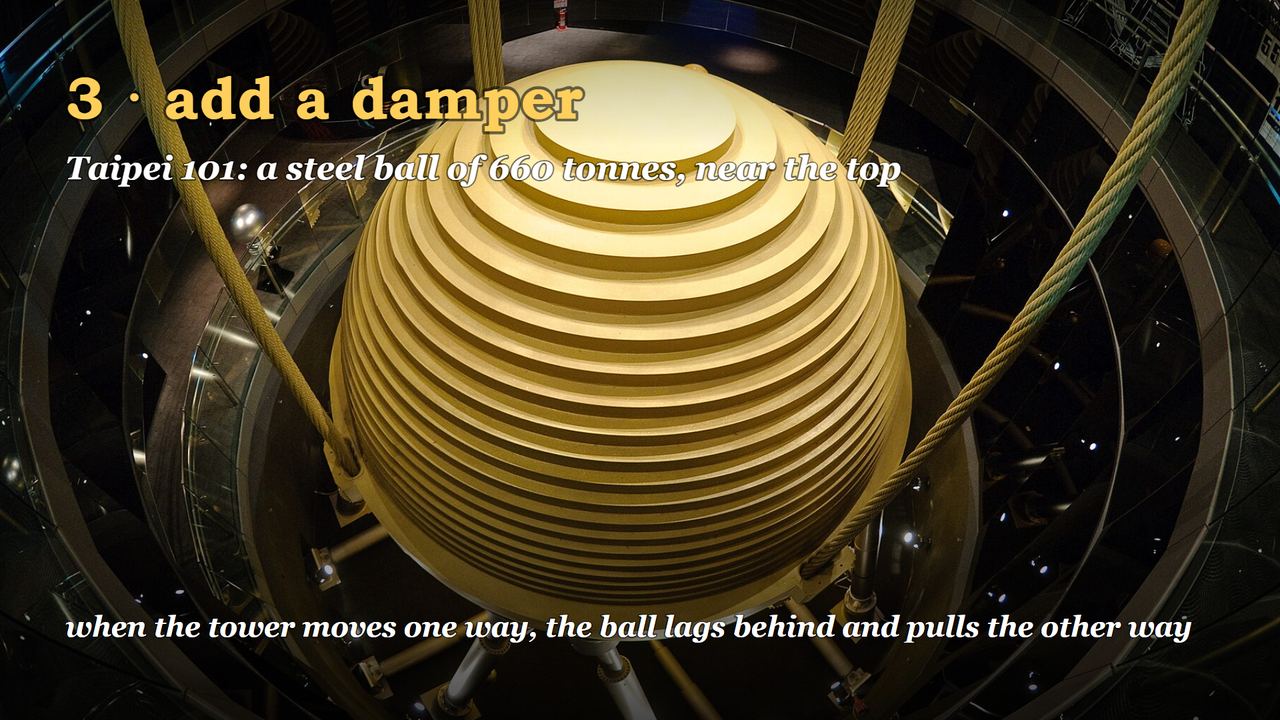
And third, add a damper. Near the top of the Taipei 101 tower hangs a steel ball that weighs 660 tonnes. When the tower moves one way, the ball lags behind and pulls the other way, and takes the energy out of the movement.
And because the wind around a real building is too complicated to calculate from a table, every very tall tower is tested as a model in a wind tunnel, before its design is finished.
So for a house, the wind is a detail. For a tower, it is the main load. The higher you build, the less the question is how to hold the building up, and the more it is how to hold it still.
This is The Bending Moment. Thank you for watching.
The Guide
Handed a set of plans and no one to check your takeoff?
How to Read Structural Drawings follows one beam, B2, from the plan to the section, the schedule and the general notes, then decodes it in the six rebar notations you will meet on real sets. Plans, not slides. Takeoffs, not bid theory.
#5H1616ØT16Ø16N1661 pages · 12 exercises with answers · about 100 abbreviations · PDF · one payment
Photo credits
- Taipei 101 tuned mass damper: Armand du Plessis, CC BY 3.0
- Taipei skyline: CEphoto, Uwe Aranas, CC BY-SA 3.0
- Glass facade: Sergiy Galyonkin, CC BY-SA 2.0
Photos from Wikimedia Commons under the licences listed. All drawings are original.
The narration uses an AI clone of the author's own voice. All drawings are original.