Forces Explained · No. 4
Tension, Compression, Bending, Shear
How Every Structure Carries Its Load
The video premieres on YouTube on 29 November 2026. The full article is below.
 Premieres 29 November
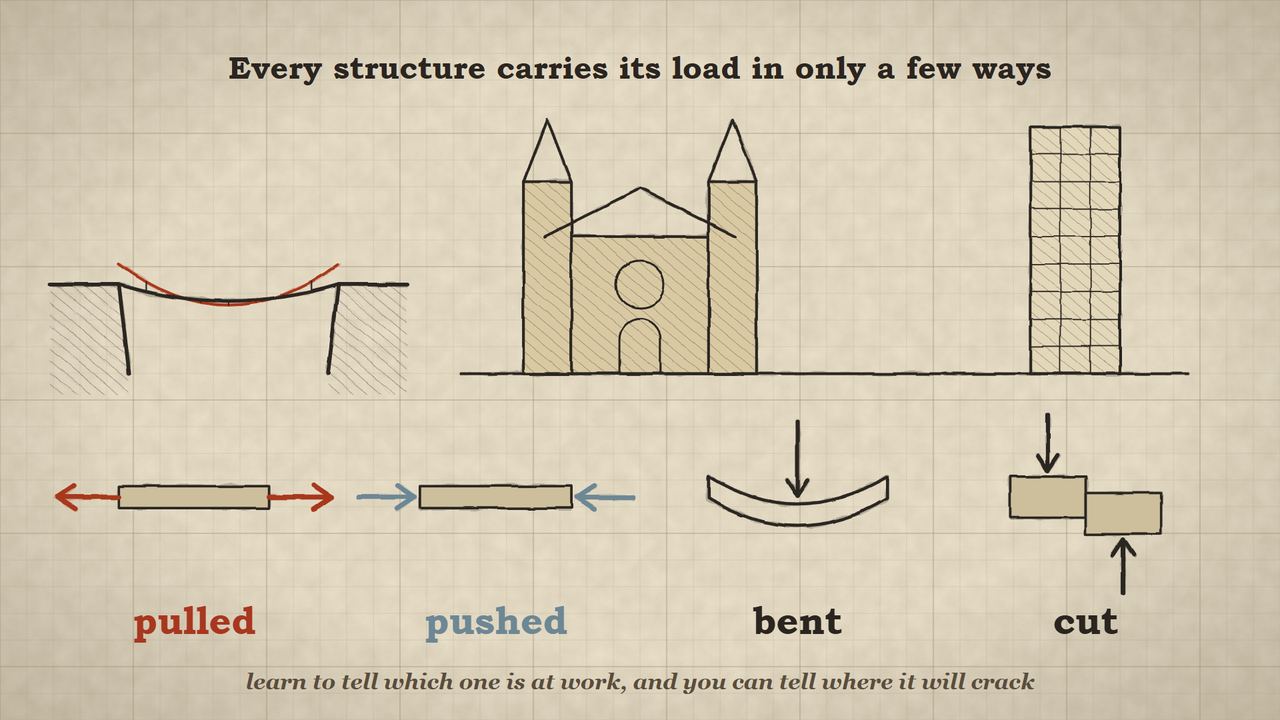
Every structure ever built carries its load in only a few ways: it is pulled, pushed, bent or cut. Learn to tell which one is at work, and you can read almost any structure, and even tell where it will crack.
This video explains tension, compression, buckling, bending and shear with simple drawings: why cables are thin and towers are thick, why beams are shaped like an I, where the steel goes in a concrete beam, and why a shear failure is more dangerous than a bending failure.
The full story
Hook
Every structure ever built carries its load in only a few ways. A rope bridge, a cathedral, a tower of steel and glass. The material can be pulled. It can be pushed. It can be bent. Or it can be cut. Learn to tell which one is at work, and you can read almost any structure. You can even tell where it will crack.
Tension
Start with the simplest one: tension. Hang a weight on a rope. Every fibre of the rope is pulled, and all of them work equally hard. Nothing is wasted. Steel is superb at this. A single steel wire five millimetres thick, the kind used in bridge cables, can hold more than three tonnes.
The weak point of tension is not the rope. It is the ends. A rope is only as good as its knot, and a cable is only as good as its anchor.
Compression
Compression is the opposite. Now the material is pushed together: a column under a roof, a stack of bricks. Stone, brick and concrete are very good at this. Concrete can take about ten times more in compression than in tension.
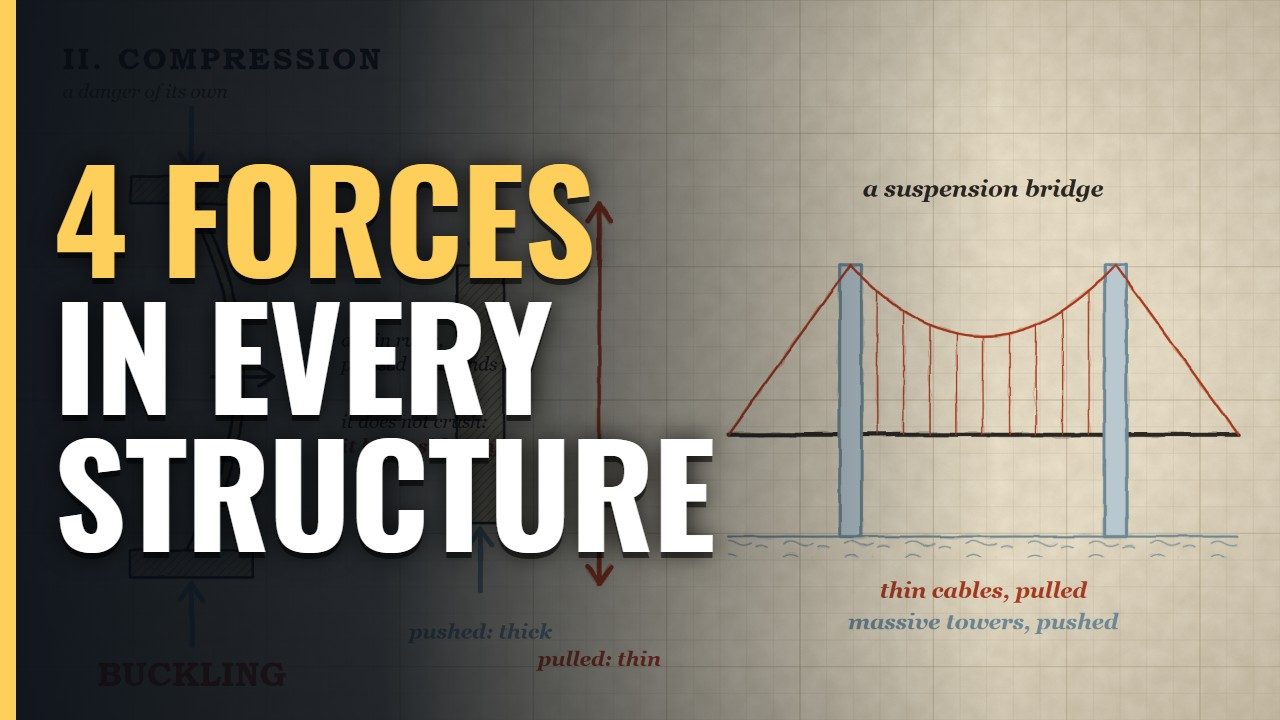
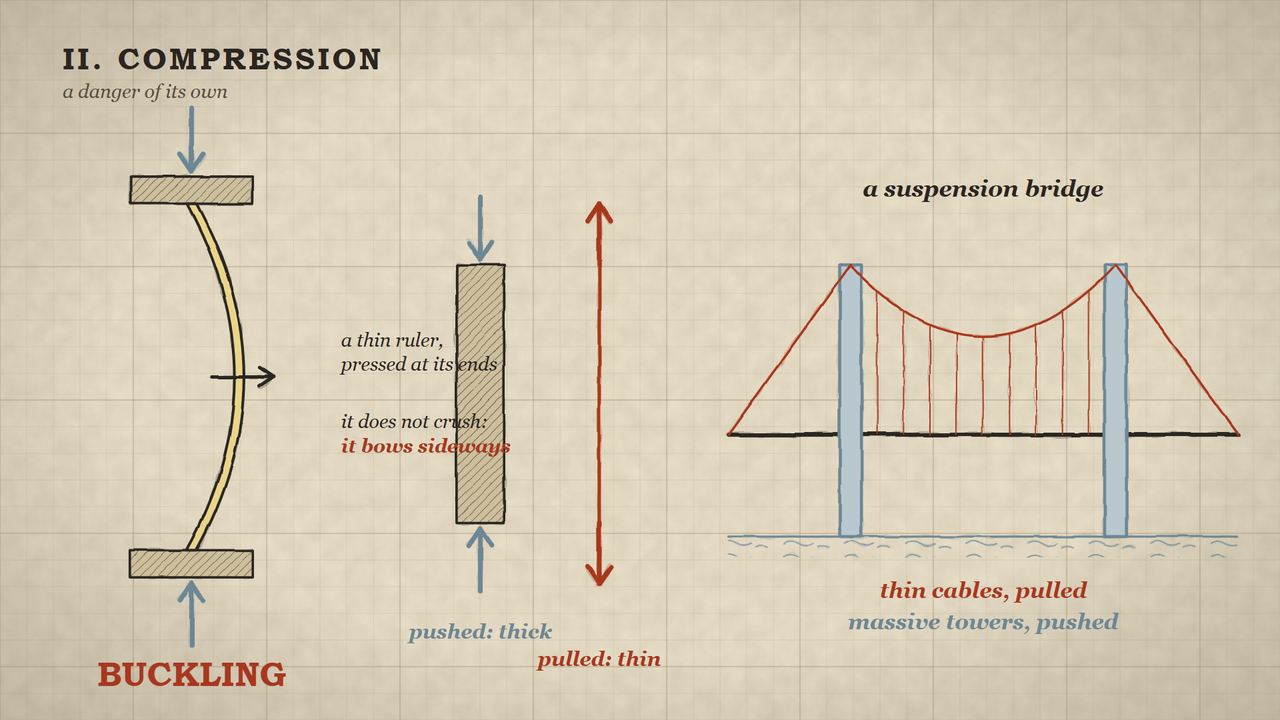
But compression has a danger of its own. Take a thin plastic ruler and press its two ends together. It does not crush. It bows out to the side. This is buckling. A slender piece fails sideways, long before the material itself gives up. So pieces in compression have to be thick, while pieces in tension can be thin. Look at a suspension bridge. The cables are thin, and they are pulled. The towers are massive, and they are pushed.
Bending
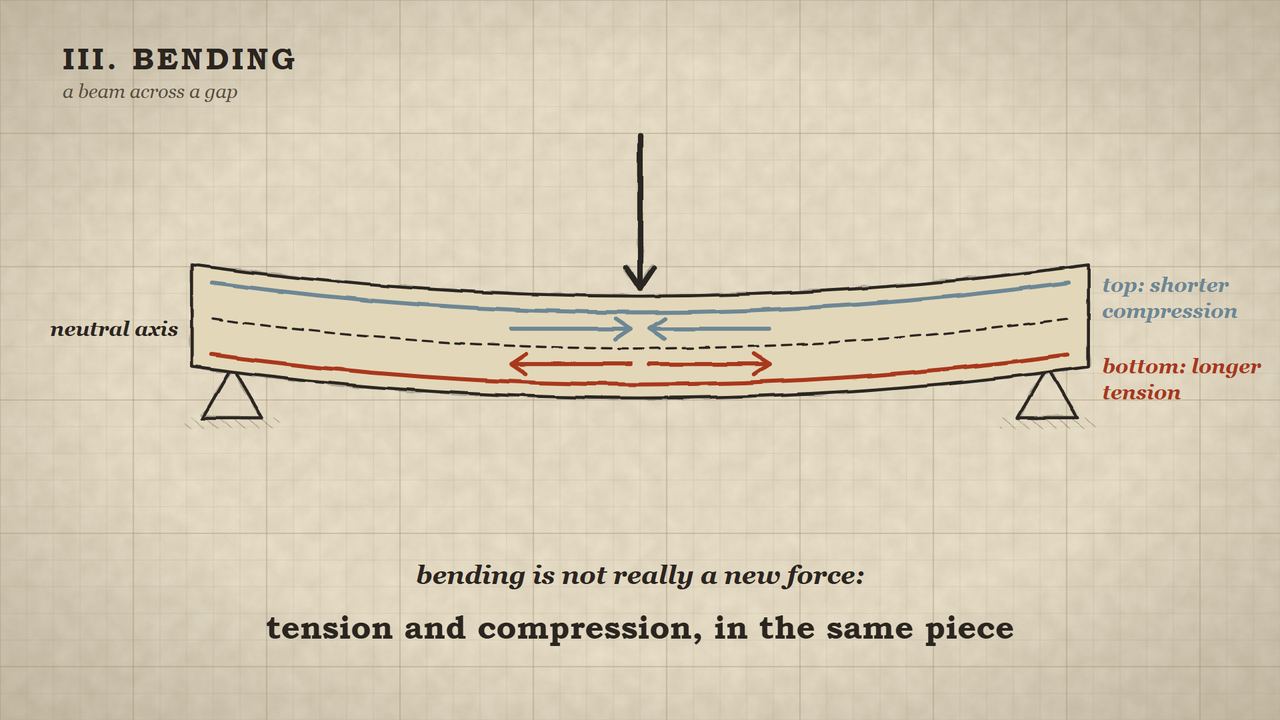
Now lay a beam across a gap, and put a load in the middle. It sags. Look inside it. The top of the beam gets shorter: it is in compression. The bottom gets longer: it is in tension. And somewhere in between there is a layer that does neither. Engineers call it the neutral axis. So bending is not really a new force. It is tension and compression, in the same piece, at the same time.
The first person to study this in print was Galileo, in 1638. He drew a wooden beam fixed into a wall, with a weight hanging from its end. That drawing is the logo of this channel. Galileo thought the whole beam was being pulled, and that it turned about its bottom edge. He was wrong about that. But he asked the right question, and it took more than a hundred years to get the answer right.
That answer explains the shape of almost every beam you see. Near the neutral axis, the material does very little. So we move it away, to the top and to the bottom. That is a steel I-beam: two flanges that do the work, and a thin web between them. And it is why depth matters so much. Take a wooden plank. Lying flat, it bends easily. Turn it on its edge, and it is many times stronger.
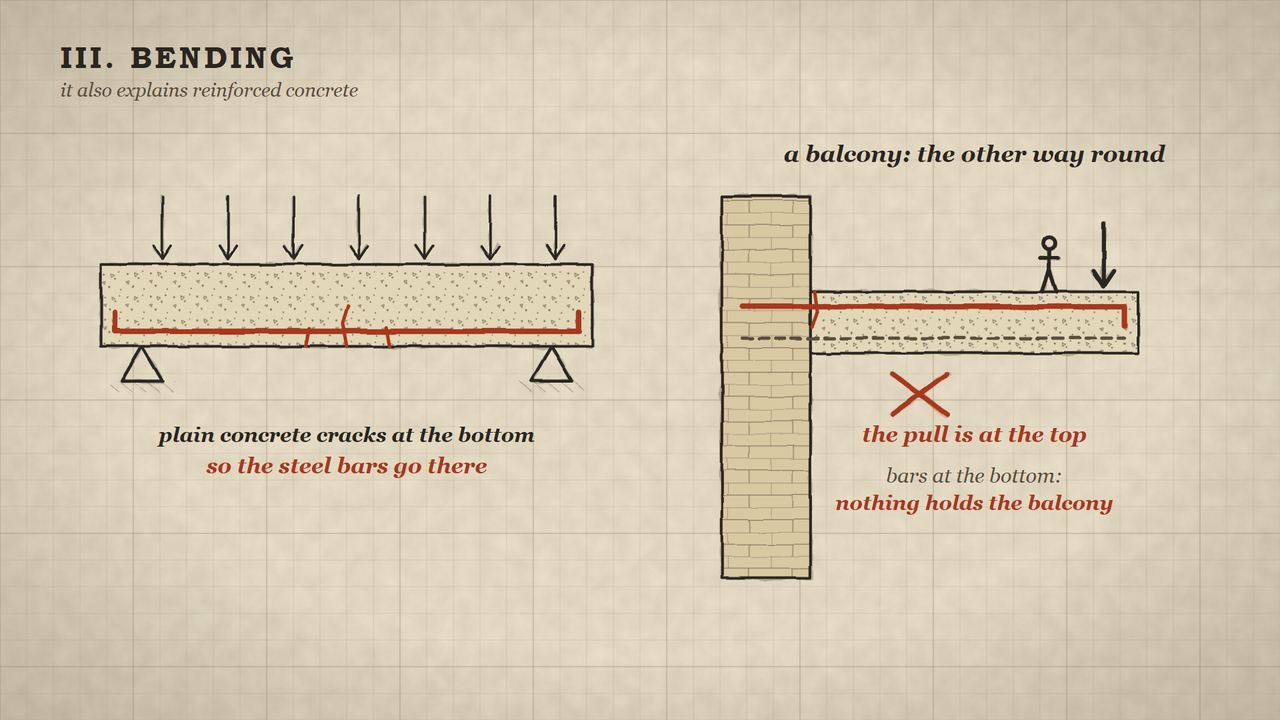
It also explains reinforced concrete. Concrete is weak in tension, so a plain concrete beam cracks at the bottom. So we put steel bars there, where the pull is. But be careful. In a balcony that sticks out of a building, it is the other way round. The pull is at the top. If the bars end up at the bottom, the balcony has nothing to hold it.
Engineers measure bending with a number called the bending moment: the force, multiplied by its distance. In a simple beam it is largest in the middle of the span. And that is where the name of this channel comes from.
Shear
The fourth one is shear. Shear is sliding. Hold a deck of cards between your hands and push one hand up and the other down. The cards slide past each other. In a beam, the load pushes down and the support pushes up, and between the two, the beam is being cut, like paper between the blades of a pair of scissors. Shear is largest near the supports. That is the opposite of bending, which is largest in the middle.
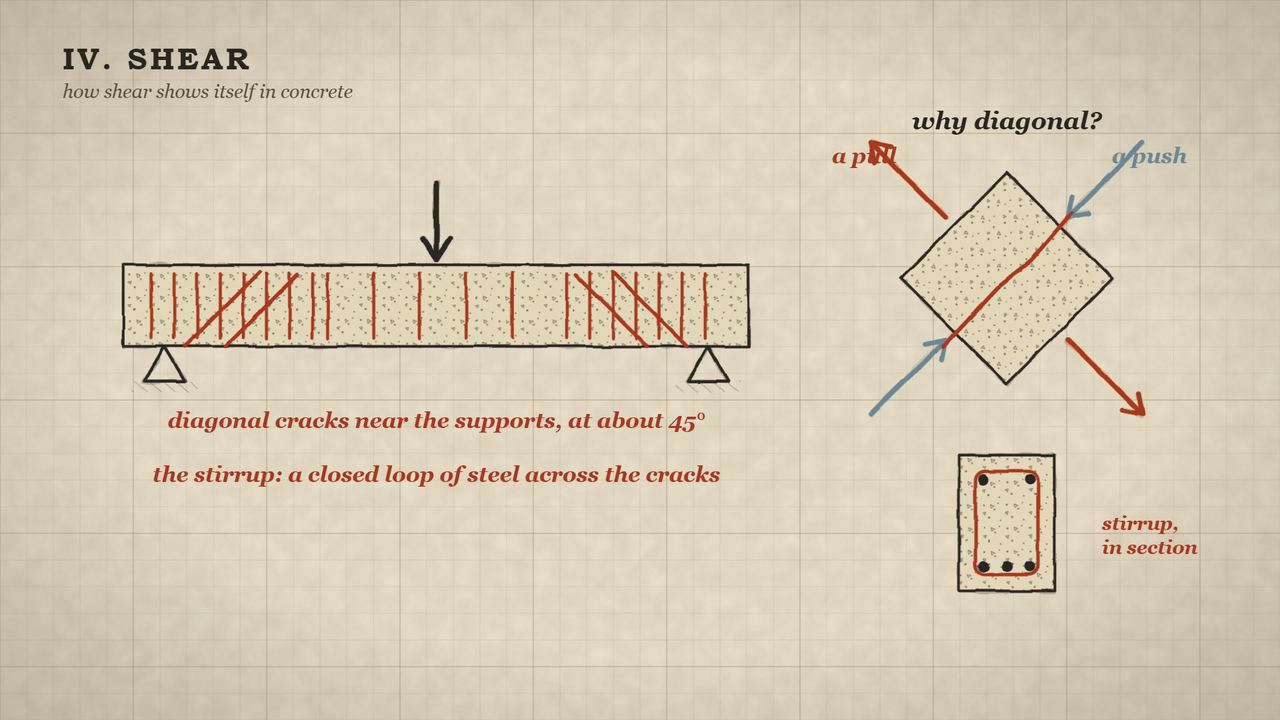
In concrete, shear shows itself as diagonal cracks near the supports, at about 45 degrees. Why diagonal? Because a sliding force, seen at 45 degrees, is really a pull in one direction and a push in the other. Concrete is weak when it is pulled, so it cracks across that pull. The answer is the stirrup: a closed loop of steel that crosses those cracks and holds the two sides together.
Why the difference matters
Here is why all this is more than theory. A beam that fails in bending usually fails slowly. The steel stretches, the cracks open wide, the beam sags. People see it, and they have time to leave. A beam that fails in shear can break suddenly.
In 1955, at an air force depot in Shelby, Ohio, the roof of a large concrete warehouse came down without warning. The beams had been designed by the code of the time. They failed in shear, under little more than their own weight. Where they broke, there were no stirrups, because the code did not ask for any. After that, the American concrete code was changed. Today, almost every concrete beam has stirrups along its whole length.
Reading a structure
Now you can read a structure. A cable is pure tension. An arch is pure compression. A truss takes a beam and turns it into triangles, so that every bar is either pulled or pushed. And a floor slab works in bending and in shear. It is the least efficient of them all. But it is flat, and you can walk on it.
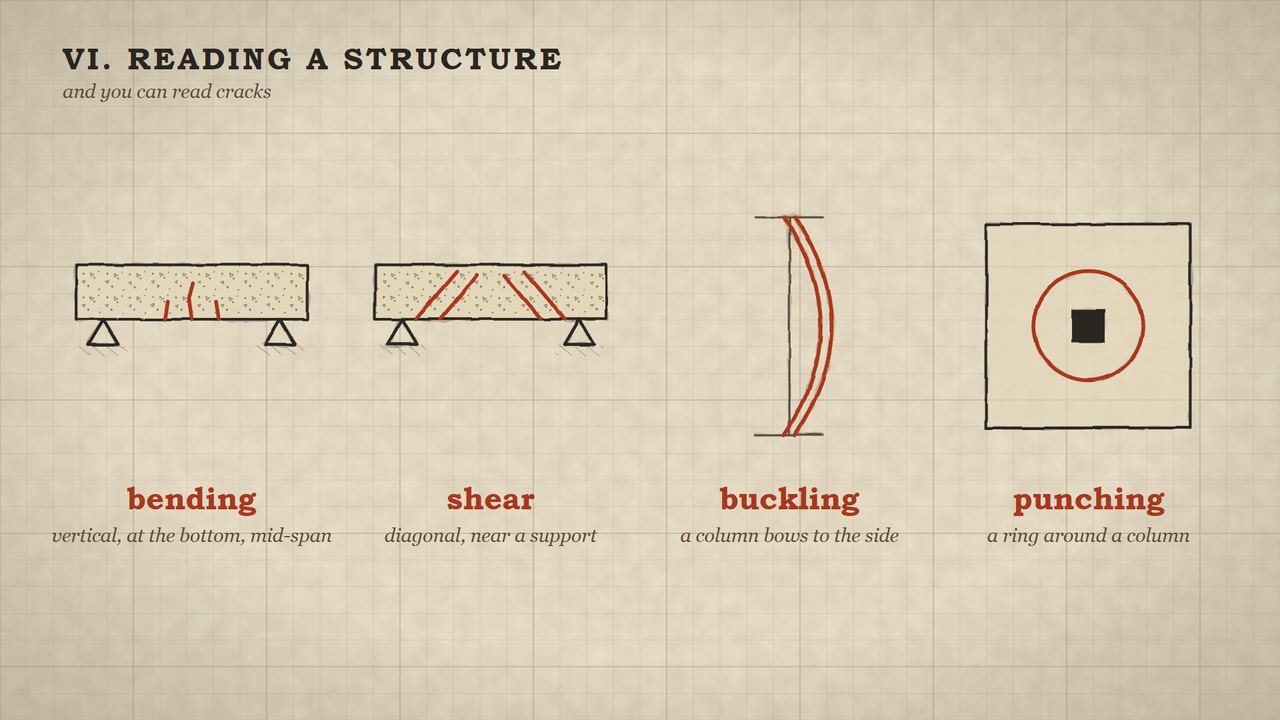
And you can read cracks. Vertical cracks at the bottom, in the middle of a beam: that is bending. Diagonal cracks near a support: that is shear. A column that bows to the side: buckling. And a ring of cracks in a slab, around a column: that is punching, and it has a video of its own.
Pull, push, bend and cut. Everything else is detail. This is The Bending Moment. Thank you for watching.
The Guide
How to Read Structural Drawings
One beam, B2, followed from the plan to the section, the schedule and the general notes, then decoded in the six rebar notations you will meet on real sets.
#5H1616ØT16Ø16N1661 pages · 12 exercises with answers · about 100 abbreviations · PDF
Sources
- Galileo Galilei, Two New Sciences (1638)
- ACI-ASCE Committee 326, Shear and Diagonal Tension (1962), on the Wilkins Air Force Depot warehouse failure
- J. Feld, Lessons from Failures of Concrete Structures (1964)
The narration uses an AI clone of the author's own voice. All drawings are original.