Forces Explained · Why It Stands · No. 5
The 5 Types of Bridges
And How to Tell Them Apart
The video premieres on YouTube on 02 December 2026. The full article is below.
 Premieres 02 December
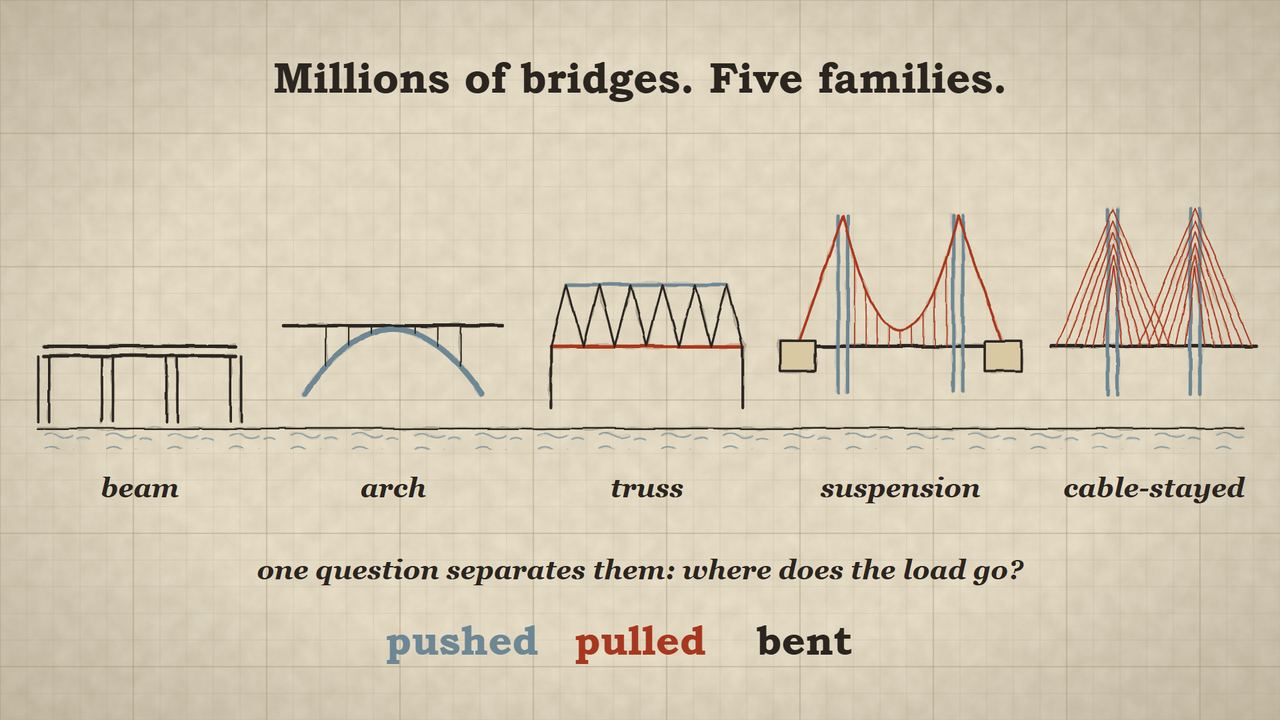
There are millions of bridges in the world, and almost all of them belong to one of five families: beam, arch, truss, suspension and cable-stayed. What separates them is one question: is the bridge pushed, pulled, or bent?
This video explains how each type carries its load, shows a famous example of each, gives the current world records, and ends with a simple way to tell a suspension bridge from a cable-stayed bridge.
The full story
Hook
There are millions of bridges in the world, and almost all of them belong to one of five families. What separates the families is one question: where does the load go? Is the bridge pushed, pulled, or bent? Once you know the five, you will recognise every bridge you cross. And you will know why the engineer chose it.
1. The beam bridge
The first family is the simplest: the beam bridge. A log across a stream. The deck rests on two supports, and it bends. The top is squeezed, and the bottom is stretched.
Bending is an expensive way to carry a load. Make the span twice as long, and the bending grows four times. So the beam quickly becomes deep and heavy. That is why most beam bridges have short spans, usually 20 to 50 metres. To go further, you simply add more supports. The Lake Pontchartrain Causeway, in Louisiana, is 38 kilometres long. It stands on thousands of concrete piles, and each span is only about 17 metres. Almost every motorway bridge you drive under is a beam bridge.
2. The arch bridge
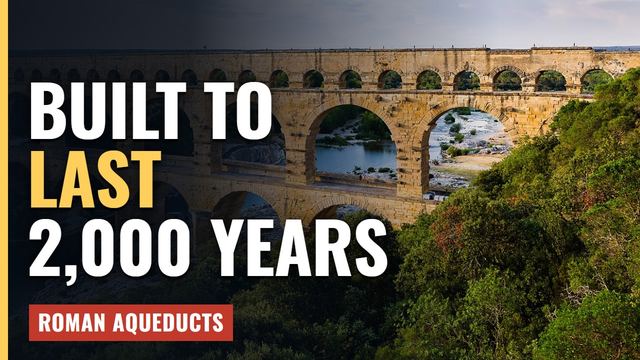
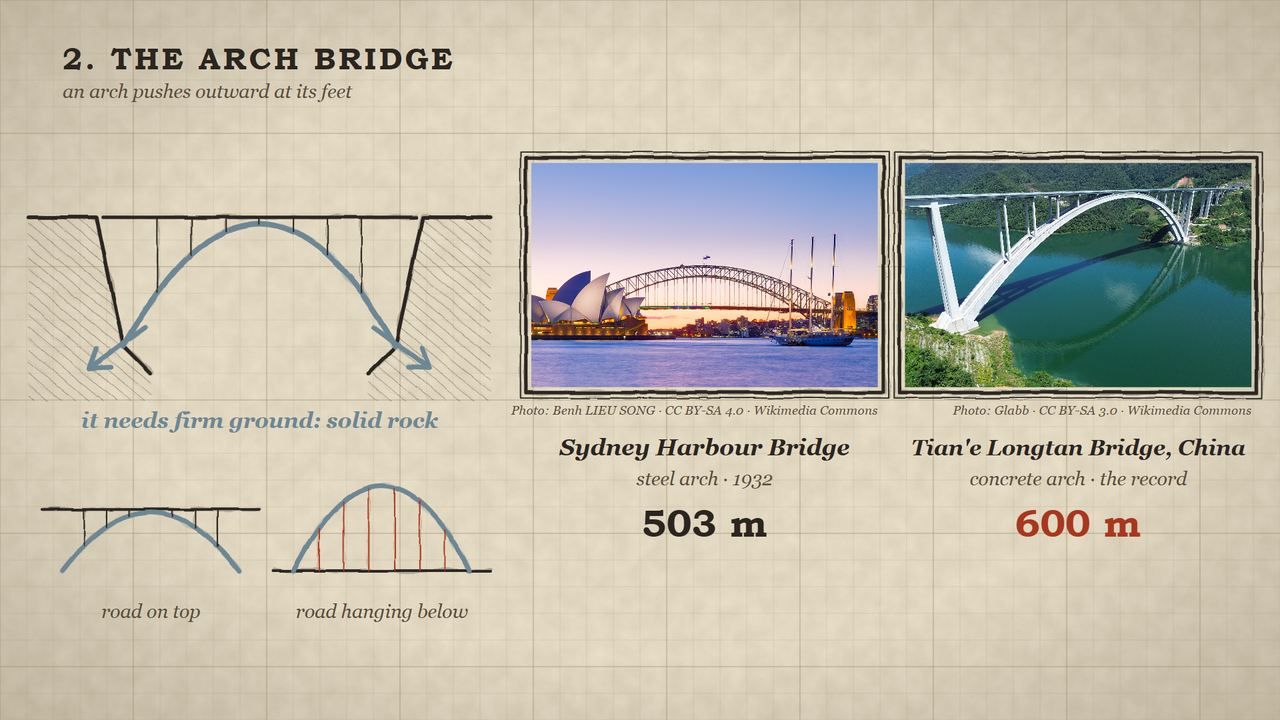
The second family is the arch. An arch does not bend. It is squeezed, from one end to the other. Stone and concrete are very strong when they are squeezed, and this is why the Romans could build the Pont du Gard two thousand years ago, with no steel at all.
But an arch pushes outward at its feet, so it needs firm ground: solid rock, or the two sides of a canyon. The road can run on top of the arch, or it can hang below it. The Sydney Harbour Bridge, opened in 1932, is a steel arch with a span of 503 metres, and its deck hangs from the arch on steel hangers. The record today belongs to the Tian'e Longtan Bridge, in China: a concrete arch, 600 metres across.
3. The truss bridge
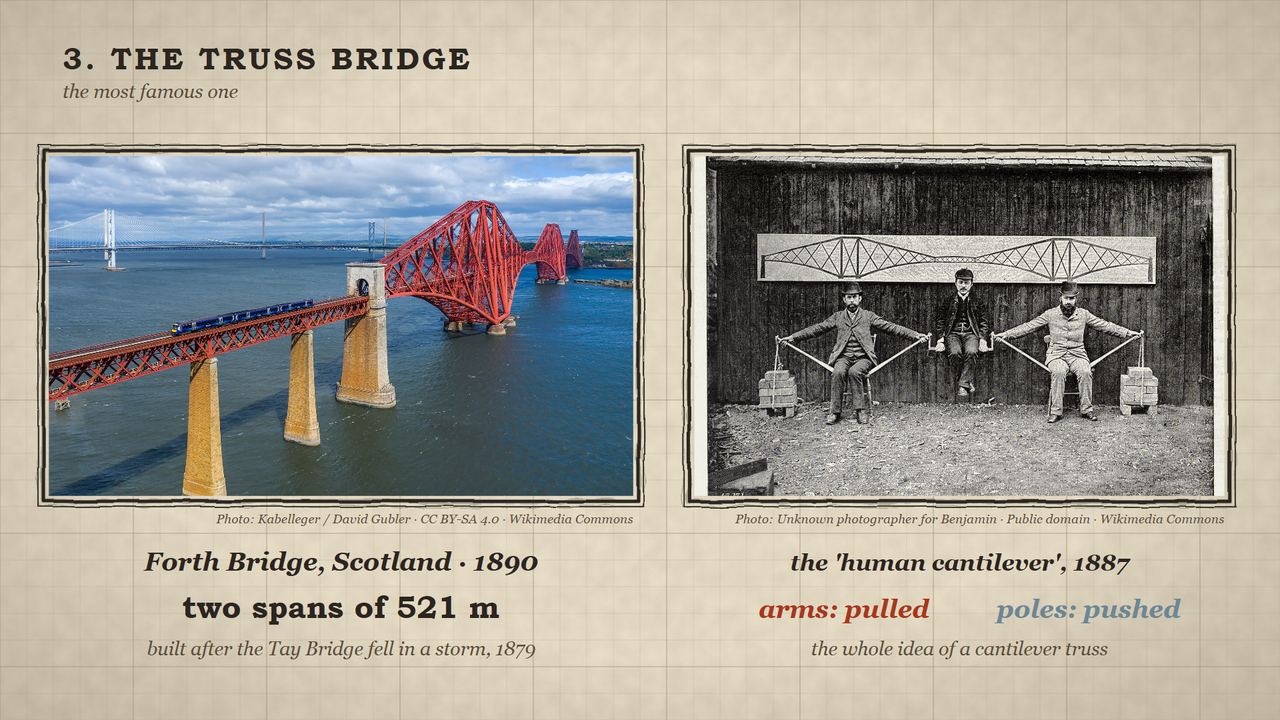
The third family is the truss. Take a deep beam, and remove all the material that is not working. What is left is a frame of triangles. In a truss, no bar is bent. Every bar is either pulled or pushed. This makes a truss light and stiff, and that is why it was the favourite of the railways in the nineteenth century.
The most famous one is the Forth Bridge, in Scotland, opened in 1890. It has two main spans of 521 metres each. It was built a few years after another Scottish railway bridge fell in a storm, with a train on it. So its engineers made it look as strong as it is. To explain how it works, they took a photograph. Two men sit on chairs with their arms stretched out, holding wooden poles. A third man sits between them, in the air. The arms are pulled. The poles are pushed. That is the whole idea of a cantilever truss.
4. The suspension bridge
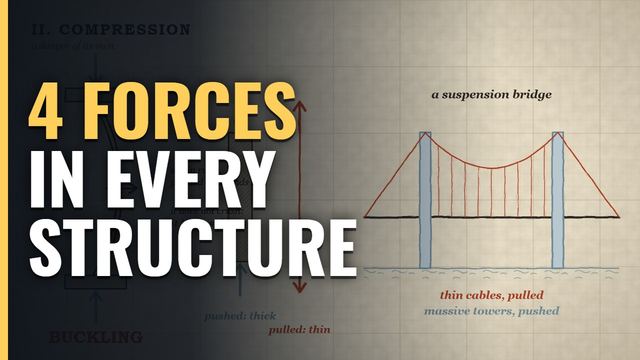
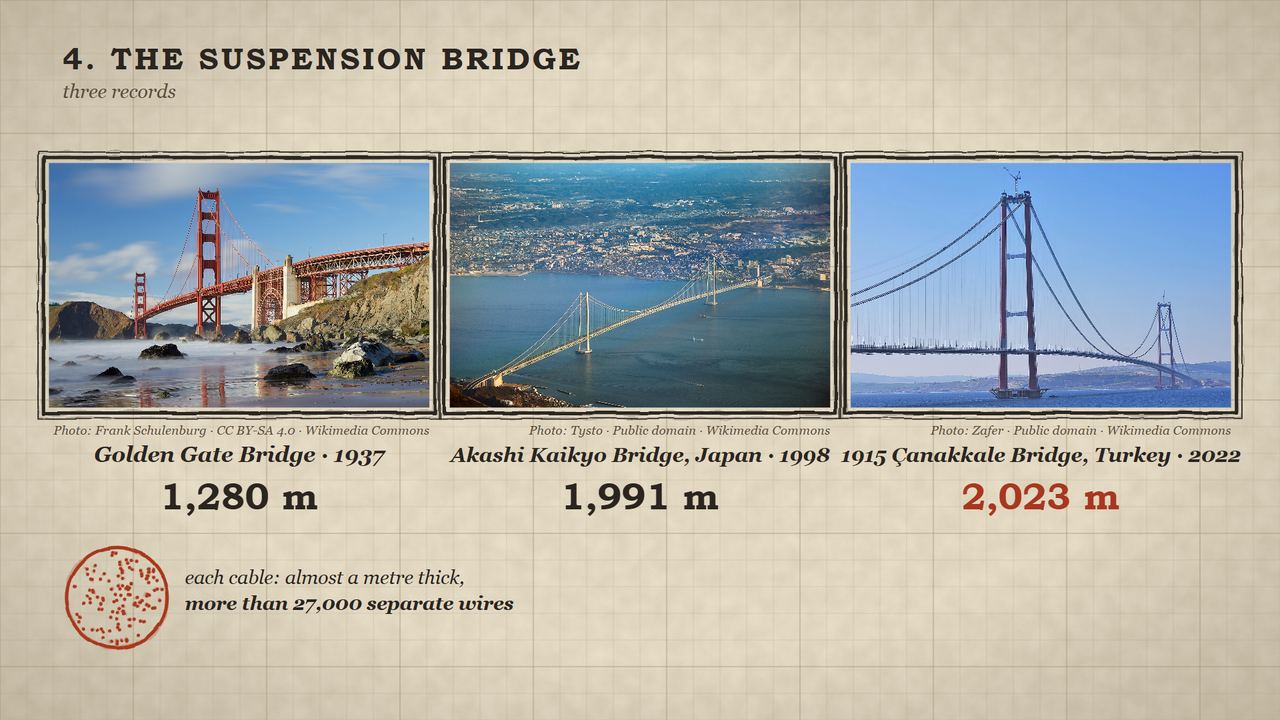
The fourth family holds almost all the records: the suspension bridge. Two main cables run over the tops of two towers, and they are anchored in the ground at each end. The deck hangs from them on vertical cables. The main cables are in pure tension, and the towers are in pure compression. A steel wire in tension is the most efficient thing a structural engineer has. That is why this family can cross the widest gaps.
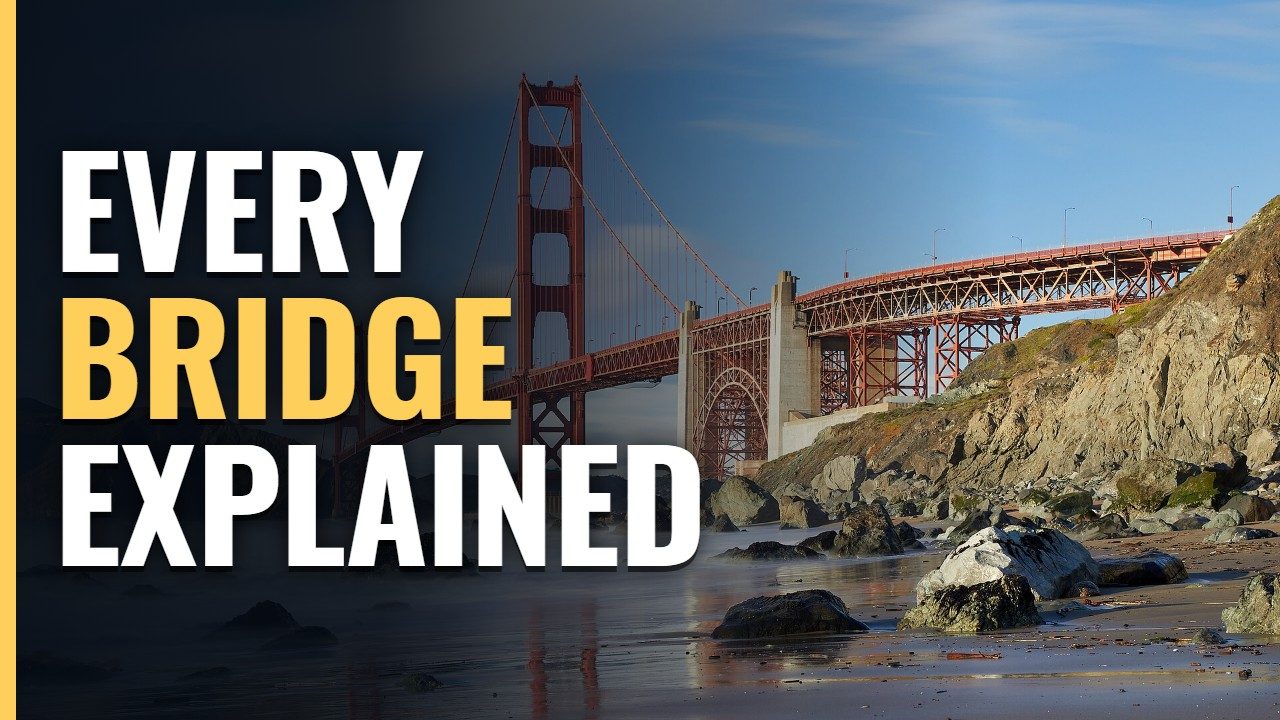
The Golden Gate Bridge, opened in 1937, has a main span of 1,280 metres. Each of its two cables is almost a metre thick, and is made of more than 27,000 separate wires. The Akashi Kaikyo Bridge in Japan reached 1,991 metres in 1998. And the record today is in Turkey: the 1915 Çanakkale Bridge, opened in 2022, with a span of 2,023 metres.
The weakness of a suspension bridge is that it is flexible. In 1940, the Tacoma Narrows Bridge in the United States twisted itself apart in a steady wind of about 65 kilometres an hour, only four months after it opened. Since then, the decks are made stiffer, they are shaped to let the wind pass, and they are tested in wind tunnels.
5. The cable-stayed bridge
The fifth family is the youngest: the cable-stayed bridge. From far away it looks like a suspension bridge. But it works in a different way. There are no main cables, and no anchors in the ground. Many straight cables run directly from the tower to the deck. The deck on one side of the tower balances the deck on the other side, like two arms of a scale.
This makes it quicker and cheaper to build. The deck grows out from the tower in both directions, piece by piece, and nothing has to stand in the water below. For spans between about 200 and 1,000 metres, it is now the first choice.
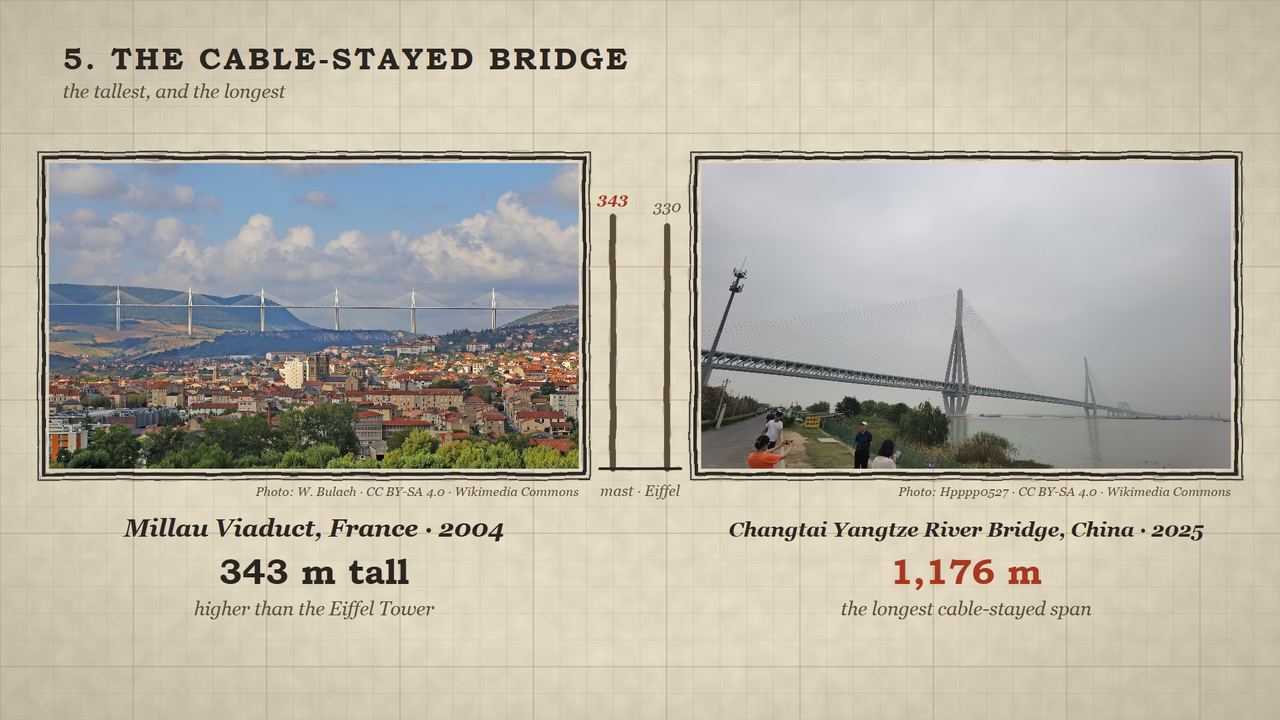
The Millau Viaduct, in France, opened in 2004, is the tallest bridge in the world. The top of its highest mast is 343 metres above the valley, higher than the Eiffel Tower. The longest span belongs to the Changtai Yangtze River Bridge, in China, opened in 2025: 1,176 metres.
How to tell them apart
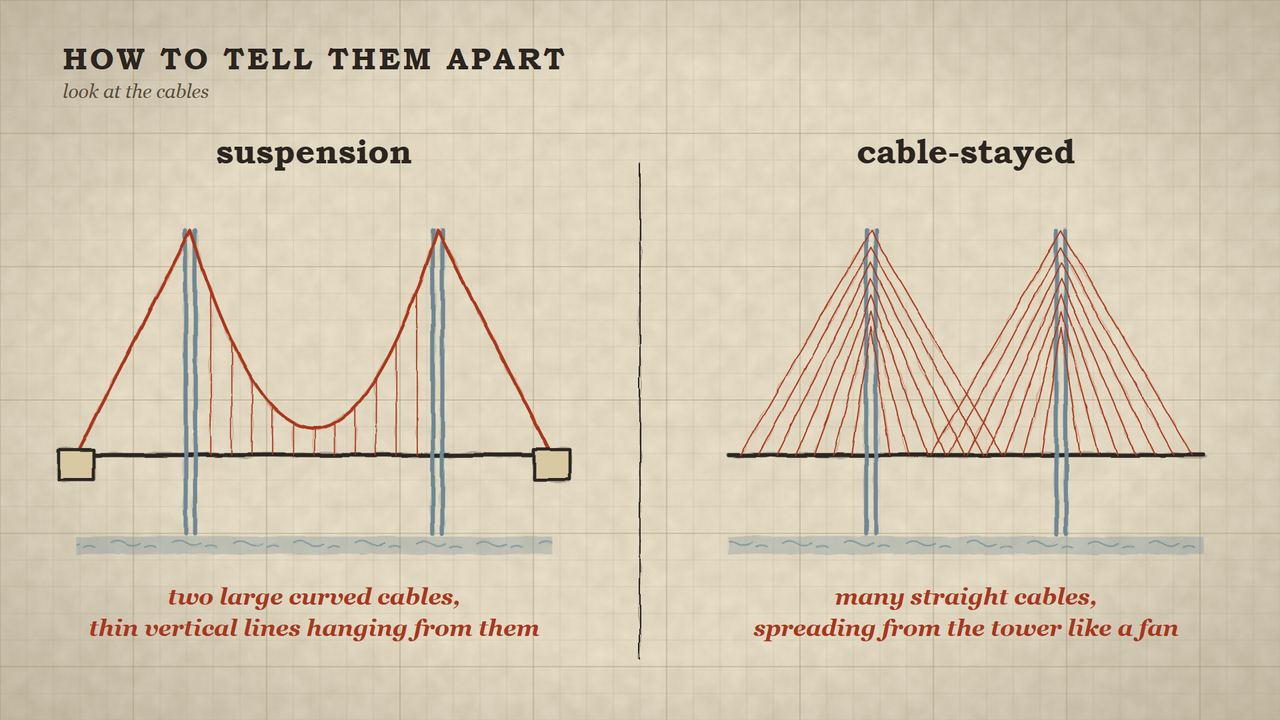
So how do you tell a suspension bridge from a cable-stayed bridge? Look at the cables. If you see two large curved cables, with thin vertical lines hanging from them, it is a suspension bridge. If you see many straight cables, spreading out from the tower like a fan, it is cable-stayed.
How engineers choose
And how does an engineer choose? Mostly by the span. For a short gap, a beam. For a few hundred metres, with good rock on both sides, an arch. For the middle range, cable-stayed. For the longest gaps, a suspension bridge. Then come the other questions. How good is the ground? How much room do ships need underneath? And how much money is there?
The records keep moving. In China, a suspension bridge with a planned span of 2,300 metres is under construction right now. But whatever the size, the question is the same one the Romans asked. Is it pushed, pulled, or bent?
This is The Bending Moment. Thank you for watching.
The Guide
How to Read Structural Drawings
One beam, B2, followed from the plan to the section, the schedule and the general notes, then decoded in the six rebar notations you will meet on real sets.
#5H1616ØT16Ø16N1661 pages · 12 exercises with answers · about 100 abbreviations · PDF
Photo credits
- Pont du Gard: Benh LIEU SONG, CC BY-SA 3.0
- Sydney Harbour Bridge: Benh LIEU SONG, CC BY-SA 4.0
- Tian'e Longtan Bridge: Glabb, CC BY-SA 3.0
- Forth Bridge: Kabelleger / David Gubler, CC BY-SA 4.0
- Human cantilever (1887): Unknown photographer for Benjamin Baker., Public domain
- Golden Gate Bridge: Frank Schulenburg, CC BY-SA 4.0
- Akashi Kaikyo Bridge: Tysto, Public domain
- 1915 Canakkale Bridge: Zafer, Public domain
- Millau Viaduct: W. Bulach, CC BY-SA 4.0
- Changtai Yangtze River Bridge: Hpppp0527, CC BY-SA 4.0
Photos from Wikimedia Commons under the licences listed. All drawings are original.
The narration uses an AI clone of the author's own voice. All drawings are original.