Why It Stands · No. 2
How Rome Moved Water 50 km With No Pumps
Roman Aqueducts Explained
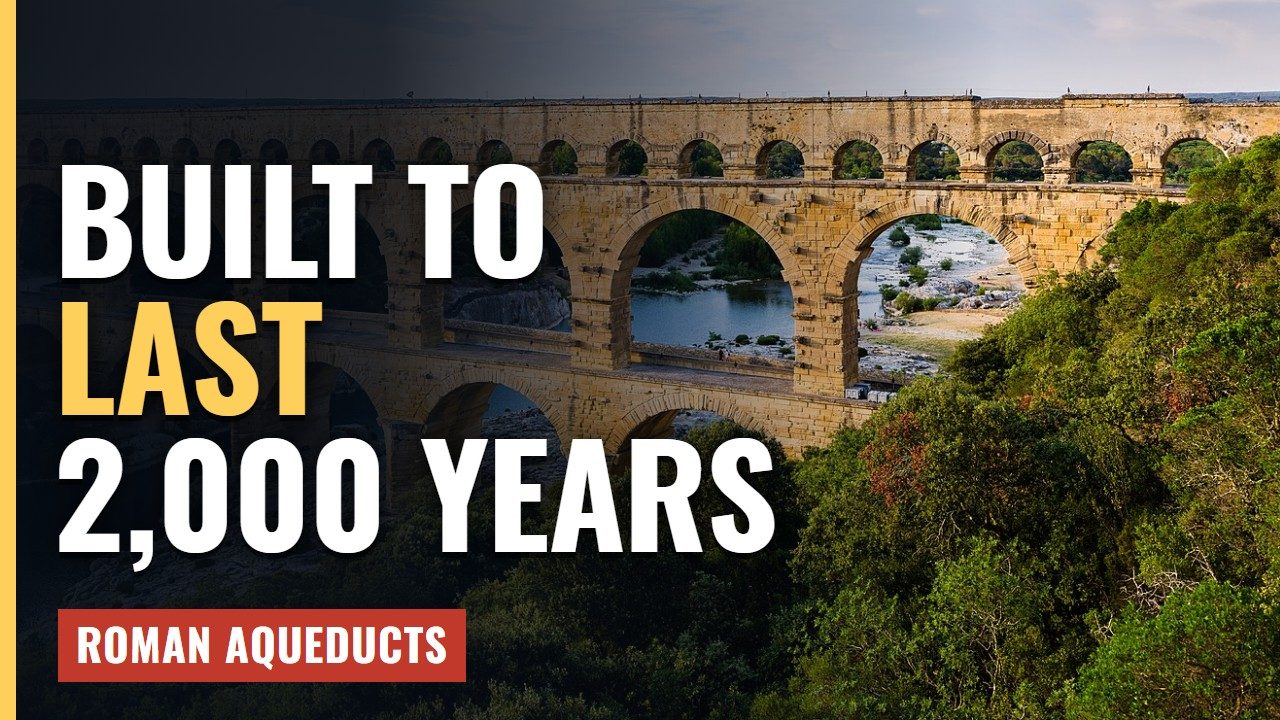
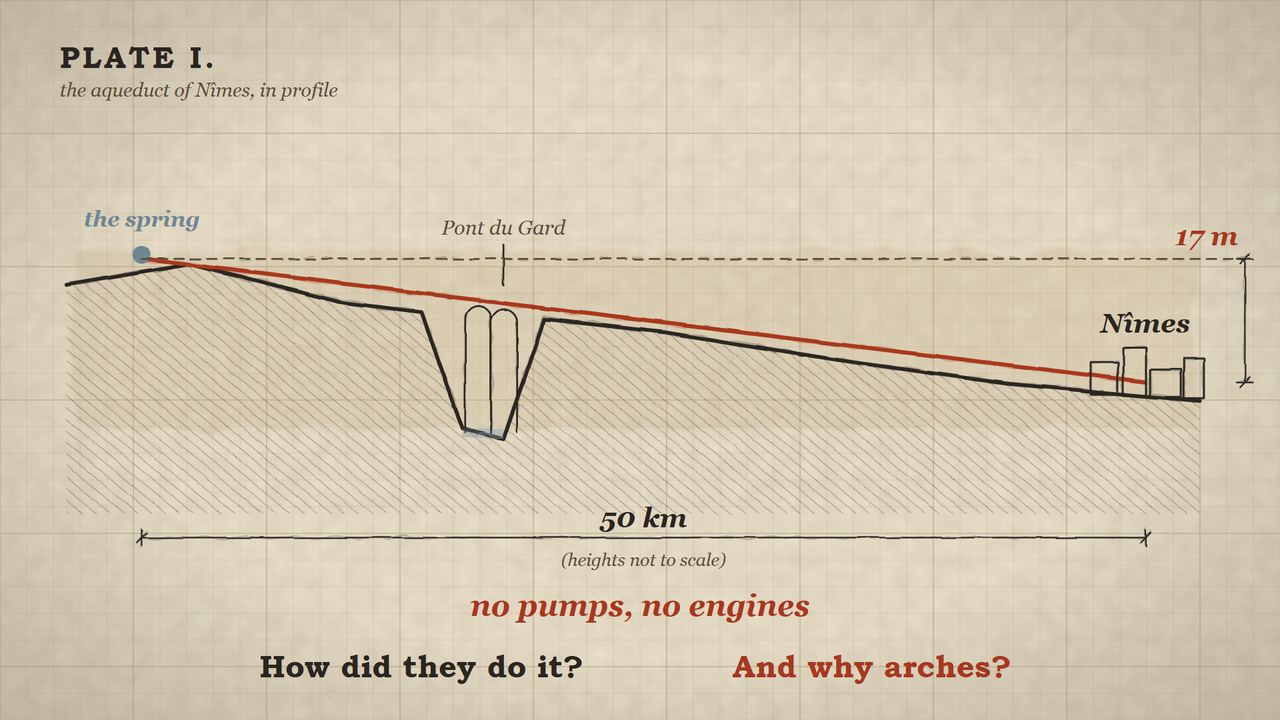
The Pont du Gard is 49 metres high and about 2,000 years old. It was built to carry a channel of water a little over one metre wide. Over 50 kilometres, that water drops by only 17 metres. No pumps, no engines.
This video explains how Roman engineers did it: the slope, the surveying, the hidden channels, and above all the arch. Why stone works in compression, why an arch pushes outward, and how you build one when it cannot stand until the last stone is in place.
The full story
Hook
In the south of France there is a bridge 49 metres high. It is built of stone blocks that weigh up to six tonnes each, with no mortar between them. It has been standing for about two thousand years. And it was not built for people, or for carts. It was built to carry a channel of water, a little over one metre wide.
This is the Pont du Gard. It is one small piece of an aqueduct 50 kilometres long. And over those 50 kilometres, the water drops by only 17 metres. There were no pumps and no engines. So how did Roman engineers do it? And why did they build it with arches?
The problem
A Roman city used a huge amount of water: for public fountains, for baths, for latrines, for workshops. Rome itself ended up with eleven aqueducts, built over more than five hundred years. Wells and rivers were not enough, and they were not clean. The clean springs were up in the hills, tens of kilometres away.
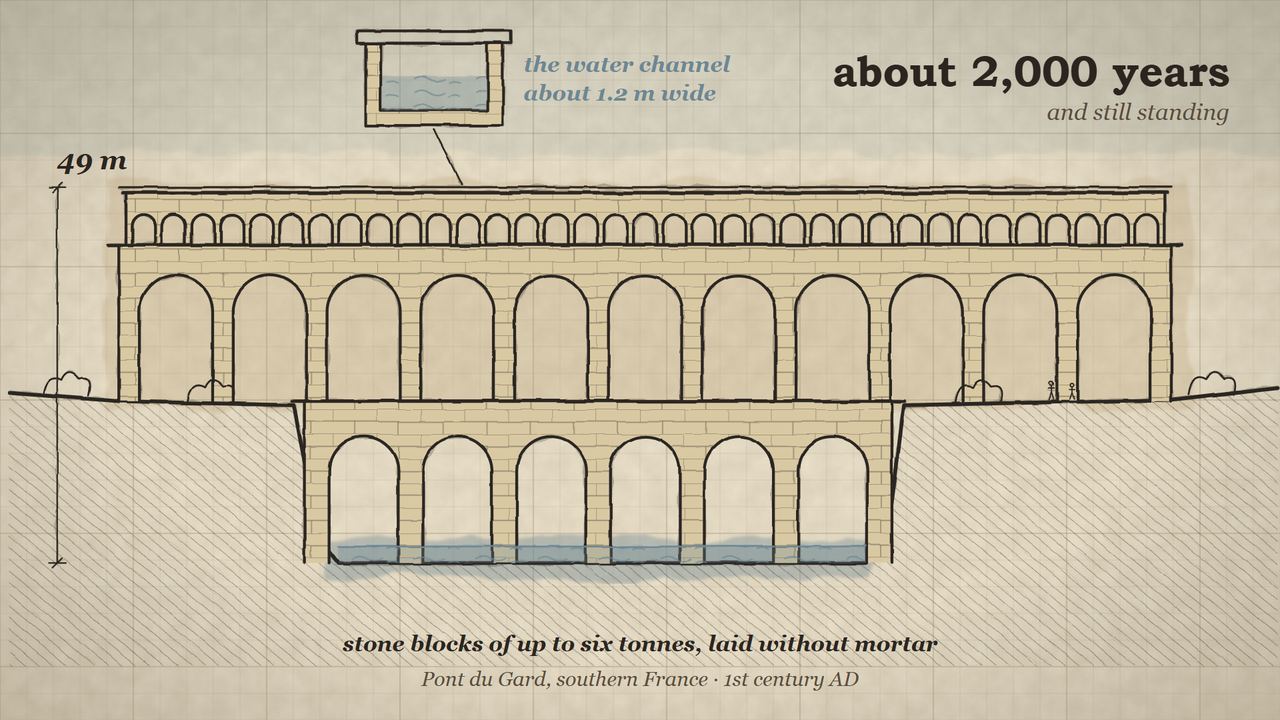
There was only one force to move that water: gravity. Water flows downhill. So the channel has to go down all the way, and never up. If it is too steep, the water runs fast and wears the channel away, and you run out of height before you reach the city. If it is too flat, the water slows down and the channel fills with dirt. So the slope must be gentle, and steady. On the aqueduct of Nîmes, the average is about 34 centimetres for every kilometre. On the Pont du Gard itself, the channel drops by about two and a half centimetres, over the whole length of the bridge.
Measuring the slope
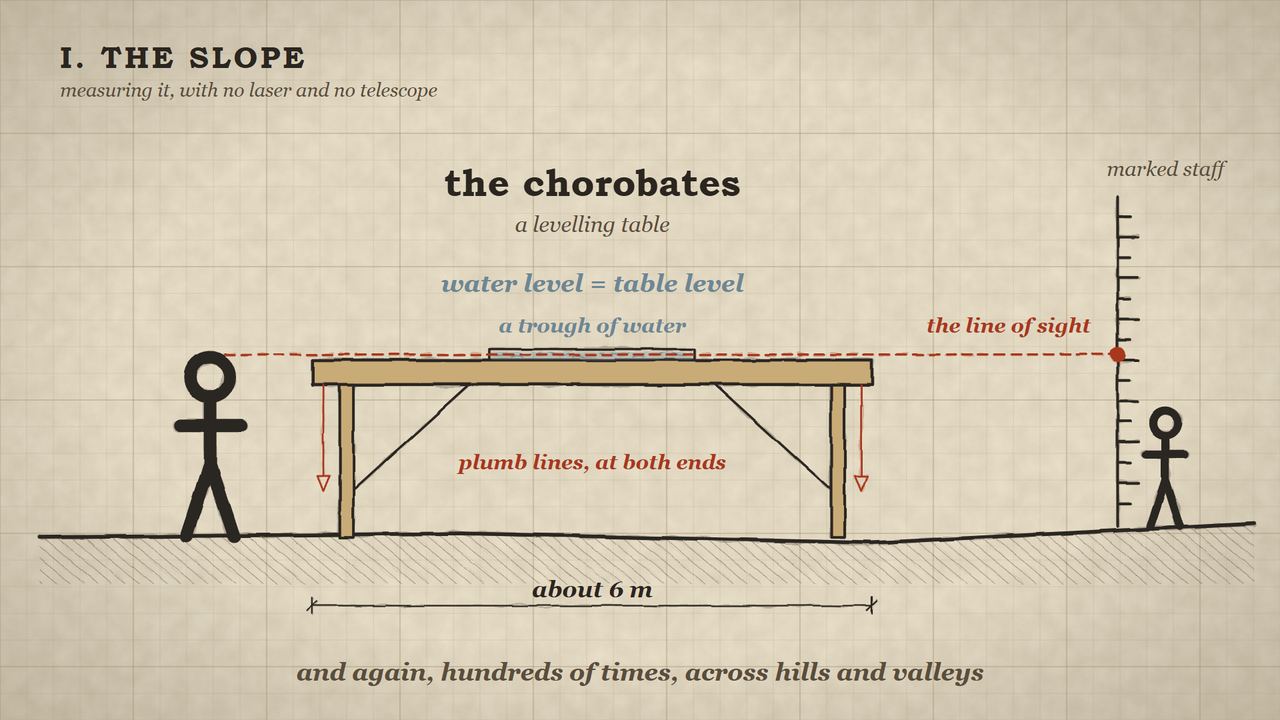
How do you set out a slope like that with no laser and no telescope? The Roman surveyor had a tool called the chorobates: a wooden table about six metres long, with plumb lines on its sides and a small trough of water on top. When the water sits level in the trough, the table is level. You look along it to a marked staff, and you write down the height. Then you move on and do it again, hundreds of times, across hills and valleys.
Mostly underground
Here is a surprise. Most of an aqueduct is not a bridge at all. Around Rome, only about one part in twenty ran on arches. The rest was a covered channel, in a trench or in a tunnel, that followed the side of the hills like a contour line on a map. It was cheaper. It was protected from heat, from dirt and from enemies. Inside, it was lined with a waterproof plaster made with crushed pottery. And every so often there was a shaft, so that workers could climb in and clean it.
But you cannot follow a hillside forever. Sooner or later you reach a valley. You can go around it, and add many kilometres. Or you can cross it. And to cross it without losing height, you have to hold the channel up in the air. This is where the arch comes in.
Why an arch
Why not just lay a long stone beam across the gap? Because of the way stone behaves. Stone is very strong when you squeeze it, and weak when you pull it. A beam across a gap bends. Its top is squeezed, but its bottom is stretched, and there the stone cracks. That is why Greek temples have their columns so close together. A stone beam can only span a few metres.
An arch changes everything. It is made of wedge-shaped stones. The load from above pushes each stone against its neighbours, and so the whole arch is squeezed. No part of it is pulled. And this is exactly what stone is good at. An arch needs no steel, and not even mortar. The weight itself locks the stones together. The largest arch of the Pont du Gard spans more than 24 metres.
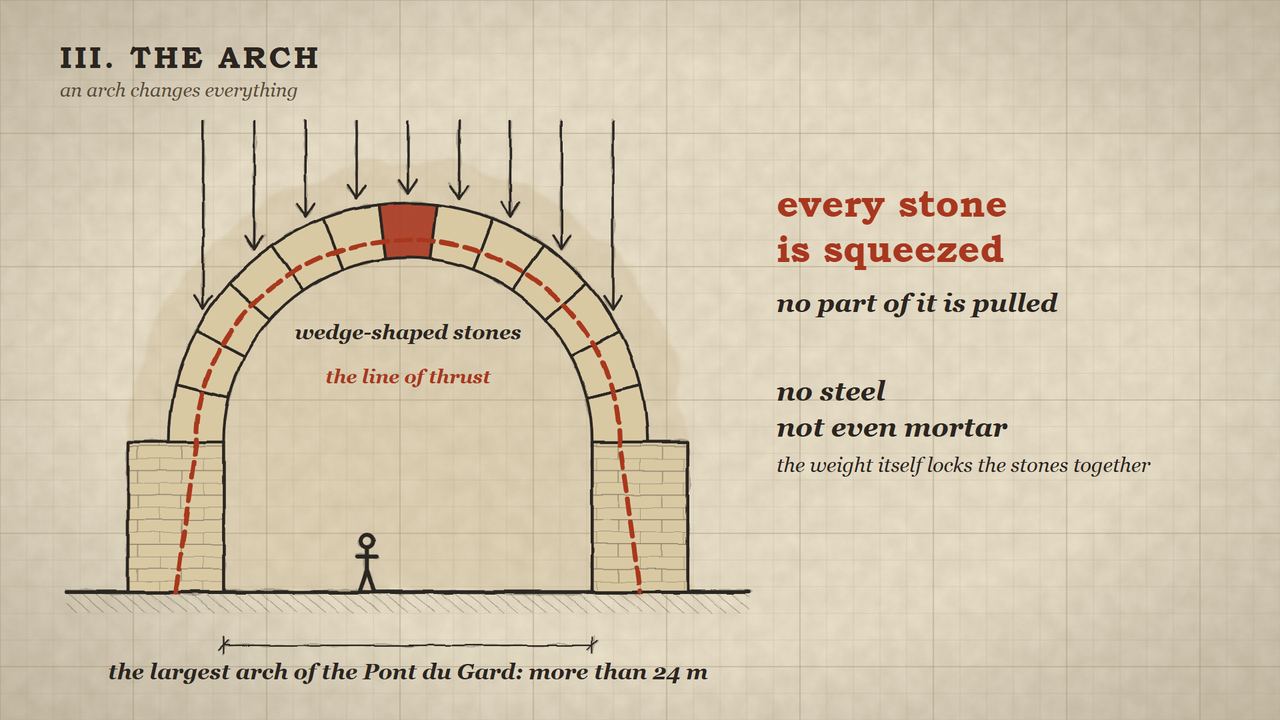
There is a price. An arch pushes outward at its feet. Engineers call this the thrust, and something has to push back. In a row of arches, each one pushes against the next, and the pushes cancel out. Only the two ends need a heavy support, or a hillside. That is why an aqueduct is a long row of equal arches, standing on heavy piers.
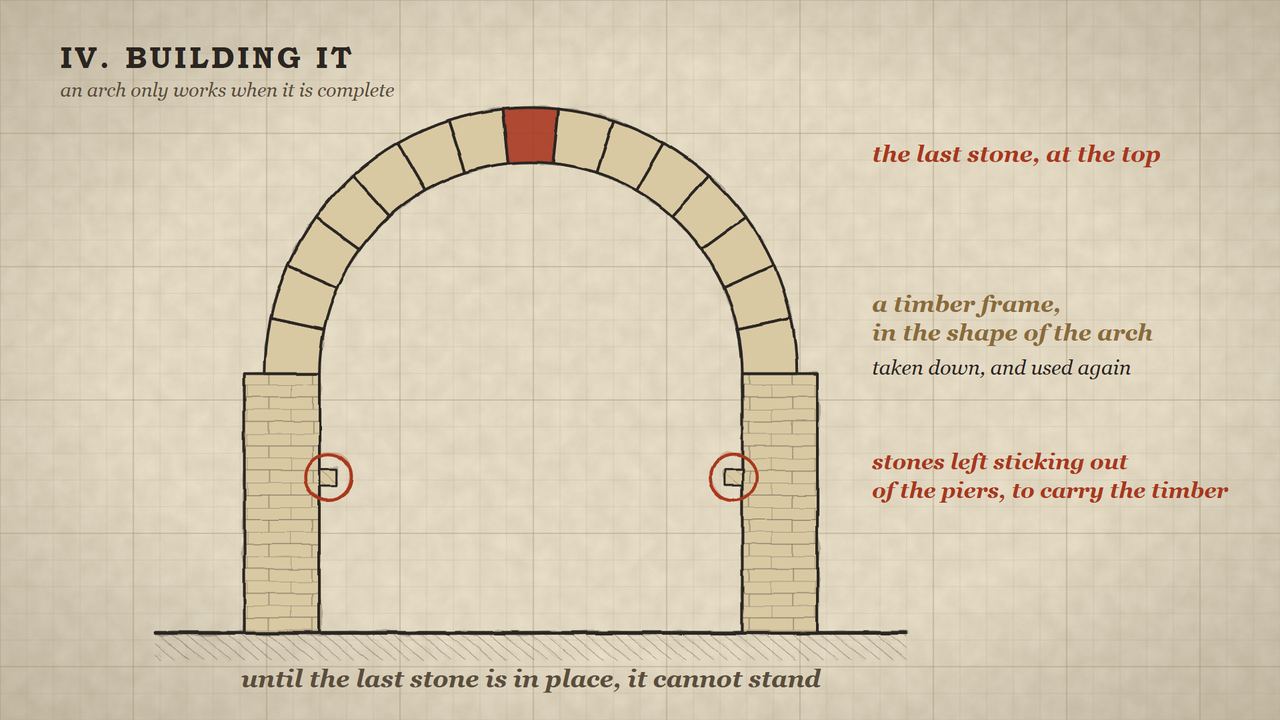
And there is a problem during construction. An arch only works when it is complete. Until the last stone at the top is in place, it cannot stand. So the Romans built a timber frame in the shape of the arch, and laid the stones on it. When the arch was closed, they took the frame down, and used it again for the next one. On the Pont du Gard you can still see stones sticking out of the piers. They were left there to carry that timber.
Deeper valleys
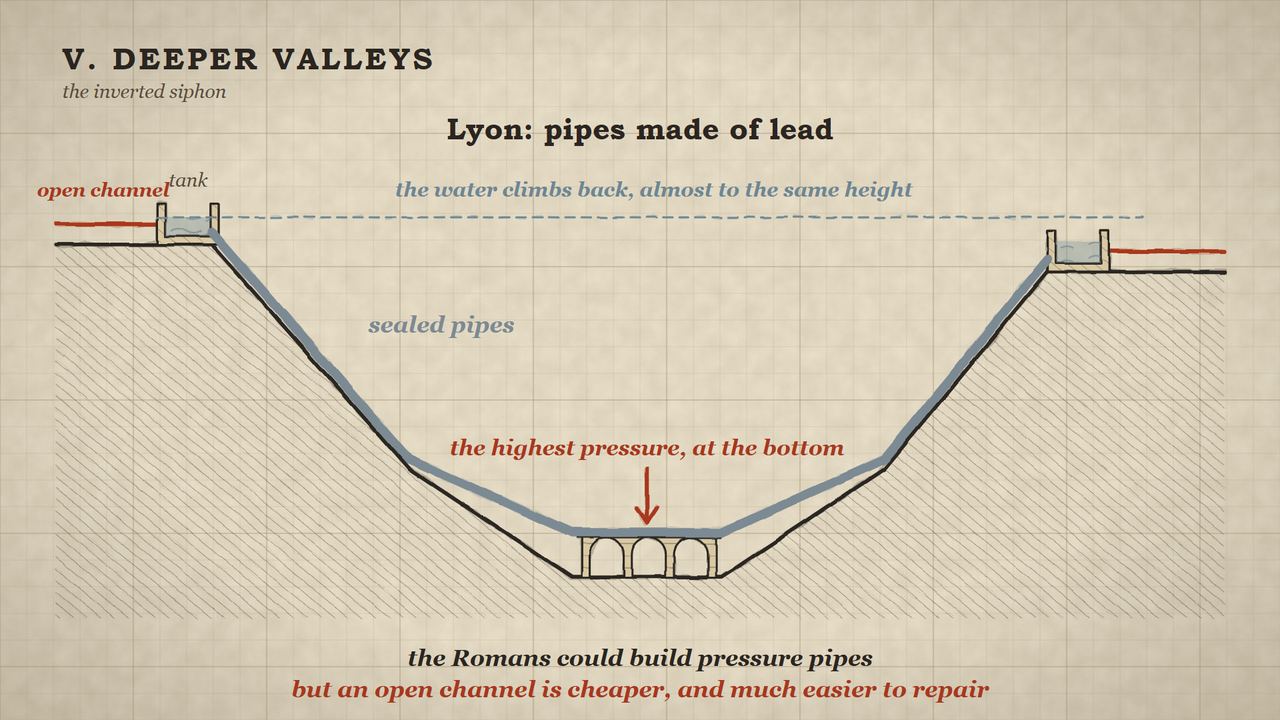
When a valley was too deep for arches, there was another way: the inverted siphon. The water entered sealed pipes, ran down one side of the valley, and climbed up the other side, pushed by its own pressure. The aqueducts of Lyon crossed valleys like this, in pipes made of lead. So the Romans knew how to build pressure pipes. They chose open channels where they could, because a channel is cheaper to build and much easier to repair.
Keeping it running
Building was only half of the work. In the year 97, a man named Frontinus was put in charge of the water of Rome, and he wrote a book about it. He measured every aqueduct. He found leaks. He found people stealing water through illegal pipes. And there was limescale: hard water leaves stone on the walls of the channel, year after year, and somebody has to cut it out.
In the end, the aqueducts did not fail because of their engineering. When the empire fell, the maintenance stopped. But some of them kept going. The aqueduct of Segovia, in Spain, built of granite blocks with no mortar, carried water into the twentieth century. And one of the aqueducts of Rome, the Aqua Virgo, was repaired again and again, and still feeds the Trevi Fountain today.
The lesson is simple. Use each material where it is strong: stone in compression. Give the load a clear path to the ground. And then look after it. Do that, and a structure can stand for two thousand years.
This is The Bending Moment. Thank you for watching.
The Guide
How to Read Structural Drawings
One beam, B2, followed from the plan to the section, the schedule and the general notes, then decoded in the six rebar notations you will meet on real sets.
#5H1616ØT16Ø16N1661 pages · 12 exercises with answers · about 100 abbreviations · PDF
Sources
- Frontinus, De aquaeductu urbis Romae (AD 97)
- Vitruvius, De architectura, Book 8
- Site du Pont du Gard (pontdugard.fr)
The narration uses an AI clone of the author's own voice. All drawings are original.