What Does EW Mean on Structural Drawings?
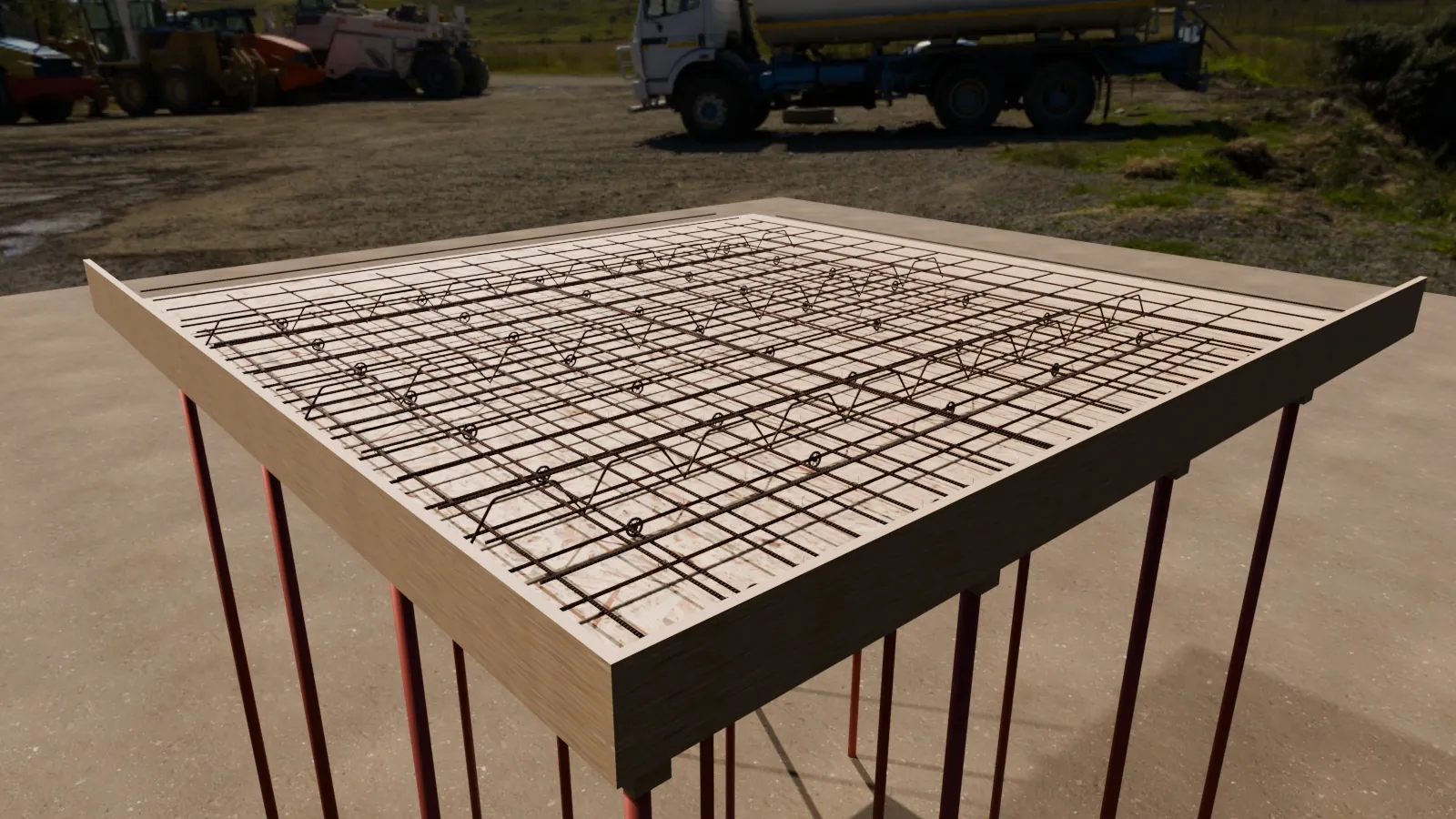
EW means each way. A callout like #4 @ 12" EW tells you that the same bar size at the same spacing runs in both directions, so the bars form a grid: one set running the long way and one set running the short way.
Where you see EW on a drawing
On the drawing you will see EW on anything that spans or spreads load in two directions:
- Slabs on grade:
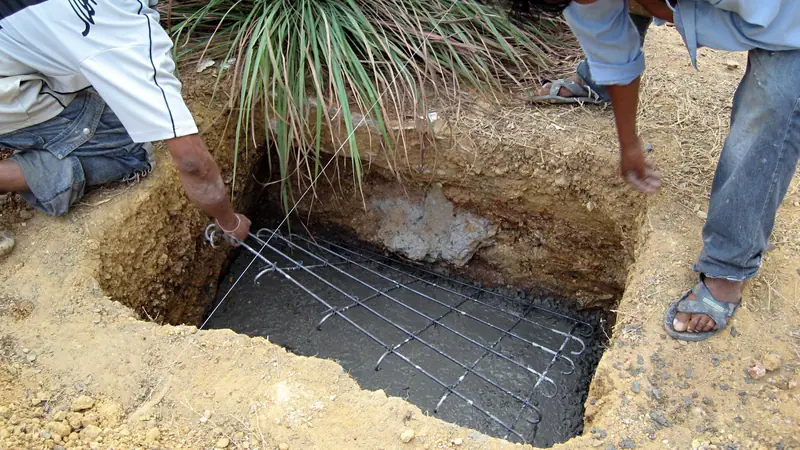
#4 @ 18" EW - Spread footings:
(7) #5 EWor#5 @ 12" EW BOTT - Two-way slabs and mats:
#5 @ 12" EW T&B - Walls:
#4 @ 12" EW(here "each way" means verticals and horizontals)
When the two directions need different steel, the designer drops EW and writes each direction, for example #5 @ 10" LONG WAY, #4 @ 12" SHORT WAY. More on two-way behaviour in one-way vs two-way slabs.
What EW changes in a takeoff
EW gives you two sets of bars to count, and they are not the same count. Bars running the long way are spread across the short side, and bars running the short way are spread across the long side.
Worked example
A slab on grade is 24 ft x 40 ft with #4 @ 12" EW. Ignore cover and laps to keep it simple.
| Set | Bar length | Spread over | Number of bars | Total length |
|---|---|---|---|---|
| Long way | 40 ft | 24 ft | 24 / 1 + 1 = 25 | 25 x 40 = 1,000 ft |
| Short way | 24 ft | 40 ft | 40 / 1 + 1 = 41 | 41 x 24 = 984 ft |
| Total | 66 bars | 1,984 ft |
At 0.668 lb/ft for #4, that is about 1,325 lb before laps and waste. The 40 ft and 24 ft bars are longer than a 20 ft stock bar, so a real takeoff also adds lap splices; see how to estimate rebar for a slab.
For a square footing, EW is quicker: a 6 ft x 6 ft footing with (7) #5 EW has 7 bars each way, 14 bars in total.
A common mistake
The most common mistake is reading EW as "each face" and doubling a slab that has one mat. A slab on grade with #4 @ 18" EW normally has a single layer, a grid at one level. EW is about directions; EF (each face) and T&B (top and bottom) are about layers. See what EF means and what T&B means.
| Callout | Directions | Layers | Sets of bars |
|---|---|---|---|
#4 @ 12" EW |
2 | 1 | 2 |
#5 @ 12" EF (wall verticals) |
1 | 2 | 2 |
#5 @ 12" EW T&B |
2 | 2 | 4 |
#5 @ 12" EW EF (wall) |
2 | 2 | 4 |
The other mistake is using the same bar count for both directions on a rectangular element. Only a square gives the same count each way.
Frequently asked questions
Does EW mean double the rebar?
It means two sets of bars, one in each direction. On a square slab or footing that is twice the count of one direction. On a rectangle the two counts differ, so work out each set separately.
What does EWB or EW BOTT mean?
Each way, bottom: a grid of bars in both directions at the bottom of the element only. It is common on spread footings, where the tension is at the bottom.
Is EW the same as B.W. or BOTH WAYS?
Yes. Some sets write BW or BOTH WAYS instead of EW. The abbreviation list on the general notes sheet confirms which the project uses.
This article explains general practice for learning purposes. On a real project, the drawings, the general notes and the governing code always win.