What Does EF Mean on Structural Drawings?
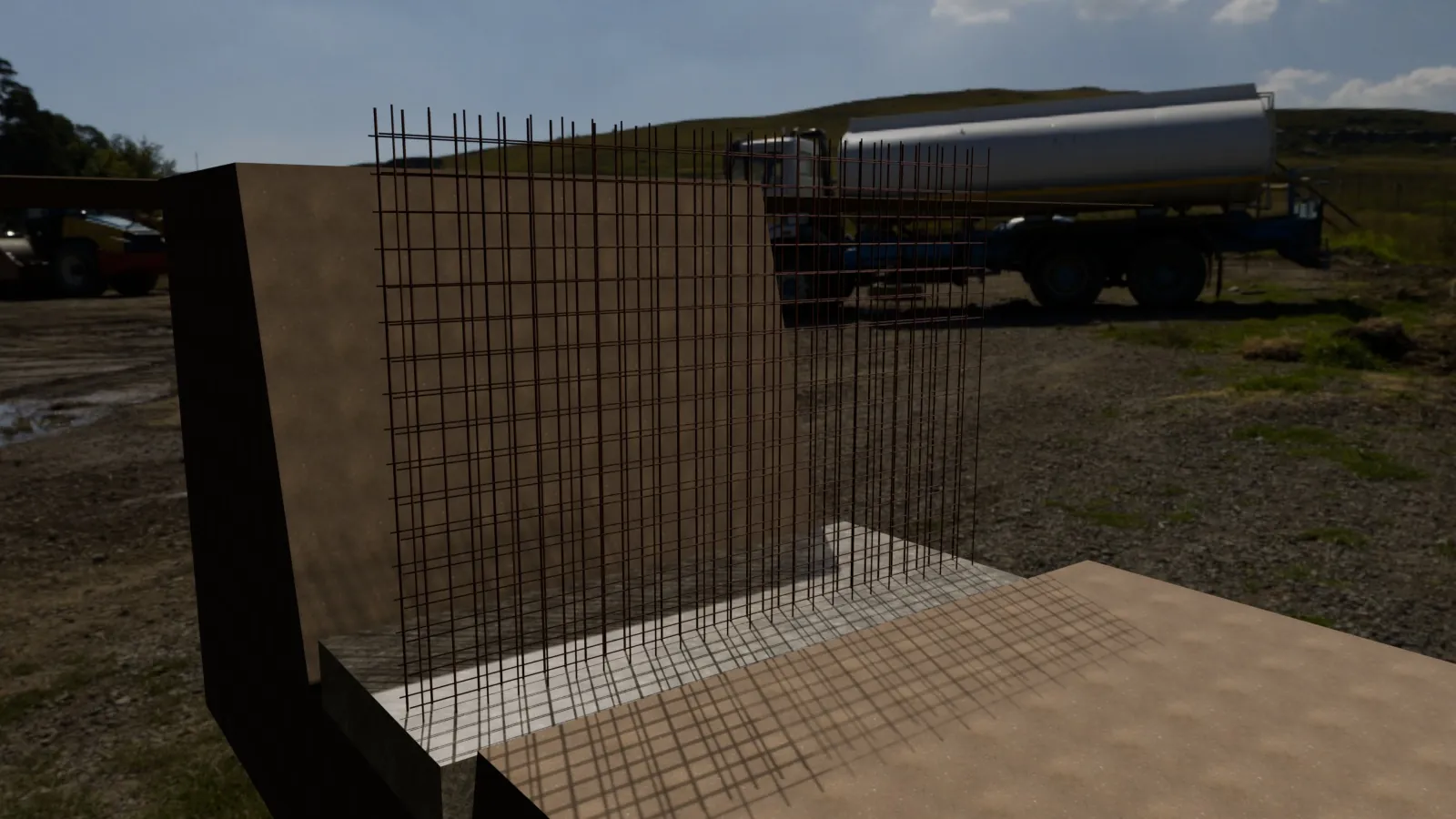
EF means each face. A callout like #5 @ 12" EF tells you that the same bars at the same spacing are placed at both faces of the element, so there are two layers of steel, one near each surface.
Where you see EF on a drawing
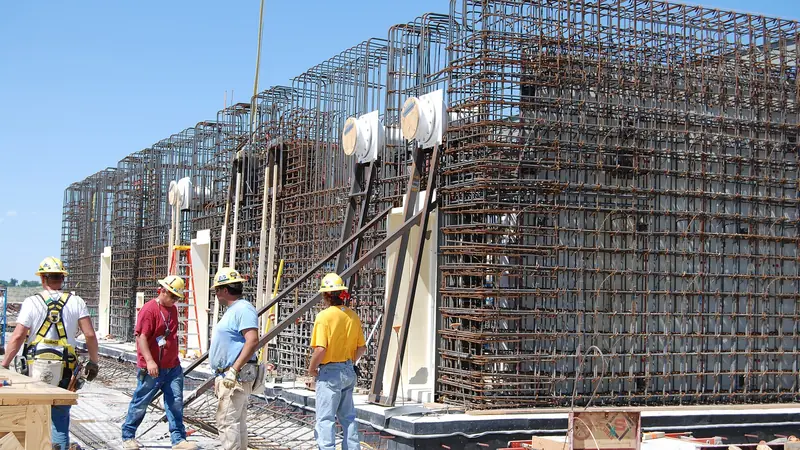
On the drawing you will see EF mostly on walls: basement walls, retaining walls, shear walls, elevator pit walls and thick foundation walls. A wall has two faces (inside and outside), and a thicker wall usually gets a layer of reinforcement near each one.
Typical wall callouts look like this:
#5 @ 12" VERT EF#4 @ 16" HORIZ EF#5 @ 12" EW EF(each way, each face: verticals and horizontals, at both faces)
EF also shows up on thick slabs, mats, pile caps and grade beams, where it means the same as "top and bottom" for a horizontal element, though many designers write T&B for those. See what T&B means.
What EF changes in a takeoff
EF doubles the bars for that callout. You count the bars for one face, then multiply by two.
Worked example
A basement wall is 30 ft long and 9 ft high, with #5 @ 12" VERT EF and #4 @ 12" HORIZ EF. We ignore laps, dowels and corner bars here to keep the arithmetic clear.
| Step | Verticals #5 | Horizontals #4 |
|---|---|---|
| Distance the bars are spread over | 30 ft | 9 ft |
| Bars per face (distance / spacing + 1) | 30 + 1 = 31 | 9 + 1 = 10 |
| Faces (EF) | x 2 = 62 bars | x 2 = 20 bars |
| Length of each bar | 9 ft | 30 ft |
| Total length | 558 ft | 600 ft |
| Weight (#5 1.043, #4 0.668 lb/ft) | about 582 lb | about 401 lb |
Without the EF, the wall would have come out at roughly half its real weight. Wall takeoffs are covered in full in how to estimate rebar for walls.
A common mistake
The classic mistake is reading #5 @ 12" EF as one layer of bars and missing half the steel. The opposite also happens: a callout of #5 @ 12" EW on a thin wall is read as "each face" and doubled when the wall has a single centered layer. EW and EF are different words: EW is about directions, EF is about faces. Check the wall section, which shows how many layers are really there, and see what EW means.
Watch also for callouts that differ by face, such as #5 @ 12" OUTSIDE FACE, #4 @ 12" INSIDE FACE. That is not EF, and each face is counted with its own bar size.
Frequently asked questions
Does EF mean the bars are doubled?
Yes, in the sense that the callout is repeated at both faces. The bar size and spacing stay the same, and the count for that callout is twice the count for one face.
What is the difference between EF and EW?
EF (each face) puts the bars at both surfaces of the element. EW (each way) puts the bars in both directions within a layer. EW EF means both: two directions at each of two faces, so four sets of bars.
Is EF used on slabs?
Sometimes, on thick slabs, mats and pile caps. On most slabs the same idea is written as T&B (top and bottom).
This article explains general practice for learning purposes. On a real project, the drawings, the general notes and the governing code always win.