Rebar Tie Wire and Tying: Gauges, Tie Types and How Estimators Carry It
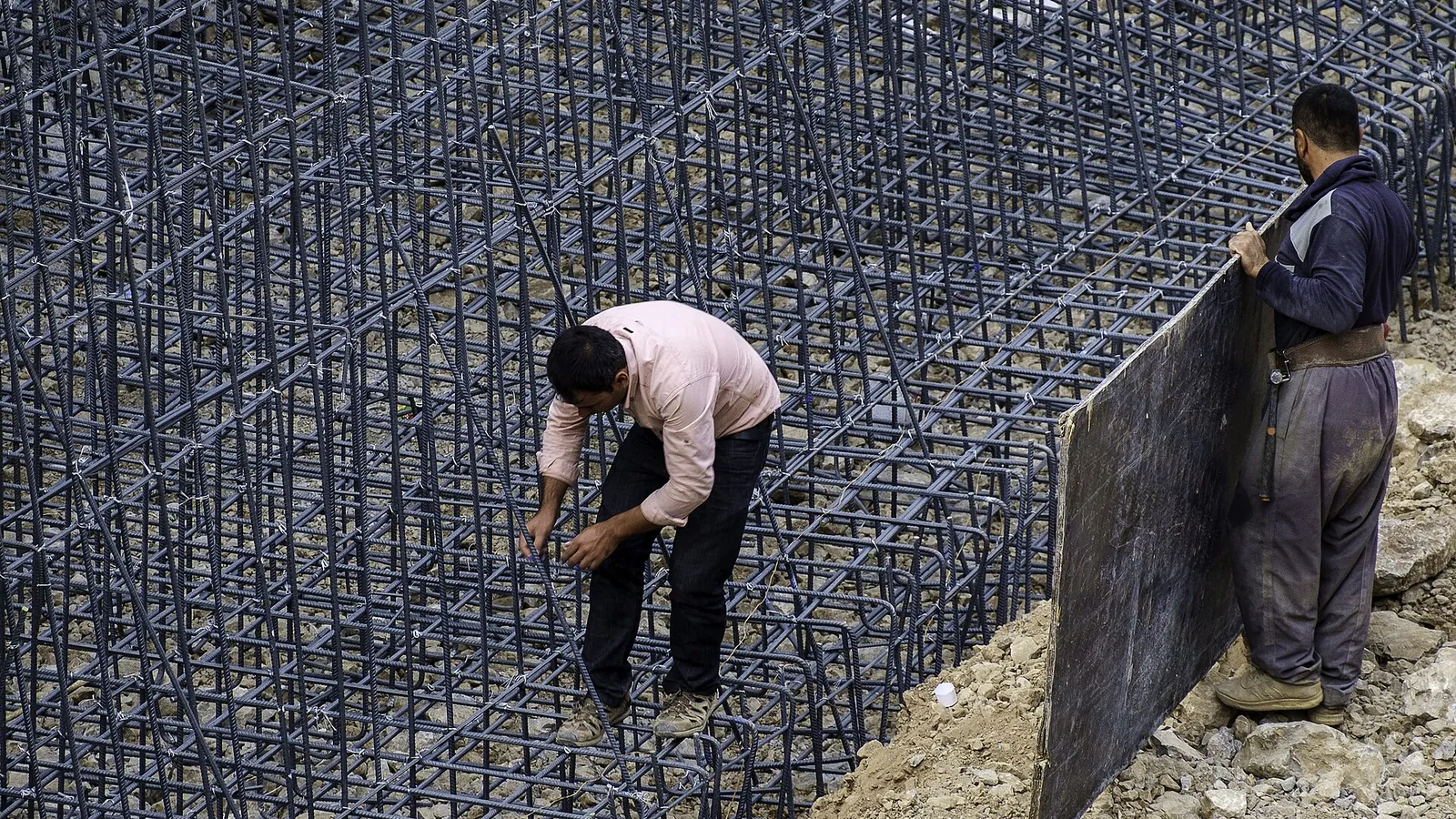
Rebar tie wire is soft steel wire used to hold reinforcing bars together at their intersections until the concrete is placed. The most common product is 16 gauge black annealed wire, sold in coils or as pre-cut loop ties, and ironworkers tie it in a few standard patterns: the snap tie, the wrap and snap, the saddle tie and the figure-eight. Tie wire has no structural role in the finished member; its job is to keep every bar where the drawings put it.
What tie wire does (and does not do)
Rebar is placed loose: bars are laid on chairs, lapped, and crossed in mats or cages. Concrete placement is rough on that assembly. Workers walk on the mat, the pump hose drags across it, and the vibrator shakes it. Tie wire holds the bars so the spacing, cover and lap positions survive all of that.
The engineer does not count on tie wire for strength. A tied intersection is not a splice and does not transfer force between bars. That is why tie wire rarely appears on the structural drawings, and why the rules for it come from the specification and from placing standards rather than from the design.
Tie wire gauge and types
Gauge
Wire gauge numbers run backwards: a smaller number is a thicker wire. For rebar the common choices are:
| Wire | Typical use |
|---|---|
| 16 gauge black annealed | The general-purpose tie wire for most rebar work |
| 16.5 gauge | A slightly lighter wire, also sold as standard rebar tie wire |
| Heavier gauges | Where the specification or the foreman calls for a stronger tie |
"Black annealed" means the wire has been heat treated to make it soft, so it bends and twists by hand without springing back, and it is left uncoated. Sizes and weights per coil vary by supplier, so read the label of the product you price rather than assuming a footage.
Coils, reels and pre-cut ties
Tie wire comes in three common forms:
- Coils that the ironworker carries on a reel at the belt and cuts to length with pliers.
- Pre-cut loop ties (bar ties), short lengths with a loop at each end, twisted with a hook-shaped twister tool. They are sold by length and by count, such as packs of 1,000.
- Spools for battery tying tools, which wrap and twist the wire automatically. Each tool takes its own wire, so the wire is bought to match the tool.
Coated and special wire
The tie wire has to suit the bar. Epoxy-coated bars are usually tied with coated wire (plastic, nylon or epoxy coated) so the wire does not damage the coating and does not create a spot of bare steel touching the bar. Stainless steel bars are often tied with stainless wire, and galvanized bars with compatible wire. The specification sets this, and it is a line item worth catching, because coated wire costs more than black wire. See coated rebar types for the bars themselves.
The common tie types
Placing references describe a small family of ties. The names below are the ones used on most sites.
| Tie | How it is made | Where it is typically used |
|---|---|---|
| Snap tie (single tie) | Wire passed diagonally around the intersection, twisted and snapped off | Slab mats and flat work: the fastest tie |
| Wrap and snap | A snap tie with an extra wrap around one bar | Walls and vertical bars, to stop bars sliding |
| Saddle tie | Wire passes around one bar on each side of the crossing bar, ends brought over and twisted | Where bars must not shift, such as mats that take traffic |
| Saddle tie with twist | A saddle tie with an extra twist around the bar | Heavier mats and cages |
| Figure-eight (cross tie) | Wire wraps both diagonals of the intersection | Cages and mats that will be lifted or handled |
The choice is the foreman's within whatever the specification requires. For the estimator, the type mostly affects labor, since heavier ties take longer, and it affects wire use a little.
How many intersections get tied
Not every crossing is always tied. The specification or the placing standard the job follows sets the pattern, which can depend on the member, the bar size and whether the mat will be walked on or lifted. Read the specification section for reinforcement before you count anything; do not assume a pattern from another job.
How estimators carry rebar tie wire
Tie wire is a small cost next to the bars, but it is real material and real labor, and it is easy to forget. Estimators handle it in one of three ways:
- Inside the placing price. If the rebar is placed by a subcontractor, tie wire is often part of their scope. Check the quote: "furnish and install" or "install only, wire by others."
- As an allowance from company history. Many companies carry tie wire as a ratio to the tonnage of rebar, based on their own past jobs. That ratio is company data. There is no universal number, and a figure copied from somewhere else can be far off for your crews and your type of work.
- Counted from intersections. On small jobs, or to sanity-check an allowance, you can count ties directly. The worked example below shows the method.
Whichever way you choose, write the basis into the estimate, so a reviewer knows whether wire is in, out, or by others. The rebar takeoff checklist is a good place to keep that line.
Worked example: counting ties in a slab mat
A slab-on-grade is 30 ft x 40 ft, reinforced with #4 at 12 in on center each way, with 3 in edge cover. The tying pattern and wire length below are example assumptions only; use the job specification and your own company data.
Step 1: bars each way. The method is in rebar spacing.
- Bars running the 40 ft way, spaced across 30 ft: (360 - 2 x 3) / 12 + 1 = 29.5 + 1 = 30.5, round up to 31 bars.
- Bars running the 30 ft way, spaced across 40 ft: (480 - 2 x 3) / 12 + 1 = 39.5 + 1 = 40.5, round up to 41 bars.
Step 2: intersections. 31 x 41 = 1,271.
Step 3: perimeter intersections. The outer bars carry 41 + 41 + 31 + 31 = 144 intersections, minus the 4 corners counted twice: 140.
Step 4: apply an example pattern. Suppose the spec asks for every perimeter intersection and every other interior intersection.
- Interior intersections: 1,271 - 140 = 1,131
- Every other: 1,131 / 2 = 565.5, round up to 566
- Total ties: 140 + 566 = 706
Step 5: material. If the crew uses pre-cut ties, 706 ties fit in one pack of 1,000 with room for losses. If they use coil wire, assume (as an example) 12 in of wire per snap tie: 706 x 1 ft = 706 ft. Divide that by the footage printed on the coil you buy, and add your normal loss allowance.
The slab itself, bars and laps, is covered in rebar estimate for a slab. The point of the tie count is not precision: it is to show whether a tonnage-based allowance is in the right range for this kind of mat.
Tying, chairs and inspection
Ties hold bars to each other. Chairs, bolsters and spacers hold the mat at the right height. Both are needed; tight ties on a mat sitting on the ground do not give you bottom cover. The rebar chairs and accessories article covers the supports.
Two details inspectors look at:
- Wire ends. Twisted ends should be bent in, away from the forms. A wire tail touching the form face can leave a rust path to the surface, which matters most in exposed and architectural concrete.
- Coated work. On epoxy-coated bars, look for black wire mixed in with the coated wire, and for coating damage at the ties.
Frequently asked questions
What gauge wire is used to tie rebar?
The most common is 16 gauge black annealed wire. Slightly lighter 16.5 gauge wire is also sold for the same work, and heavier wire is used where the specification calls for it. The project specification can require a specific gauge or coating.
What is the strongest way to tie rebar?
Ties that wrap more of the bar, such as the saddle tie with twist and the figure-eight, hold better than a simple snap tie and are used for cages and mats that will be lifted or walked on. They also take longer to make. The specification and the foreman choose the tie for the situation.
Do you have to tie every rebar intersection?
Not always. The specification or the placing standard the job follows sets how many intersections are tied, and it varies with the member and the job. Read the reinforcement section of the specification before you count ties or price labor.
Is tie wire included in a rebar estimate?
It should be, either as material in your own price, as part of a placing subcontractor's scope, or as an allowance. Many estimators carry it as a ratio to rebar tonnage based on their company's past jobs. State which approach you used so nothing is double counted or missed.
Can you use regular tie wire on epoxy-coated rebar?
Specifications usually require coated tie wire for epoxy-coated bars, to protect the coating and avoid bare steel contact. Check the specification section for coated reinforcement before pricing.
This article explains general practice for learning purposes. On a real project, the drawings, the general notes and the governing code always win.