Why It Stands · No. 20
Domes
How They Stand, and How They Were Built
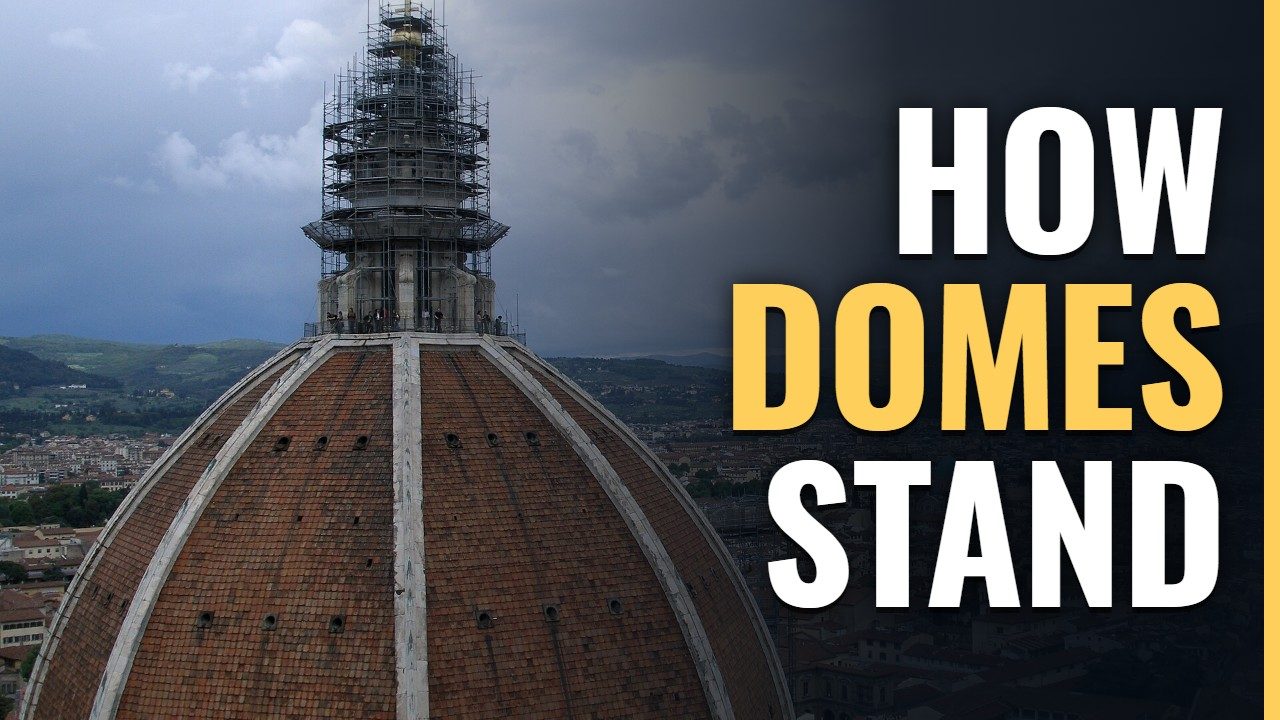 Video coming soon. Full article below
For two thousand years, the largest covered spaces on Earth were under domes. Why does this shape work so well?
A dome is an arch in every direction at once. This video explains the rings that let it stand even when it is unfinished, the first corbelled domes, the Pantheon, the two families of force inside a dome, why old domes crack like an orange, how the base is held together, and how Brunelleschi built his dome in Florence with no formwork.
The full story
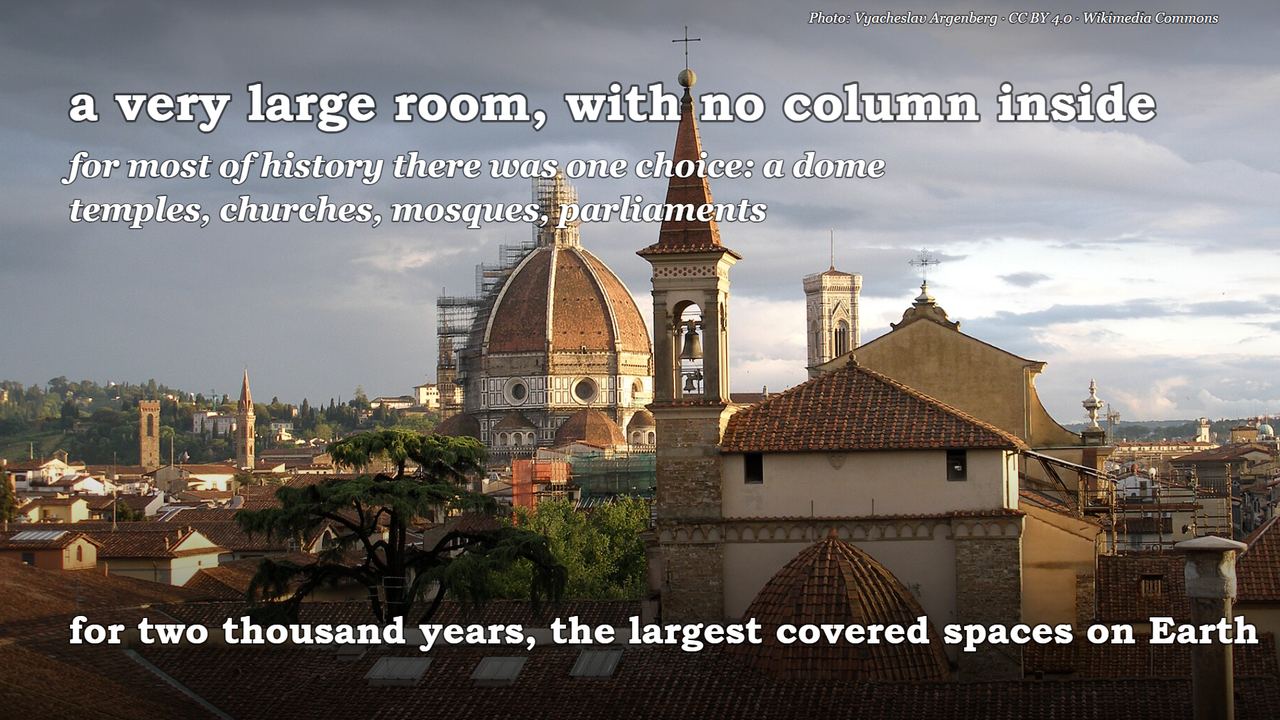
For most of history, if you wanted to cover a very large room without a single column inside it, you had one choice: a dome. Temples, churches, mosques, parliaments. For two thousand years, the largest covered spaces on Earth were under domes. Why does this shape work so well?
Start with an arch. An arch carries its load by squeezing: every stone pushes on the next one, all the way down to the ground. Now turn that arch around its centre, a full circle. You get a dome. A dome is an arch in every direction at once.
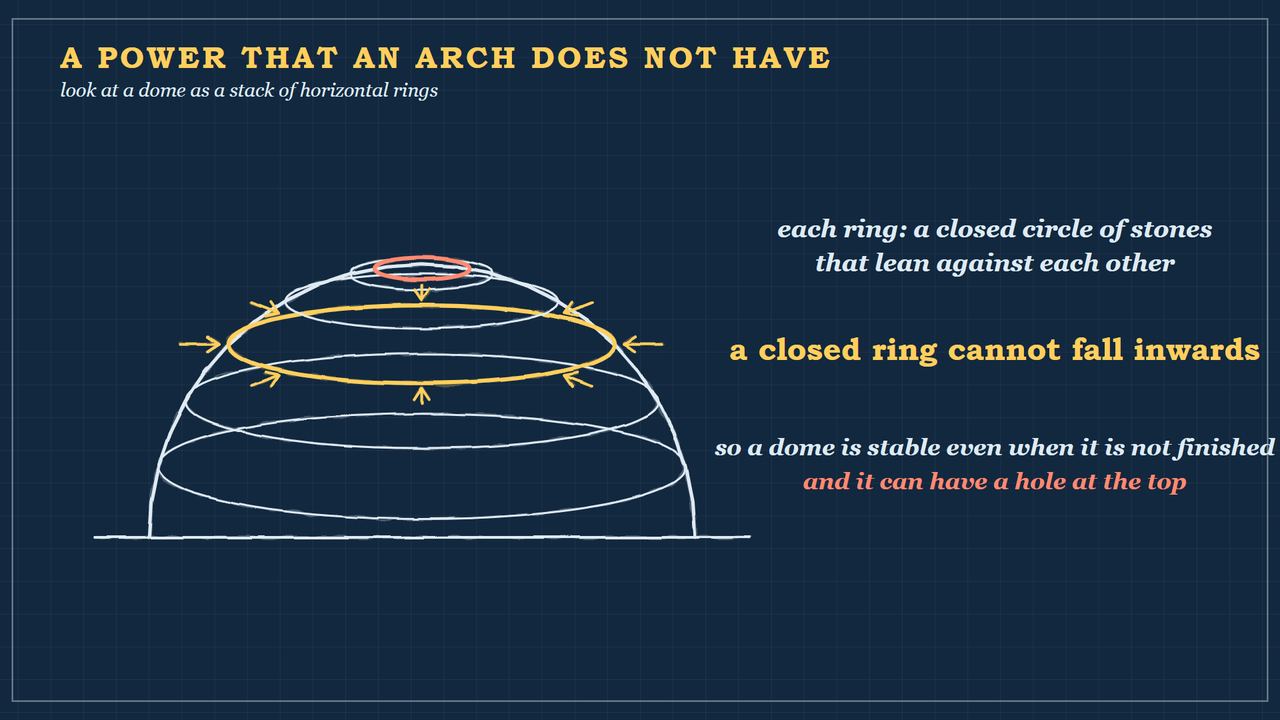
And that gives it a power that an arch does not have. Look at a dome as a stack of horizontal rings. Each ring is a closed circle of stones that lean against each other. A closed ring cannot fall inwards. So a dome can be stable even when it is not finished, and it can even have a hole at the top. An arch falls if you take out one stone. A dome does not.
The first domes were not true domes. More than three thousand years ago, in Greece, builders made round tombs of stone. Each ring of stones stepped a little further in than the one below it, until they met at the top. It works, but it needs very heavy walls, and it cannot be very wide.
The Romans made the jump. With concrete, they could pour a dome as one piece. The dome of the Pantheon, from the second century, is 43 metres across, with an open eye of nine metres at the top. For more than a thousand years, nothing larger was built.
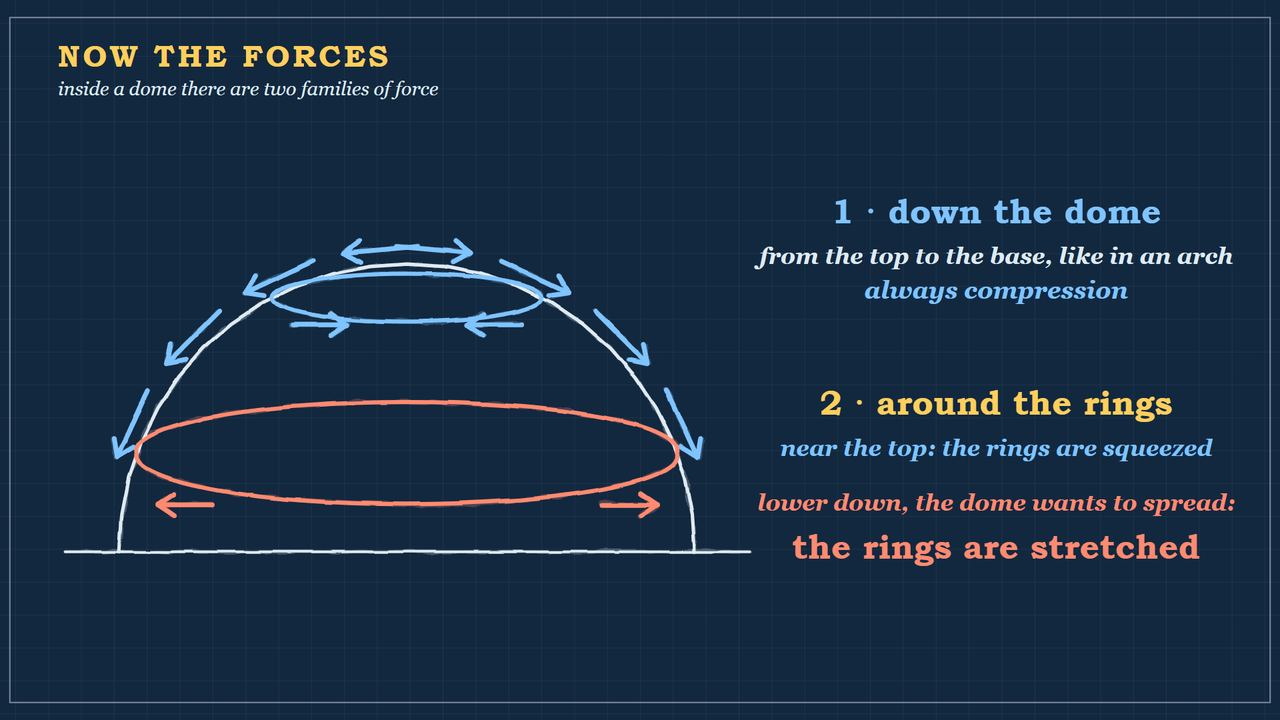
Now the forces. Inside a dome, there are two families of force. The first runs down the dome, from the top to the base, like in an arch. It is always compression. The second runs around the dome, along the rings. Near the top, the rings are squeezed. But lower down, something changes. The dome wants to spread outwards, and the rings are stretched.
And stone, brick and plain concrete cannot take stretching. So the lower part of a masonry dome cracks, along lines that run down from the top, like the cuts between the pieces of an orange. Almost every old dome has these cracks. The dome then stands as a ring of arches that lean against each other, and pushes outwards on whatever is under it.
So the real problem of a dome is at its base: the outward push. There are two classic answers. The first is weight. Make the walls under the dome thick and heavy, as the Romans did. The second is a tie. Put a ring around the base of the dome, a chain of iron or timber, that holds it together like the hoop of a barrel.
How do you build one? The classic way is to build a wooden form first, a complete dome of timber, and to lay the stone or pour the concrete on top of it. That works, but for a very large dome the timber itself becomes an enormous structure.
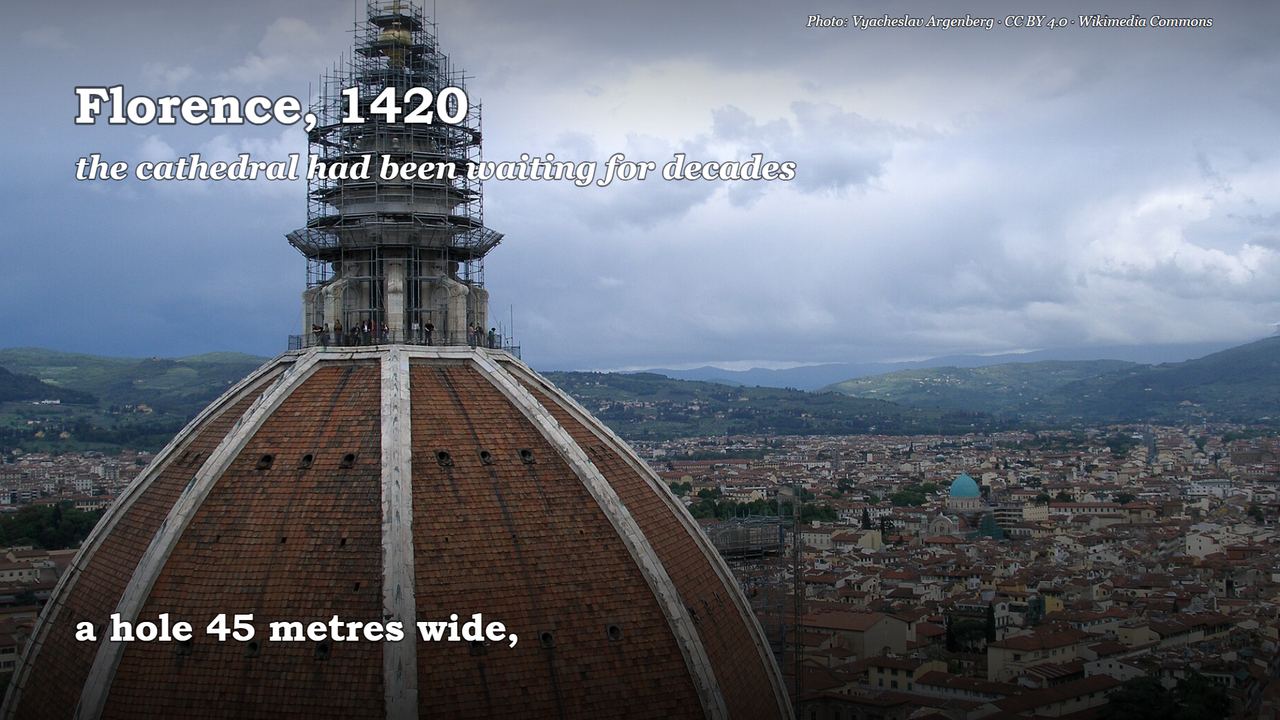
In Florence, in 1420, the cathedral had been waiting for decades with a hole 45 metres wide, and nobody knew how to cover it. Filippo Brunelleschi did it without any form at all. He built two shells, one inside the other, laid the bricks in a pattern that locked each ring before the next one, and tied the dome with chains of stone and timber. Each ring held itself up. It is still the largest brick dome in the world.
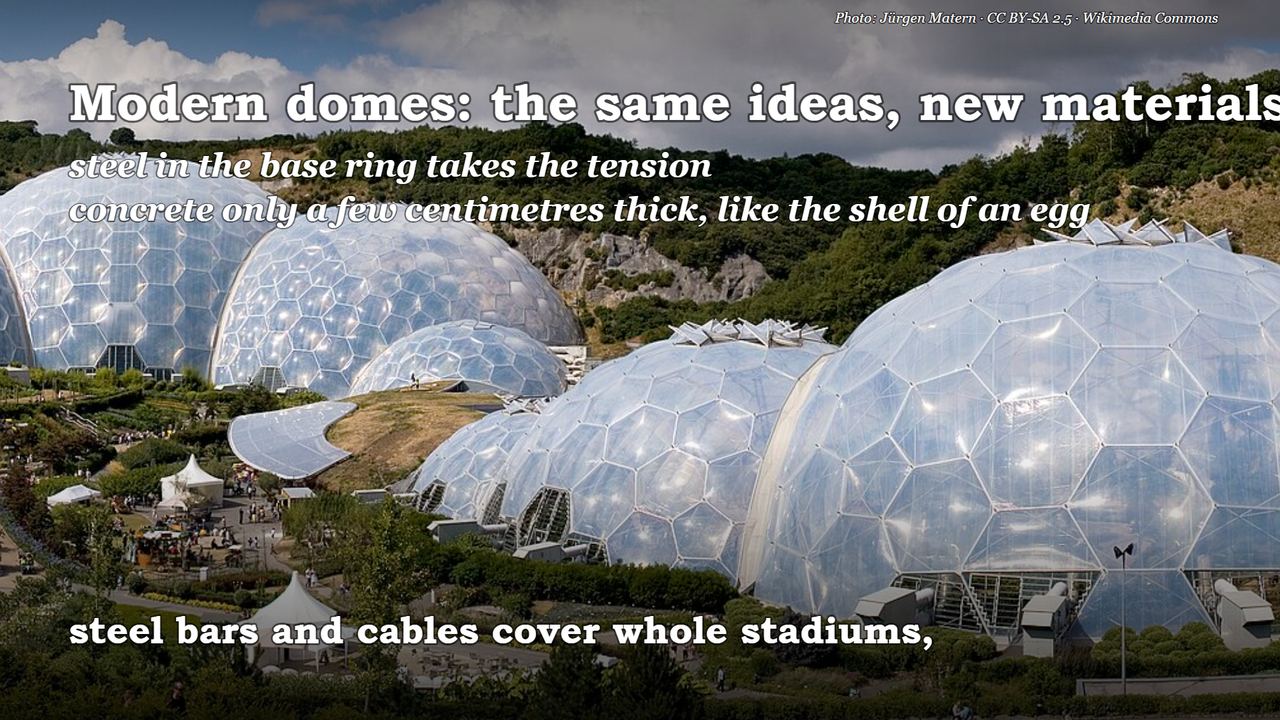
Modern domes use the same ideas with new materials. Steel in the base ring takes the tension. Reinforced concrete can be only a few centimetres thick, like the shell of an egg. And domes of steel bars or cables now cover whole stadiums, with almost no weight at all.
So a dome is not just a beautiful shape. It is a shape in which almost every part is squeezed, and stone and concrete love to be squeezed. Hold the base together, and it will stand for a very long time.
This is The Bending Moment. Thank you for watching.
The Guide
Handed a set of plans and no one to check your takeoff?
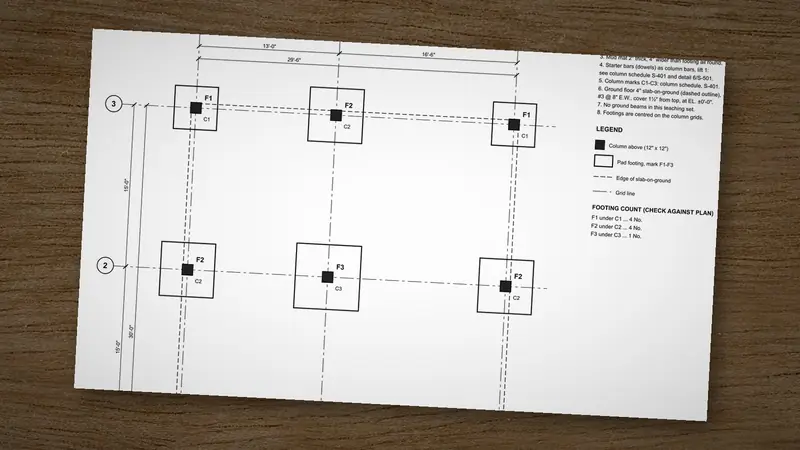
How to Read Structural Drawings follows one beam, B2, from the plan to the section, the schedule and the general notes, then decodes it in the six rebar notations you will meet on real sets. Plans, not slides. Takeoffs, not bid theory.
#5H1616ØT16Ø16N1661 pages · 12 exercises with answers · about 100 abbreviations · PDF · one payment
Photo credits
- Florence Cathedral: Vyacheslav Argenberg, CC BY 4.0
- Treasury of Atreus, Mycenae: Zde, CC BY-SA 4.0
- The Pantheon dome: Ank Kumar, CC BY-SA 4.0
- Brunelleschi's dome from above: Vyacheslav Argenberg, CC BY 4.0
- Model of the dome, Museo dell'Opera del Duomo: Armin Kleiner, CC BY-SA 4.0
- Eden Project domes: Jürgen Matern, CC BY-SA 2.5
- St Peter's Basilica dome: Alvesgaspar, CC BY-SA 4.0
Photos from Wikimedia Commons under the licences listed. All drawings are original.
The narration uses an AI clone of the author's own voice. All drawings are original.