Why It Stands · No. 30
How 27,000 Wires Hold Up the Golden Gate
The Simple Math of a Suspension Cable
 Video coming soon. Full article below
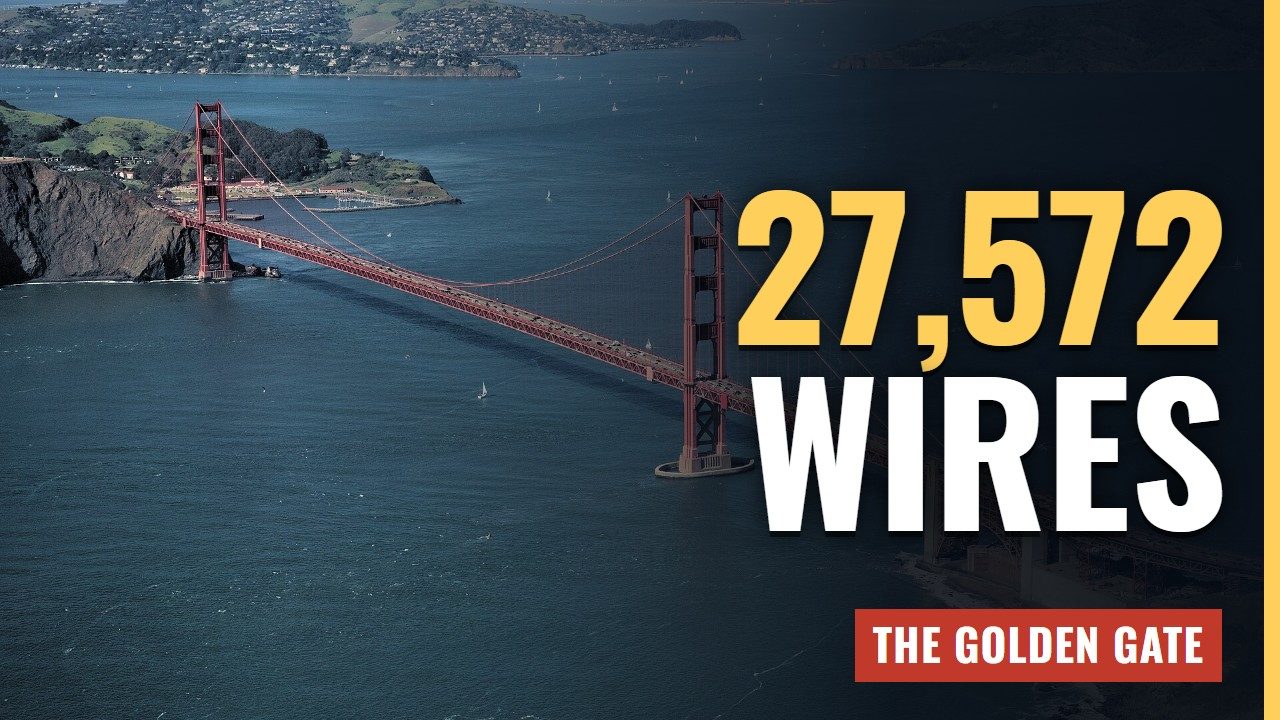
How does the Golden Gate Bridge hold up its road? With two cables, each made of 27,572 steel wires thinner than a pencil.
This video follows the load from the deck to the suspenders, the main cables, the towers and the anchorages. Then one simple hand calculation, H = wL²/8f, shows why the sag of a cable decides the force in it, and why halving the sag doubles the pull. Finally, how the cables were spun in the air from 1935 to 1936, the engineers behind the design, the safety net, and how the bridge is kept alive today.
The full story
Look at the Golden Gate Bridge. More than a kilometre of road, hanging in the air above the sea. Now look closer. The whole road hangs from just two cables. And each of those cables is not one piece of steel. It is twenty seven thousand, five hundred and seventy two separate wires, each one thinner than a pencil. So why would anyone build the most famous bridge in the world out of thin wire?
Here is the short answer. A steel wire that is pulled along its length is the most efficient way there is to carry a load. A beam has to bend. A wire in tension just stretches a tiny bit, and holds. And thin steel wire is much stronger than thick steel, for its size. So engineers make one big cable out of many small wires. Next, we follow the load, do one simple calculation, and see how those wires got up there.
First, the bridge itself. It crosses the entrance to San Francisco Bay. Work started on the fifth of January, nineteen thirty three. It opened on the twenty seventh of May, nineteen thirty seven. The main span, the distance between the two towers, is one thousand two hundred and eighty metres. When it opened, it was the longest suspension span in the world.
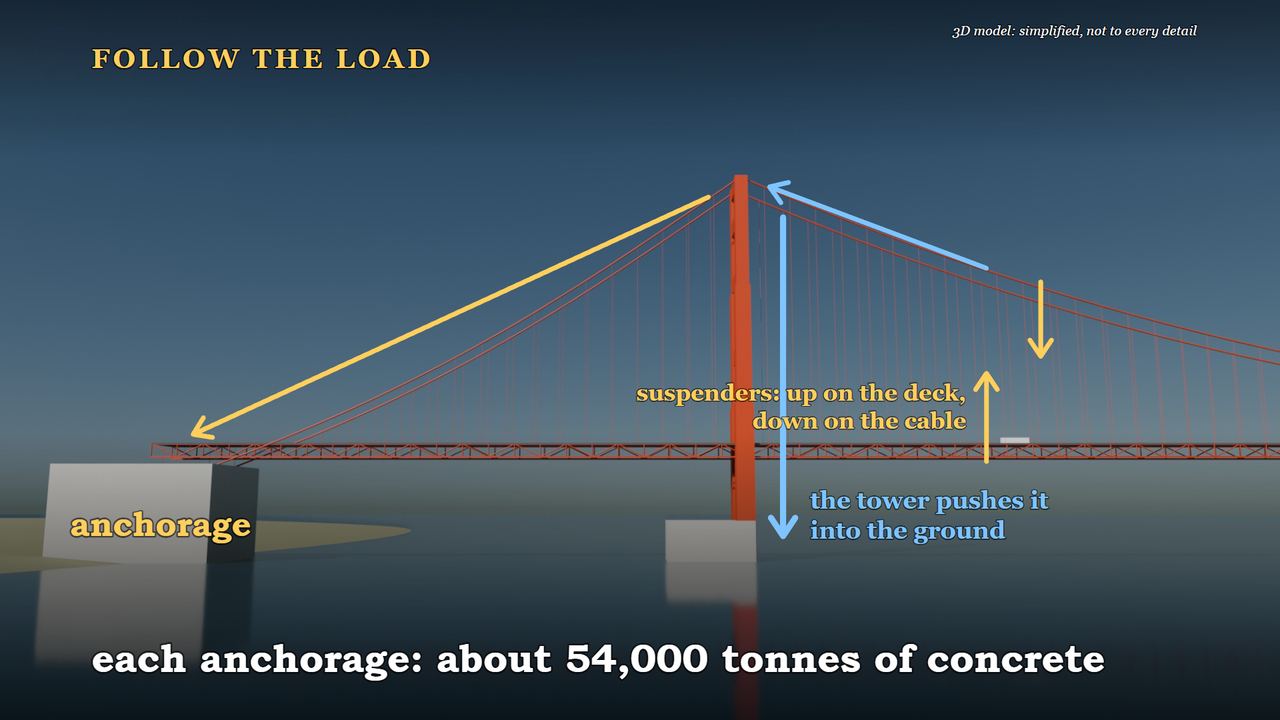
Now follow the load. A truck on the road pushes down on the deck. The deck hangs from vertical steel ropes called suspenders. There are two hundred and fifty pairs of them, about fifteen metres apart. The suspenders pull up on the deck, and they pull down on the two main cables. The main cables run over the tops of the two towers, and the towers push all of that load down into the ground under the water. At each end, the cables dive into a huge block of concrete on land, called an anchorage. Each anchorage weighs around fifty four thousand tonnes.
So every part has one simple job. The suspenders and the cables are pulled. The towers are pushed. The anchorages hold the ends of the cables down, with their own weight. And that is why a suspension bridge can cross a gap that no beam could.
But why is the cable curved? Hang a rope between two hooks, and put equal weights along it. It falls into a smooth curve. When the load is spread evenly along the span, like the weight of a road, that curve is a parabola. The drop of the cable at mid-span, below the tops of the towers, is called the sag. For the Golden Gate, the engineers chose a sag of four hundred and seventy feet. That is about one hundred and forty three metres, or about one ninth of the span.
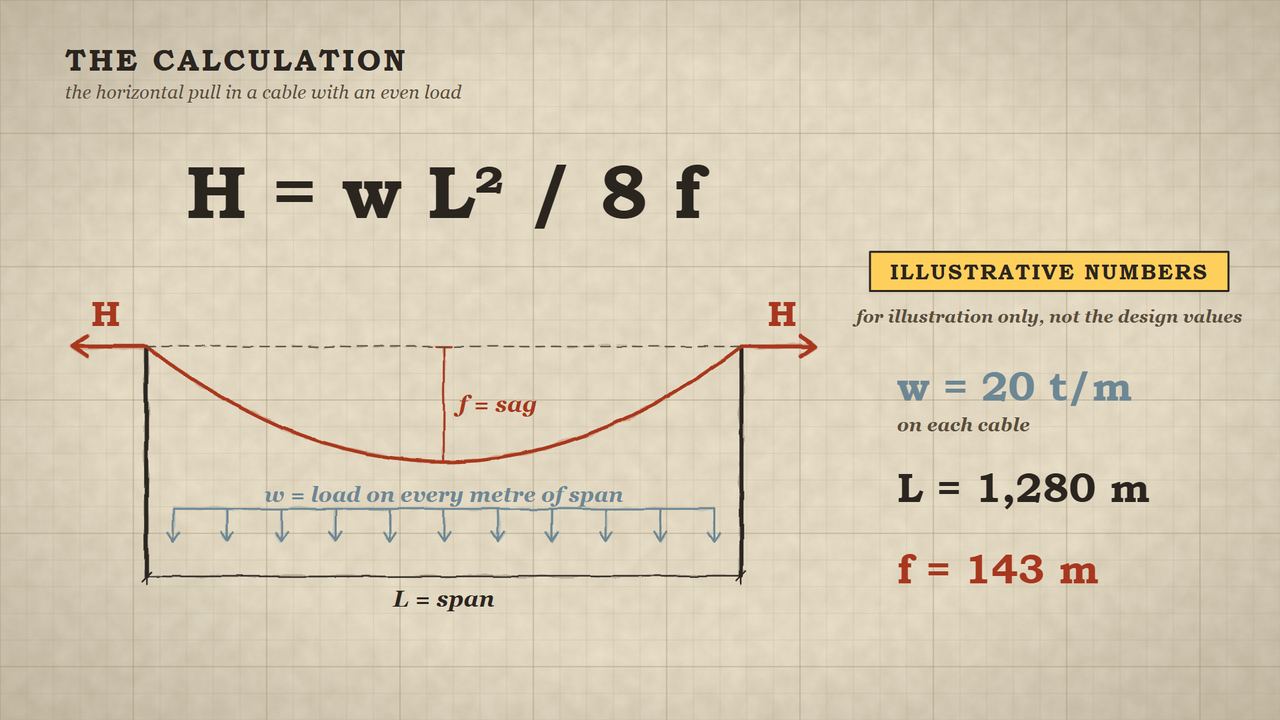
Now the calculation. For a cable with an even load, the horizontal pull in the cable is H equals w L squared, over eight f. Here w is the load on every metre of span. L is the span. And f is the sag. Let us use round numbers. They are for illustration only, not the design values. Say each cable carries twenty tonnes on every metre of span. The span is twelve hundred and eighty metres. The sag is one hundred and forty three metres.
Twelve hundred and eighty, squared, is about one point six four million. Times twenty, that is about thirty three million. Now divide by eight times one hundred and forty three, which is eleven hundred and forty four. The answer is about twenty nine thousand tonnes. That is the horizontal pull in one cable. The chief engineer's report from nineteen thirty seven gives a pull of about twenty eight thousand tonnes at each end of each cable. Our rough number lands very close.
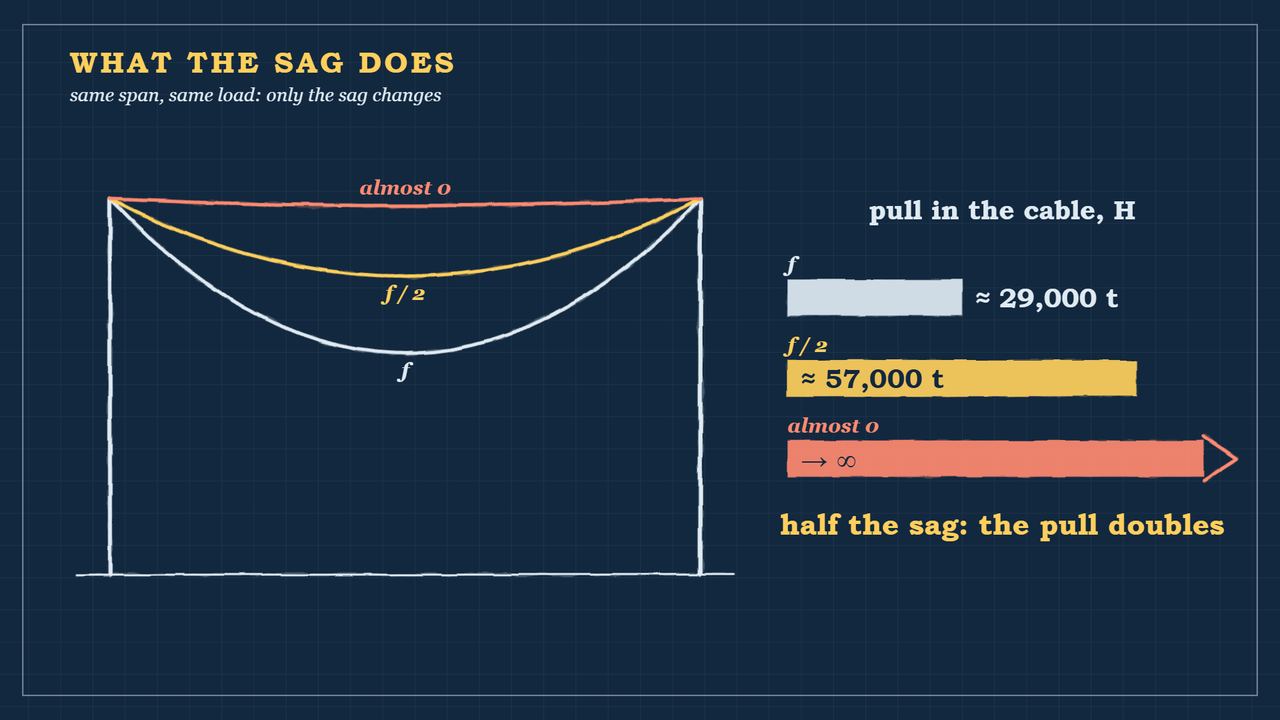
Now watch what the sag does. Make the cable flatter, with half the sag, and the pull doubles, to about fifty seven thousand tonnes. Try to make it almost straight, and the pull grows without limit. That is why you can never pull a washing line perfectly straight. And this is the real design choice. A deeper sag means a smaller force and a lighter cable, but taller towers. A flatter cable means shorter towers, but a much heavier cable. The Golden Gate's towers stand two hundred and twenty seven metres above the water.
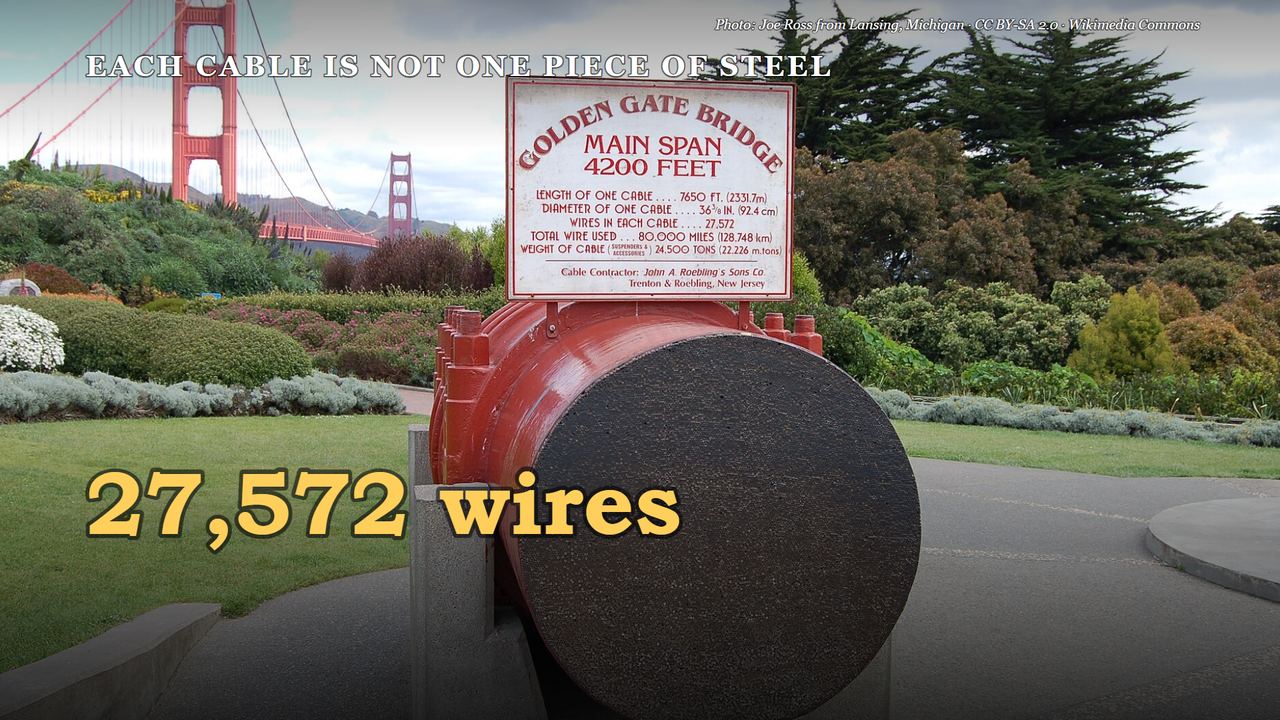
Back to the wires. Twenty nine thousand tonnes, shared by twenty seven and a half thousand wires, is about one tonne on each wire. Each wire is about five millimetres thick. The engineers asked for wire with a strength of at least two hundred and twenty thousand pounds per square inch. That means a single wire can hold about three tonnes before it breaks. So in our rough example, each wire works at about a third of its breaking strength.
So why not one solid bar of steel instead? There are three reasons. First, thin wire is stronger. The steel is pulled through smaller and smaller holes, and that makes it far stronger than the same steel in a thick bar. Second, a finished cable weighs about twelve thousand tonnes. There is no way to lift that to the top of a tower. Third, redundancy. If one wire breaks, it is one wire out of more than twenty seven thousand. The others share its load, and nobody on the road will ever notice.
So the cables were built in the air, one wire at a time. The method was invented by John Roebling in the eighteen hundreds, and the company that still carried his name, John A. Roebling's Sons, made the cables. Spinning wheels ran back and forth between the anchorages, over both towers, laying wire on every trip. The wires were gathered into sixty one strands, with about four hundred and fifty wires in each. Spinning began in October nineteen thirty five, and it was finished in May nineteen thirty six. About six months, for both cables.
Then hydraulic presses squeezed the strands together, into one round cable. With its wrapping, it is about ninety two centimetres thick. Both cables together hold about one hundred and twenty nine thousand kilometres of wire. That is enough to go around the Earth more than three times.
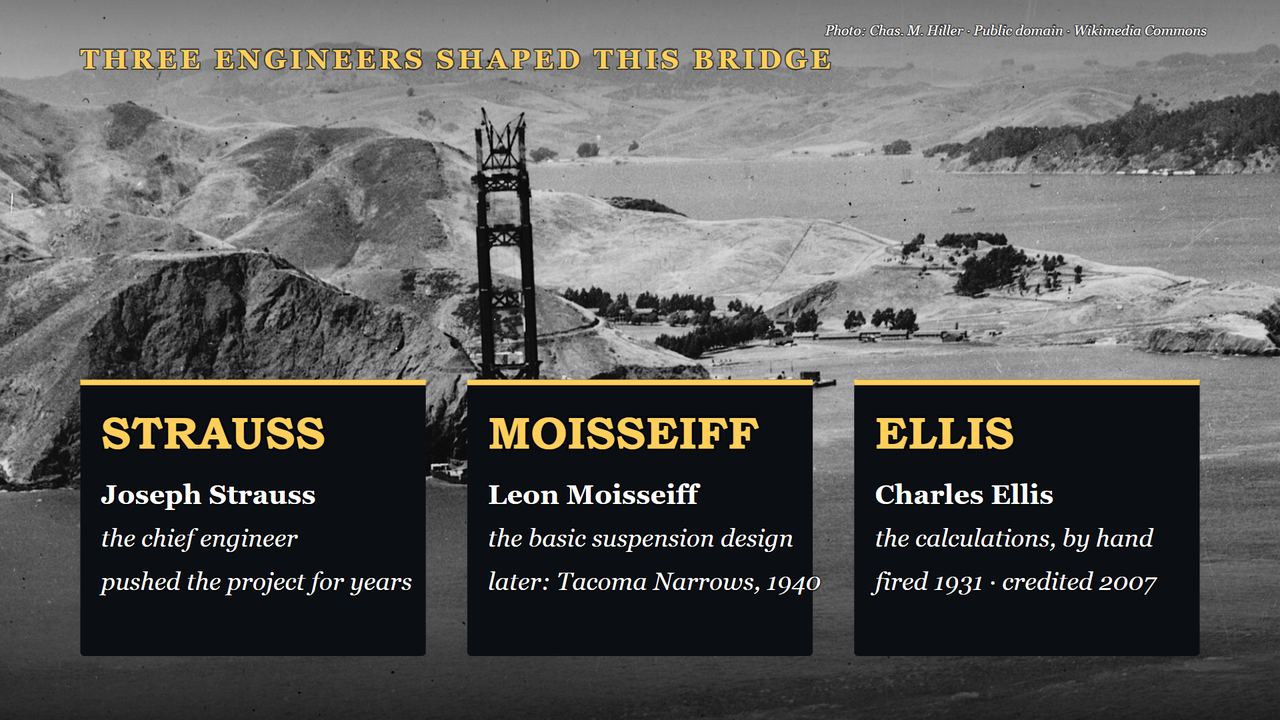
Three engineers shaped this bridge. Joseph Strauss was the chief engineer, and he pushed the project for years. Leon Moisseiff developed the basic suspension design. A few years later, his ideas were also behind the Tacoma Narrows Bridge. And Charles Ellis did much of the detailed calculation, by hand, in about ten volumes. Strauss fired him in nineteen thirty one, and for decades his name was left out. In two thousand and seven, the bridge district finally gave him major credit for the design.
The builders also cared about the workers. A safety net was hung under the whole bridge. It was new and expensive. It caught nineteen men, who called themselves the Half Way to Hell Club. But on the seventeenth of February, nineteen thirty seven, a scaffold fell, and it tore through the net. Ten men died that day. In all, eleven men lost their lives building the bridge.
A cable bridge also needs care for its whole life. Salt air eats steel. In the late nineteen sixties, inspectors found corrosion in the suspenders, near the road. Between nineteen seventy two and nineteen seventy six, every one of them was replaced, with the bridge still open. From nineteen eighty two to nineteen eighty six, the concrete deck was replaced with a lighter steel deck, working at night. And a team of painters keeps the steel covered, in its famous colour, International Orange.
In nineteen eighty seven, on the bridge's fiftieth birthday, about three hundred thousand people walked onto it at once. The middle of the span flattened under their weight. But the bridge was designed to move. Officials estimated that the cables never went above forty percent of the stress where the steel starts to yield.
So that is the secret of the Golden Gate. The heavy parts, the towers and the anchorages, are there to hold the cables in place. The cables do the real work, in pure tension, with a gentle sag. Twenty seven thousand thin wires, each one carrying its small share, every second, for almost ninety years.
That is all for now. This is The Bending Moment.
The Guide
Handed a set of plans and no one to check your takeoff?
How to Read Structural Drawings follows one beam, B2, from the plan to the section, the schedule and the general notes, then decodes it in the six rebar notations you will meet on real sets. Plans, not slides. Takeoffs, not bid theory.
#5H1616ØT16Ø16N1661 pages · 12 exercises with answers · about 100 abbreviations · PDF · one payment
Sources
- The Golden Gate Bridge, Report of the Chief Engineer (1937); Golden Gate Bridge, Highway and Transportation District (goldengate.org).
Photo credits
- Aerial view of Golden Gate Bridge from southwest dllu: Daniel L. Lu (user:dllu), CC BY-SA 4.0
- New Air View of Golden Gate Bridge Tower (1934 ACME press photo): ACME Newspictures, Public domain
- Construction of the Golden Gate Bridge 3c22793u: Associated Oil Company / Chas. M. Hiller, Public domain
- Golden Gate Bridge under construction 3c00678u: Associated Oil Company / Chas. M. Hiller, Public domain
- Display of Golden Gate Bridge cable cross-section, May 2006: Joe Ross from Lansing, Michigan, CC BY-SA 2.0
- Cut away section of cable on display, Golden Gate Bridge (10376018964): Robert Ashworth from Bellingham, WA., USA, CC BY 2.0
- Closeup of wires inside cable on Golden Gate Bridge, San Francisco (2006): http://photo.doobya.com, CC BY-SA 3.0
- Detail of cable and suspender connection, Golden Gate Bridge (HAER CA-31): Jet Lowe, Historic American Engineering Record, Public domain
- Cable seat on top of the southern tower, Golden Gate Bridge (HAER CA-31): Jet Lowe, Historic American Engineering Record, Public domain
- Golden Gate Bridge cable, CA-31-15 (suspender connection to cable): Jet Lowe, Historic American Engineering Record, Public domain
- A view straight up the support cables of the Golden Gate Bridge: Gabe Torney, CC BY-SA 3.0
Photos from Wikimedia Commons under the licences listed. All drawings are original.
The narration uses an AI clone of the author's own voice. All drawings are original.