Why It Stands · No. 23
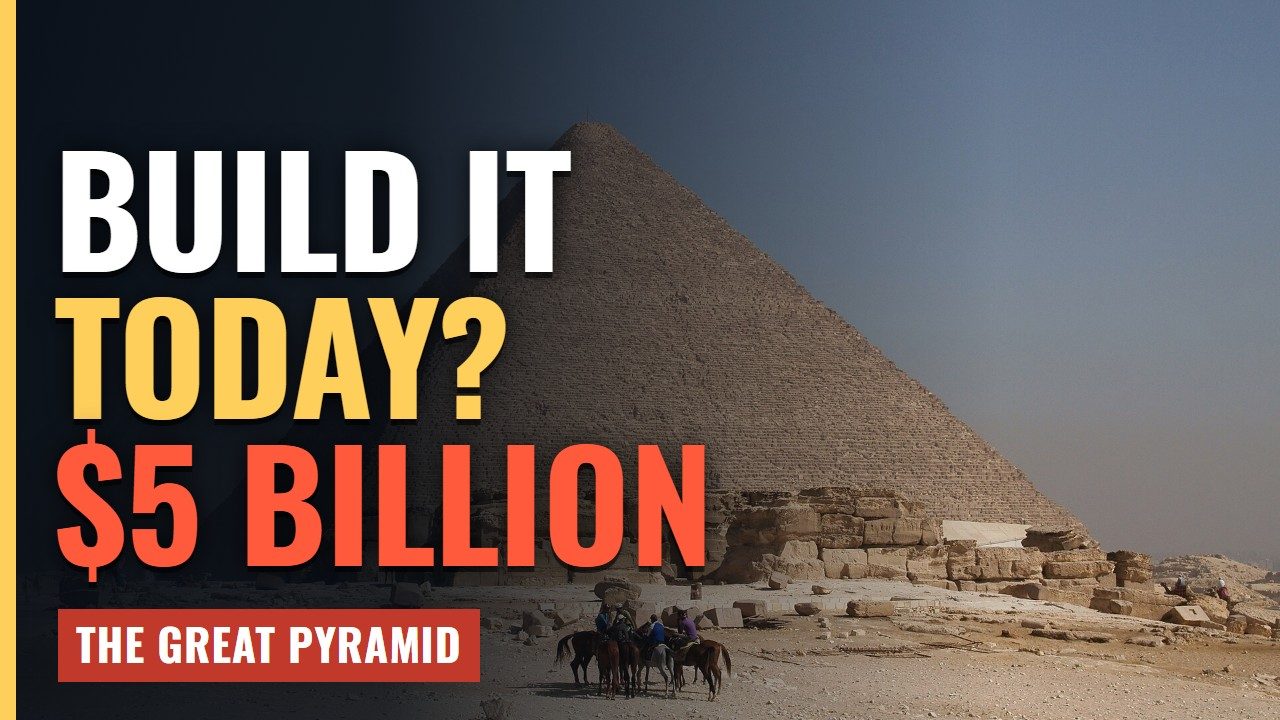
Could We Build the Great Pyramid Today?
Cranes, Stone, Workers and Cost
 Video coming soon. Full article below
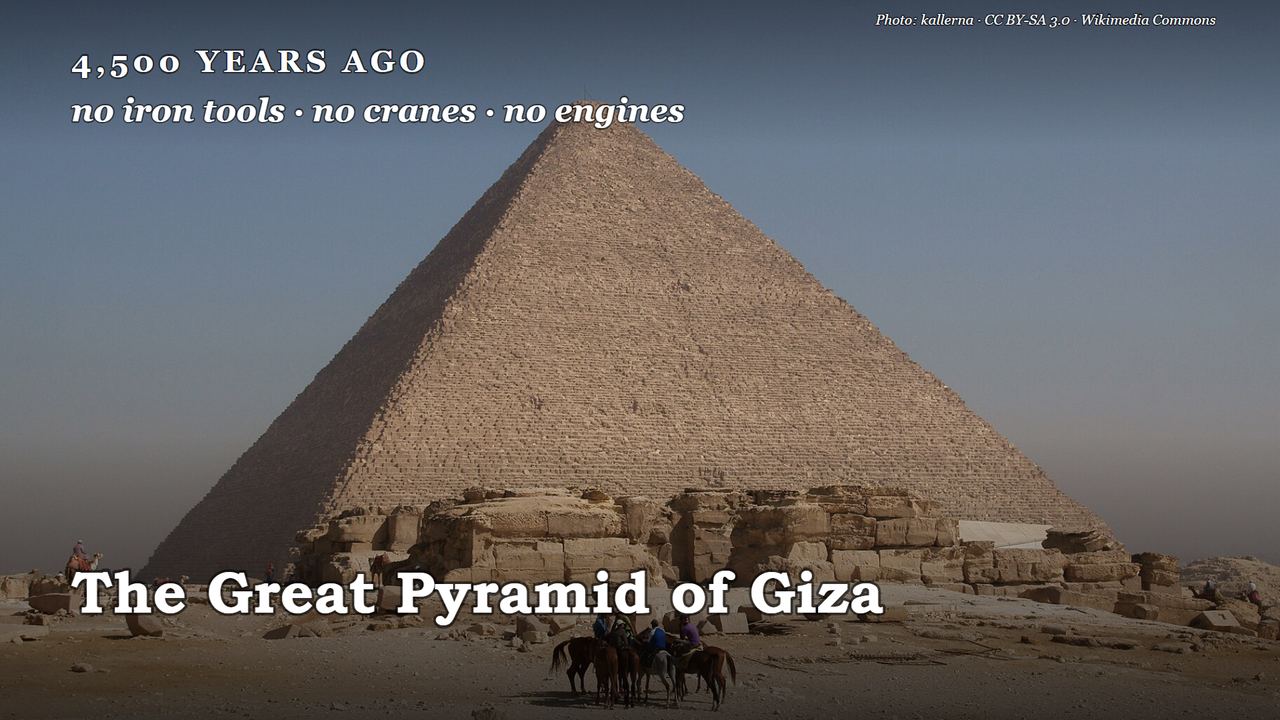
Four and a half thousand years ago, with no iron tools, no cranes and no engines, people in Egypt built a mountain of stone. What would it take to build the Great Pyramid of Giza again, today?
First, the structure itself: its size, the 2.3 million blocks, the three kinds of stone, the chambers inside, and why the shape is so stable. Then the modern job, step by step: the survey, the quarry, moving six million tonnes, tower cranes, the chambers, and finally how many workers, how many years and how much money.
The full story
Four and a half thousand years ago, with no iron tools, no cranes and no engines, people in Egypt built a mountain of stone. The Great Pyramid of Giza. So here is a question. What would it take to build it again, today?
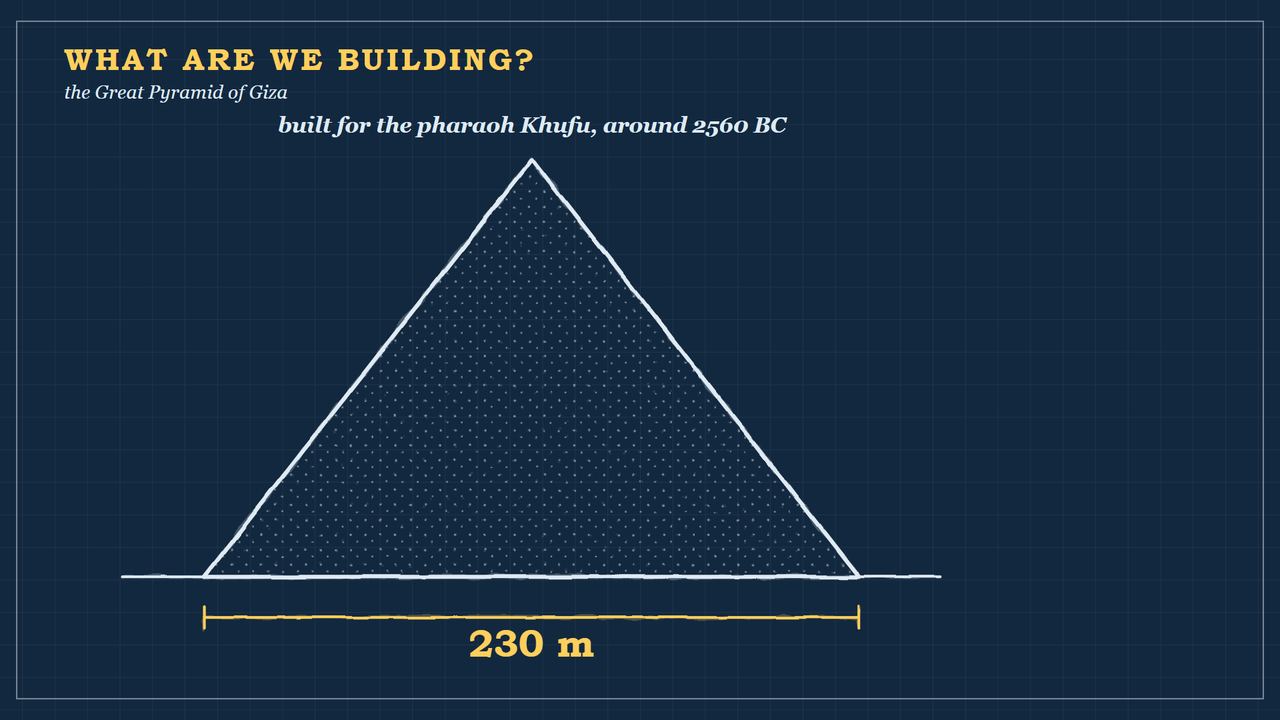
First, what exactly are we building? The pyramid was built for the pharaoh Khufu, around 2560 BC. Each side of its base is two hundred and thirty metres long. It was almost one hundred and forty seven metres high. For nearly four thousand years, it was the tallest structure made by people.
It is made of about two point three million blocks. An average block weighs two and a half tonnes, about as much as two cars. All together, about six million tonnes.
Three kinds of stone went into it. The core is rough limestone, cut from a quarry right next to the site. The outside was covered with fine white limestone, brought from across the Nile, and polished smooth. And deep inside, around the king's chamber, there is granite from Aswan, eight hundred kilometres to the south. Some of those granite beams weigh as much as eighty tonnes.
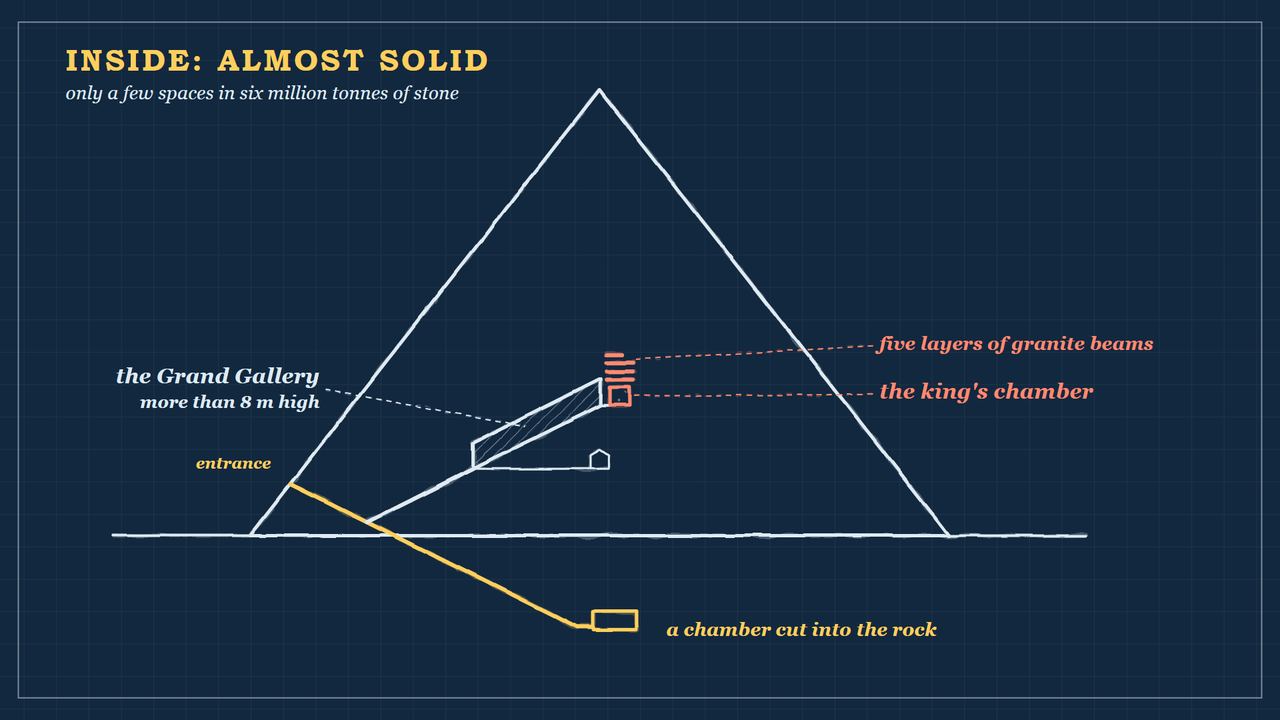
Inside, it is almost solid. There are only a few spaces. A chamber cut into the rock under the pyramid. A sloping passage that opens into the Grand Gallery, a hall more than eight metres high. And the king's chamber, with five layers of granite beams stacked above it, to carry the weight of the stone overhead.
As a structure, a pyramid is the safest shape there is. Every block rests on the blocks below it, so everything is in compression, and the base is wide. What is hard is the accuracy. The base is level to within about two centimetres. And the sides point north, south, east and west, almost perfectly.
The Egyptians did it in about twenty years, with something like twenty thousand workers. That means one block set in place every two or three minutes, all day, for twenty years.
Now, let us build it today. Start with the survey. With satellite positioning and lasers, the accuracy that took the Egyptians years of care takes us a few days. The ground is the easy part too. The pyramid stands on solid rock, and it has to. Six million tonnes press down with about a hundred tonnes on every square metre.
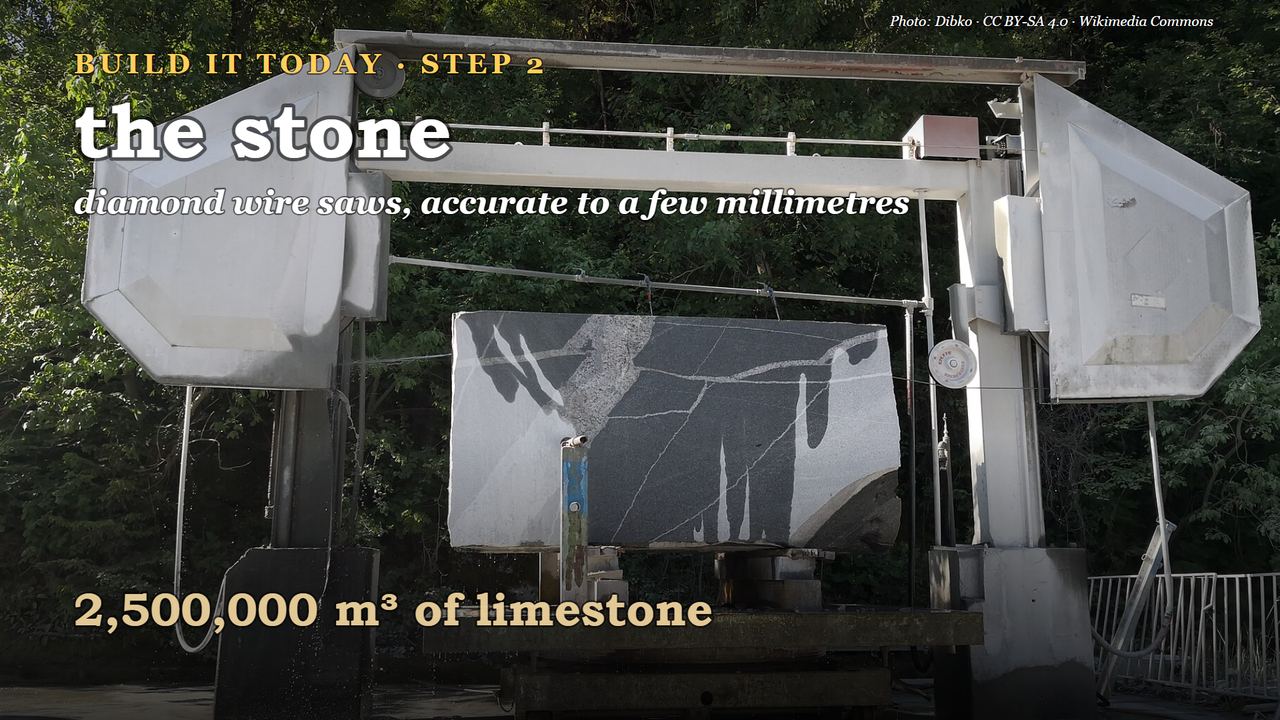
Next, the stone. We would not use copper chisels. A modern quarry cuts limestone with diamond wire saws, into straight, clean blocks, accurate to a few millimetres. But we need about two and a half million cubic metres of it. So we would open a quarry close to the site, exactly as the Egyptians did.
Then, moving it. A block that once needed about twenty men and a sledge now rides on a truck, ten blocks at a time. Even so, six million tonnes means about a quarter of a million truck loads. The granite would come from Aswan by rail, or by barge on the Nile. And the eighty tonne beams would travel on special trailers with many axles.
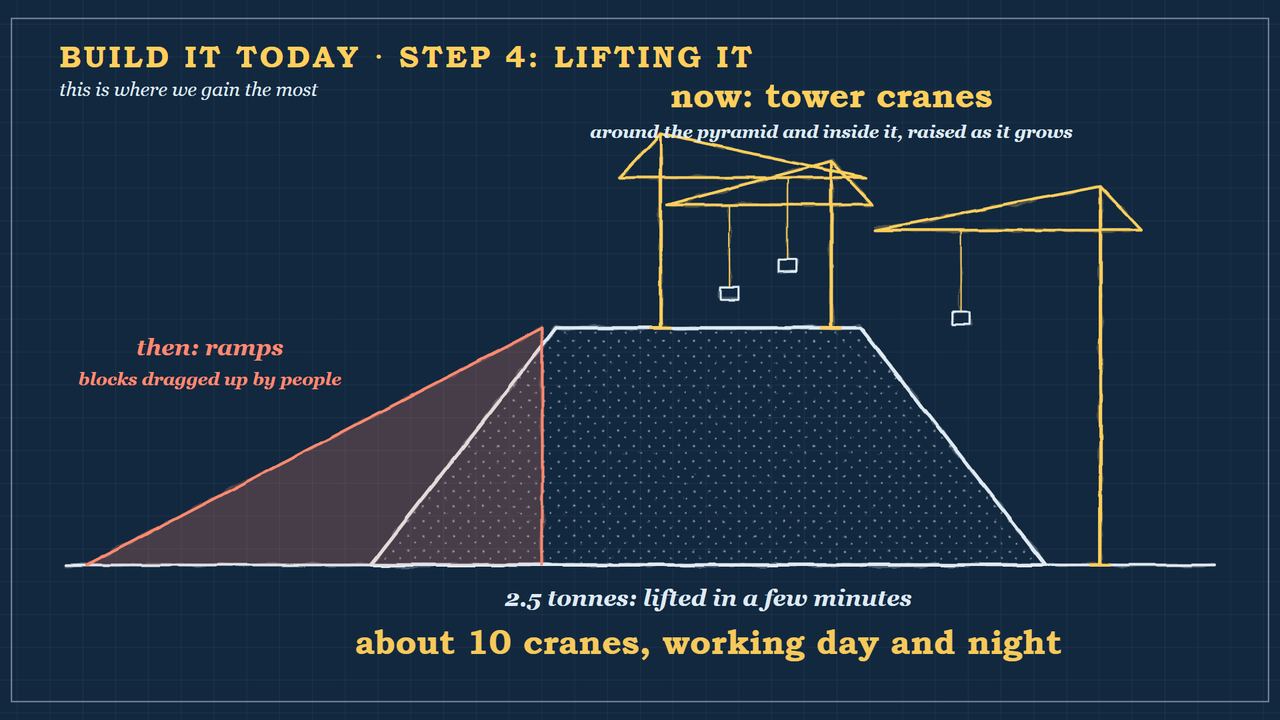
And lifting it. This is where we gain the most. The Egyptians probably dragged the blocks up ramps. We would stand tower cranes around the pyramid and inside it, and raise them as it grows. A tower crane lifts a two and a half tonne block in a few minutes, without effort. To keep up, we would need about ten cranes, working day and night. And for the granite beams, one large crawler crane.
What about the chambers? The spaces inside are built, not dug. You leave them open as the layers rise, and a crane lowers the roof beams into place. Only the lowest chamber is cut into the rock. The Egyptians cut it by hand, with copper chisels and stone hammers. We would use a machine called a roadheader, or hydraulic breakers, and finish in weeks.
But an engineer would ask one more question. Why blocks at all? The Hoover Dam contains about the same volume as the Great Pyramid, in concrete. It was built in the nineteen thirties, in five years, by about five thousand workers. A concrete pyramid would be faster and cheaper. It just would not be the same monument.
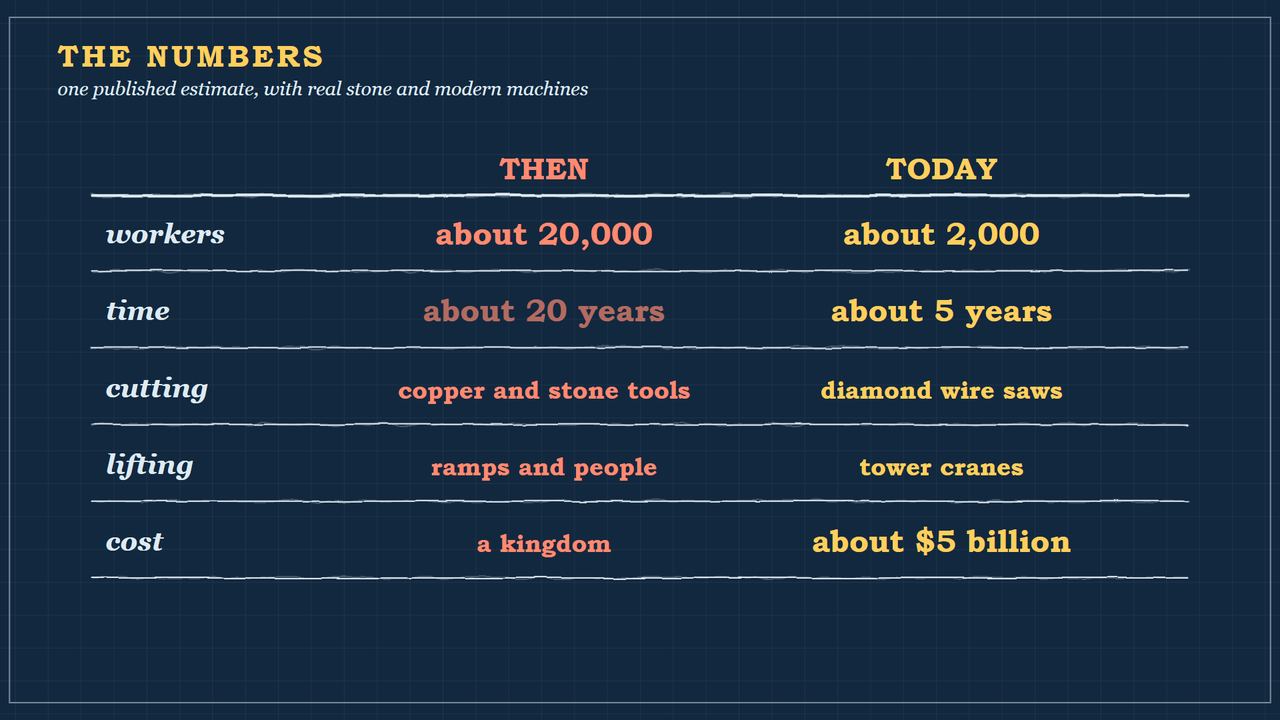
So, the numbers. With real stone and modern machines, one published estimate says about two thousand workers, about five years, and a cost of around five billion dollars. Compare that with twenty thousand people, and twenty years.
We could build it faster, with a tenth of the people. But the plan would be the same one. A quarry next to the site. A steady stream of blocks. And a very careful survey. The Egyptians did not have our machines. They had the same engineering.
That is all for now. This is The Bending Moment.
The Guide
Handed a set of plans and no one to check your takeoff?
How to Read Structural Drawings follows one beam, B2, from the plan to the section, the schedule and the general notes, then decodes it in the six rebar notations you will meet on real sets. Plans, not slides. Takeoffs, not bid theory.
#5H1616ØT16Ø16N1661 pages · 12 exercises with answers · about 100 abbreviations · PDF · one payment
Photo credits
- The Great Pyramid of Giza: kallerna, CC BY-SA 3.0
- Pyramid of Khufu, side: kallerna, CC BY-SA 3.0
- Unfinished obelisk, Aswan: Diego Delso, CC BY-SA 4.0
- Grand Gallery of the Great Pyramid: Keith Adler, CC BY-SA 4.0
- The Great Pyramid of Khufu: Gary Todd from Xinzheng, China, CC0
- Total station: FedericaGaspari, CC BY-SA 4.0
- Stone saw in a quarry: Dibko, CC BY-SA 4.0
- Granite blocks, Prakasam district: Shagil Muzhappilangad, CC BY-SA 4.0
- Modular heavy transporter: TII Sales, CC BY-SA 4.0
- Crawler crane lifting a bridge: Hallucegenia, CC0
- Tunnelling machine: Игоревич, CC BY-SA 3.0
- Hoover Dam: P, Hughes, CC BY-SA 4.0
- The Great Pyramid of Khufu: Gary Todd from Xinzheng, China, CC0
Photos from Wikimedia Commons under the licences listed. All drawings are original.
The narration uses an AI clone of the author's own voice. All drawings are original.