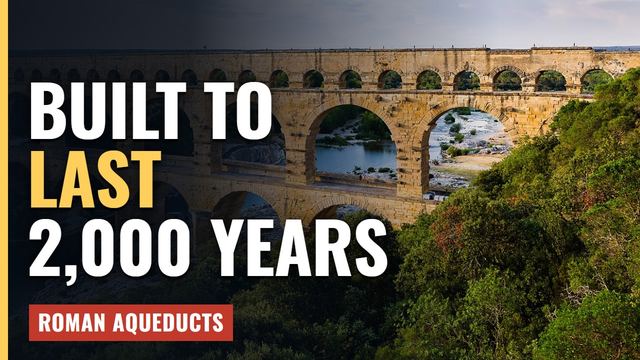
Why It Stands · No. 28
Why Is Half of the Colosseum Missing?
The Engineering of a Broken Ring
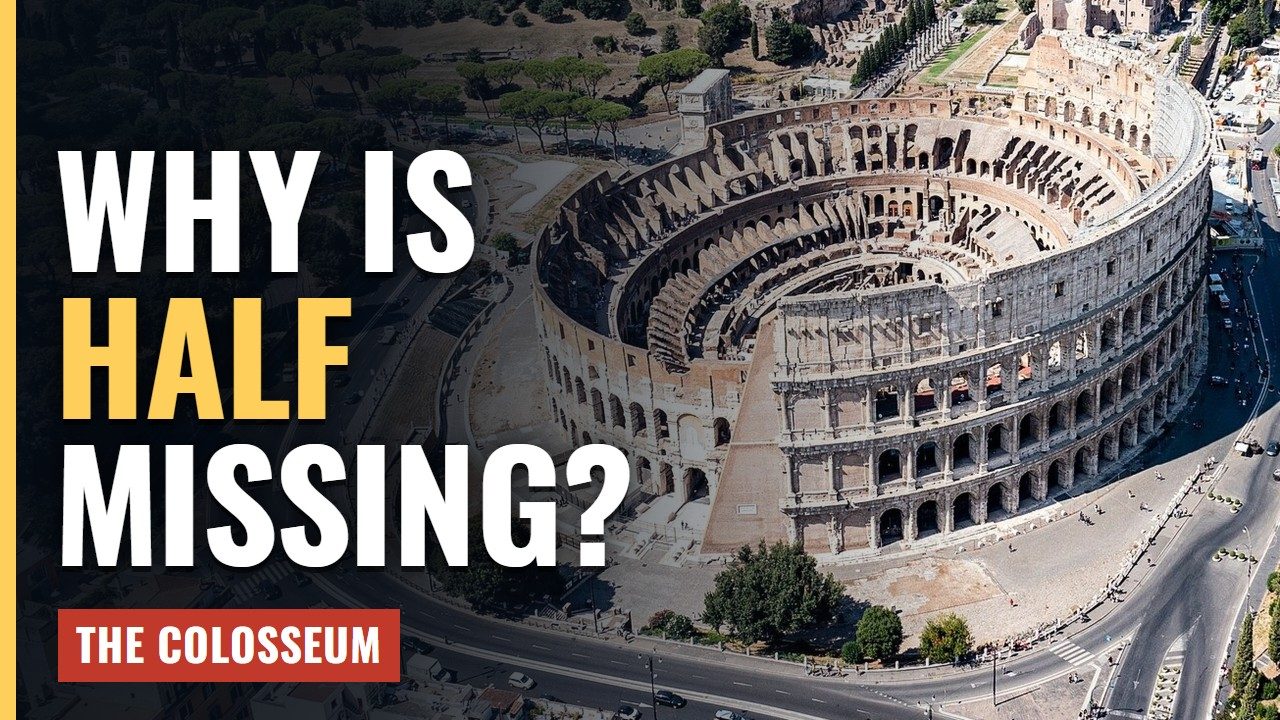 Video coming soon. Full article below
Why is half of the Colosseum missing? On the north side the outer wall still stands four storeys high. On the south side it is gone. An earthquake, softer ground and centuries of stone robbing explain what fell. Engineering explains why the rest still stands.
We look at how stacked stone arches carry their weight, with a simple hand calculation of arch thrust, why a closed ring of 80 arches balances itself, and why a broken ring needs help at its ends. Then the story: the earthquake of 1349, the Colosseum as a quarry, the holes left by the iron clamps, and the two giant brick buttresses of the 19th century.
The full story
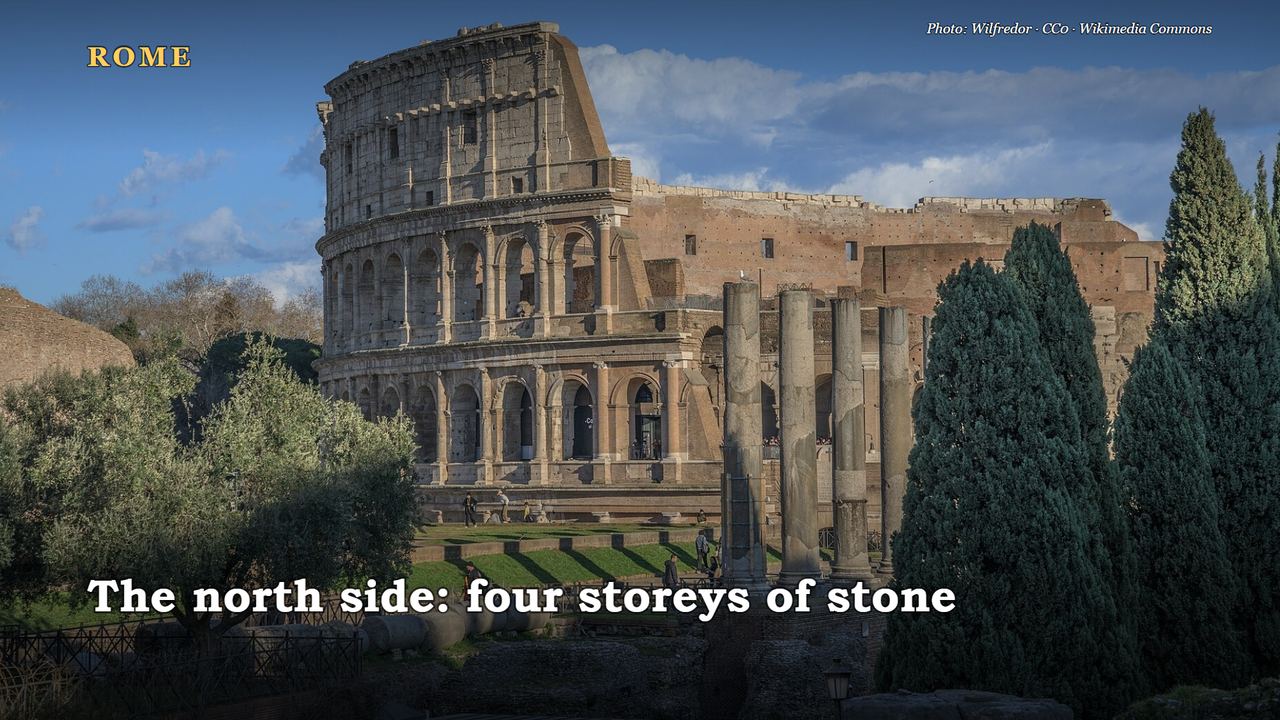
Stand on the north side of the Colosseum, and you see a giant wall. Four storeys of stone, arches stacked on arches, almost fifty metres high. Now walk around to the south side. That wall is gone. So where did half of the outer wall go? And why is the rest still standing, almost two thousand years later?
Here is the short answer. It was not one event. Part of the wall sat on softer ground. A great earthquake brought it down. And then, for hundreds of years, people carried the fallen stone away. But the more interesting question is the engineering one. Why did one side fall, while the other side still stands? To answer that, we need to look at how the Colosseum carries its weight.
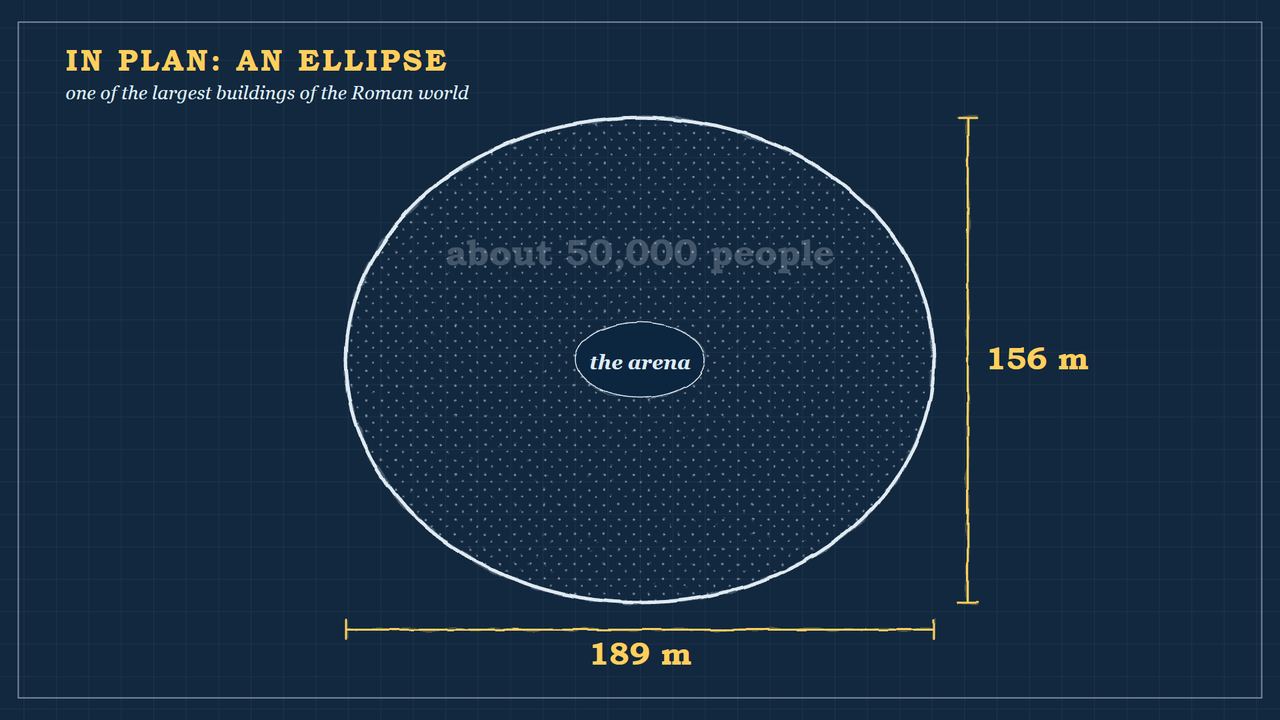
Construction began under the emperor Vespasian, around the year seventy. His son Titus opened it in the year eighty. That is about ten years, for one of the largest buildings of the Roman world. In plan, it is an ellipse, about one hundred and eighty nine metres long and one hundred and fifty six metres wide. Modern estimates say it held about fifty thousand people.
The Romans chose each material for its job. The piers and the outer wall are travertine, a hard limestone. More than one hundred thousand cubic metres of it, laid without mortar. Between the piers on the lower levels, they used tuff, a lighter volcanic stone. The vaults and many of the inner walls are brick and Roman concrete. And the foundations are concrete too.
Think of the building as a set of rings. The outer ring has eighty arches on each of its three lower storeys, and a solid wall on top. Behind it, there are more rings of piers. Walls and vaults run between the rings, like the spokes of a wheel, and they carry the seats, sloping down towards the arena.
Now, how does an arch work? A stone arch is in compression everywhere. The weight above it pushes down, and the arch turns that weight into a curved line of force, down into the two piers. But at the bottom, that force does not point straight down. It leans outward. The sideways part of it is called the thrust.
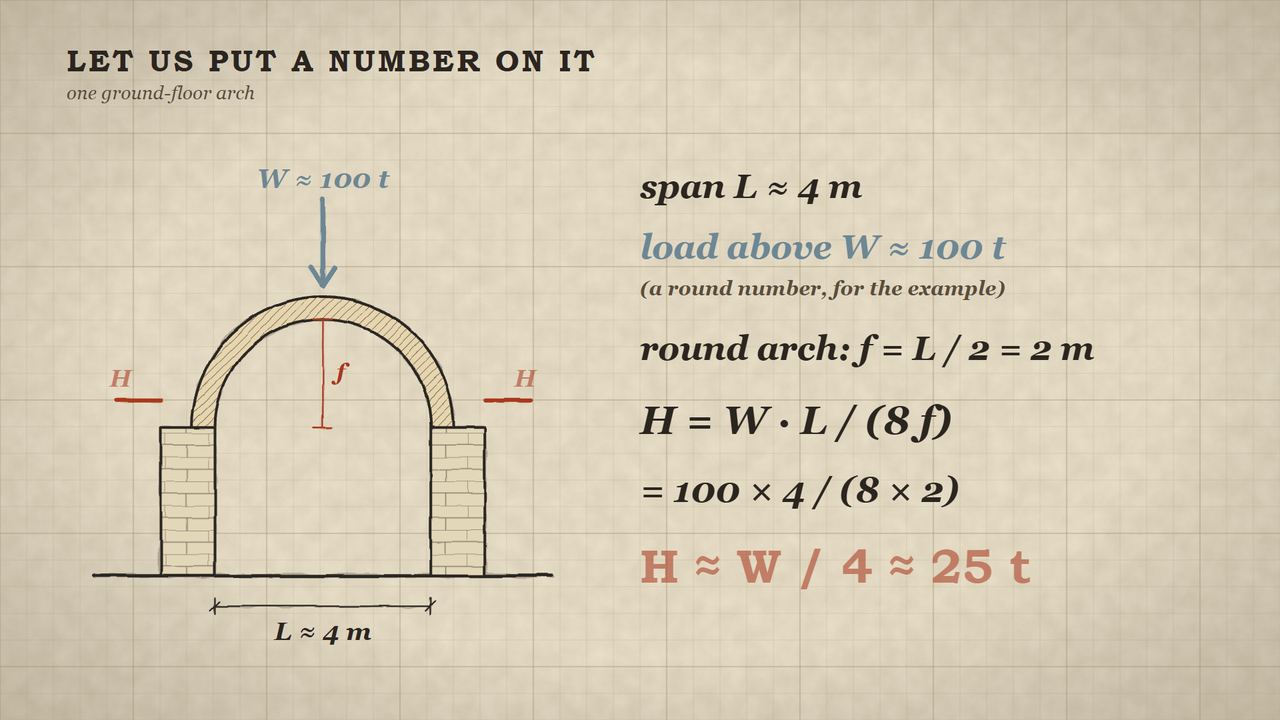
Let us put a number on it. Take one arch on the ground floor, about four metres wide. Say the wall above it weighs about one hundred tonnes. That is a round number, just for the example. For a round arch, the height is half the width, and the sideways push comes out to about a quarter of the load. So each arch pushes outward with about twenty five tonnes, on each side.
So every pier is pushed by twenty five tonnes from the arch on its left, and twenty five tonnes from the arch on its right. The two pushes cancel. All that is left for the pier is the weight, going straight down. And in a closed ring there is no last arch. Every push meets an equal push, all the way around.
Stacking the storeys makes this even better. Each storey adds weight on the piers below it. A pier stands safely as long as the line of force stays inside its base. More weight from above makes that line steeper, and keeps it closer to the middle. That is why a tall arcade of heavy stone can be very stable.
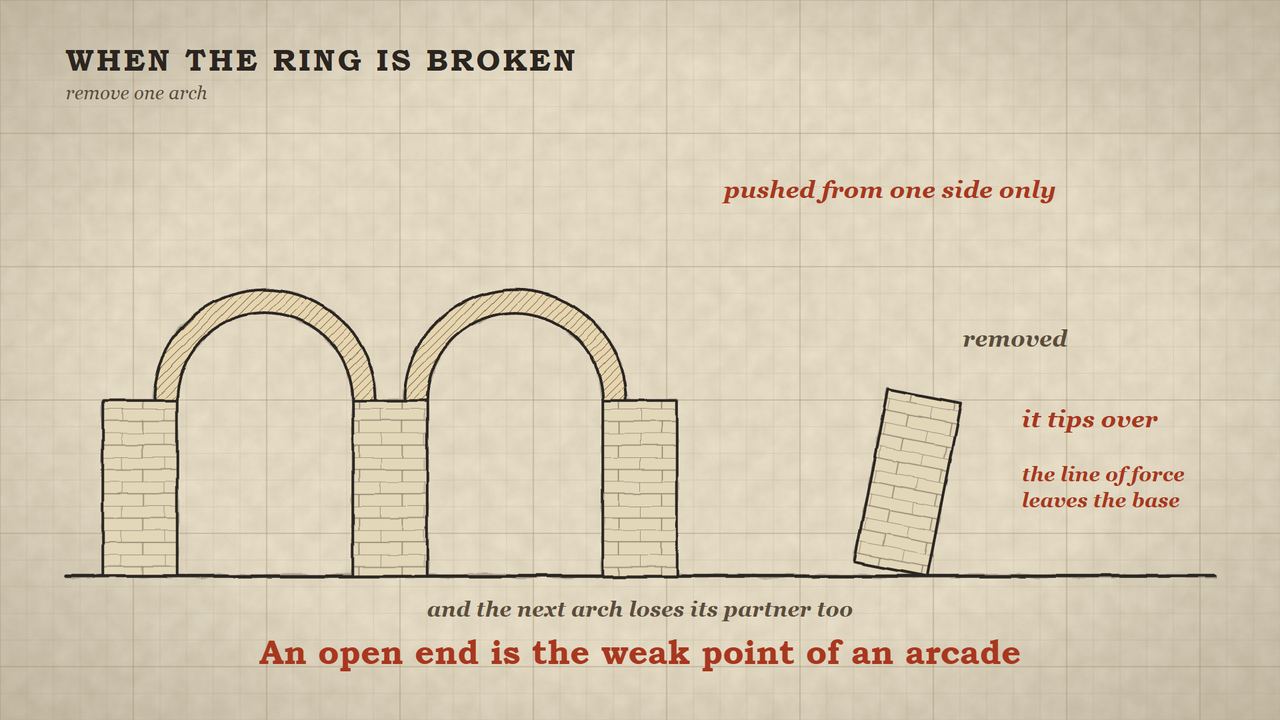
But what happens when the ring is broken? Remove one arch, and its neighbour loses its partner. The last pier is now pushed by twenty five tonnes from one side only, high above the ground. The line of force leans out of the pier, and the pier wants to tip over. If it goes, the next arch loses its partner too. An open end is the weak point of an arcade.
And that is where the story comes in. In thirteen forty nine, a great earthquake struck Rome. On the south side, the outer ring stood on less stable ground, laid down by water long ago. Soft ground shakes more. And the outer ring is the tallest part, and the least supported. On the south side, it came down.
What fell became a quarry. A mountain of cut travertine was now lying in the middle of the city. For centuries, people took it. Much of the stone went into palaces, churches and hospitals in Rome. Marble from the building was burned to make lime. Even in seventeen oh three, after another earthquake, fallen stones went into building a river port in Rome.
There is one more thing you notice up close. The walls are full of holes. The travertine blocks were held together with iron clamps, about three hundred tonnes of them. In the Middle Ages, iron was valuable. So people dug into the joints, stone by stone, to pull the clamps out. The holes are still there today. You can see them on almost every pier.
Here is the interesting part. Taking the clamps did not bring the building down. In a normal day, an arch does not need them. Its stones are held in place by compression, by their own weight. Clamps help when something tries to pull the stones apart. The arches still stand because the forces in them still push, and do not pull.
So why is the rest still standing? On the south side, what you see today is not the outer wall at all. It is the old inner ring. It is lower than the outer wall, and the radial walls and vaults behind it brace it, like buttresses, all the way around. On the north side, the full outer ring is still tied into the rings behind it by those vaults.
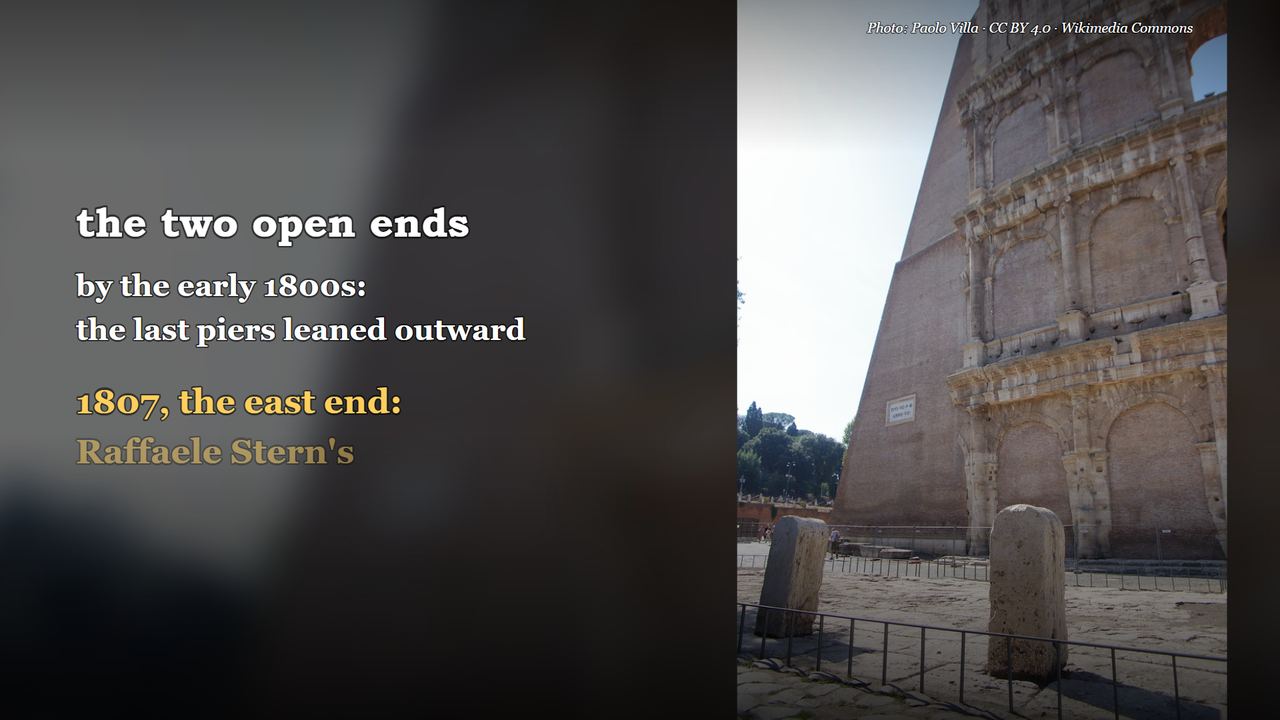
But the two open ends were a problem. By the early eighteen hundreds, the last piers of the outer wall were leaning outward. In eighteen oh seven, at the east end, the architect Raffaele Stern built a huge sloping wedge of brick against the wall. In the eighteen twenties, at the west end, Giuseppe Valadier rebuilt several arches in brick, each one a step lower, and finished them with another sloping wedge.
A buttress does the job of the missing arches. The arch that fell used to push back with about twenty five tonnes. Now a heavy mass of brick leans against the last pier instead. Its weight turns the combined line of force downward, and keeps it inside the base. And the wedge is widest at the bottom, exactly where the line of force moves furthest out.
So the Colosseum did not lose half of its outer wall because arches are weak. It lost the part that stood on softer ground, and then it lost what people could carry away. In a closed ring, arches hold each other up. Break the ring, and every open end needs something to push back. That is why half of the Colosseum is missing, and why the other half is still standing.
That is all for now. This is The Bending Moment.
The Guide
Handed a set of plans and no one to check your takeoff?
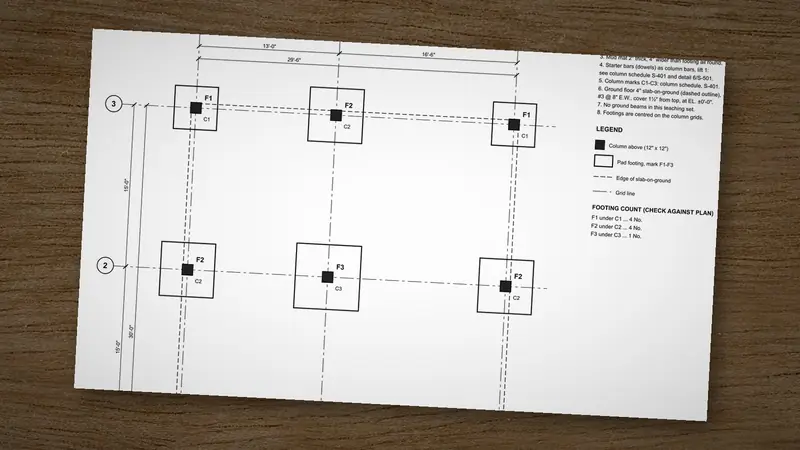
How to Read Structural Drawings follows one beam, B2, from the plan to the section, the schedule and the general notes, then decodes it in the six rebar notations you will meet on real sets. Plans, not slides. Takeoffs, not bid theory.
#5H1616ØT16Ø16N1661 pages · 12 exercises with answers · about 100 abbreviations · PDF · one payment
Sources
- the Wikipedia article "Colosseum", Structurae, the-colosseum.net, and ISPRS Archives XLIV-M-1-2020 (p. 543).
Photo credits
- Colosseum and Roman Forum: Wilfredor, CC0
- Aerial view of the Colosseum: Kasa Fue, CC BY-SA 4.0
- The Colosseum, bird's-eye view, 1776: Giovanni Battista Piranesi, public domain
- Outer arcades: Paolo Villa, CC BY-SA 4.0
- Barrel vaults from outside: Paolo Villa, CC BY-SA 4.0
- Vaulted gallery: Paolo Villa, CC BY-SA 4.0
- Vaults under the seating: Paolo Villa, CC BY-SA 4.0
- Clamp holes in the travertine: trukdotcom, CC BY-SA 3.0
- Metal pin in a joint: Paolo Villa, CC BY 4.0
- Stern buttress: Paolo Villa, CC BY 4.0
- The Colosseum from the west: Ypsilon from Finland, CC0
- East end of the Colosseum: Mattes, CC BY-SA 3.0
- The cut end of the outer ring: Vitold Muratov, CC BY-SA 3.0
- Plan of the Colosseum: Wolfgang Sauber, CC BY-SA 3.0
Photos from Wikimedia Commons under the licences listed. All drawings are original.
The narration uses an AI clone of the author's own voice. All drawings are original.