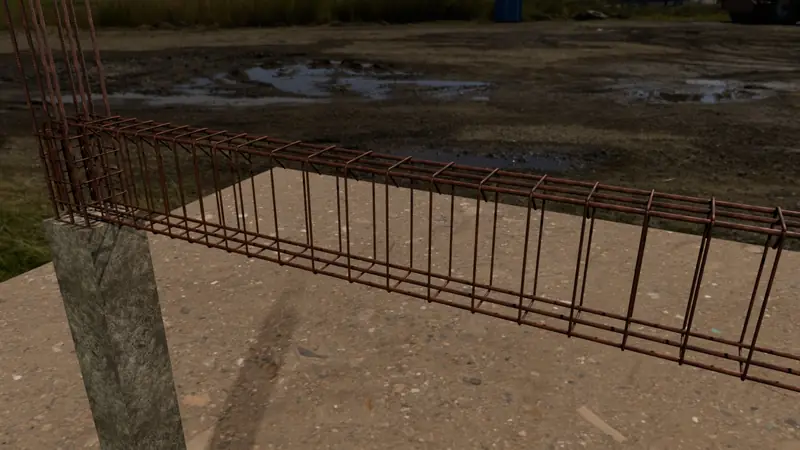
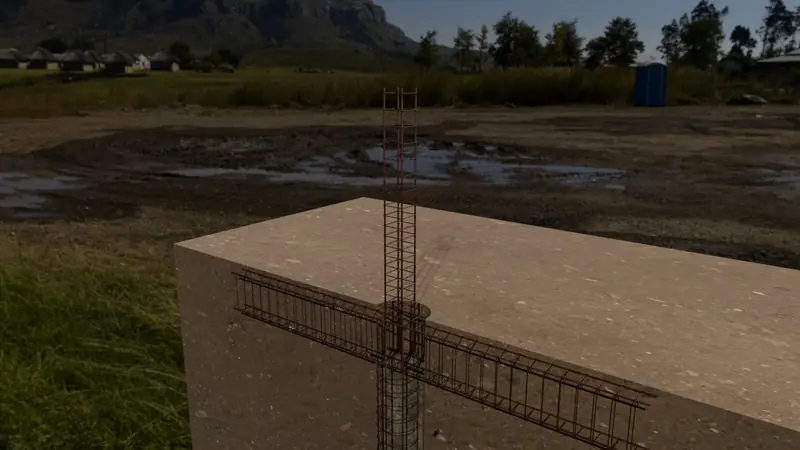
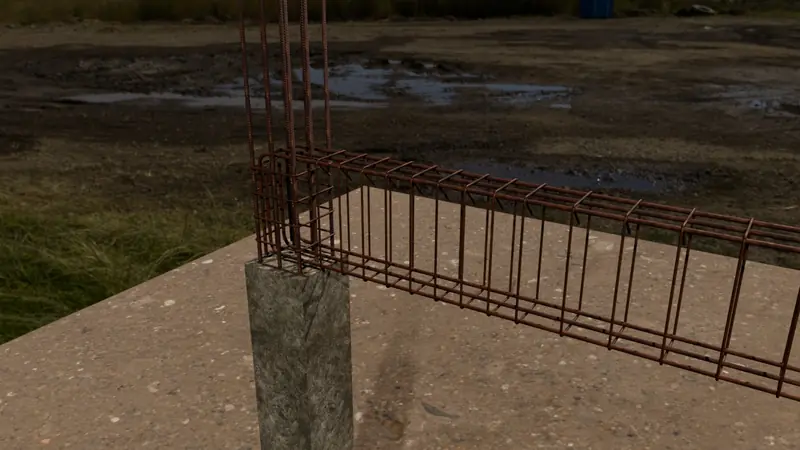
Bundled Bars in Reinforced Concrete: Limits, Drawings and Takeoff
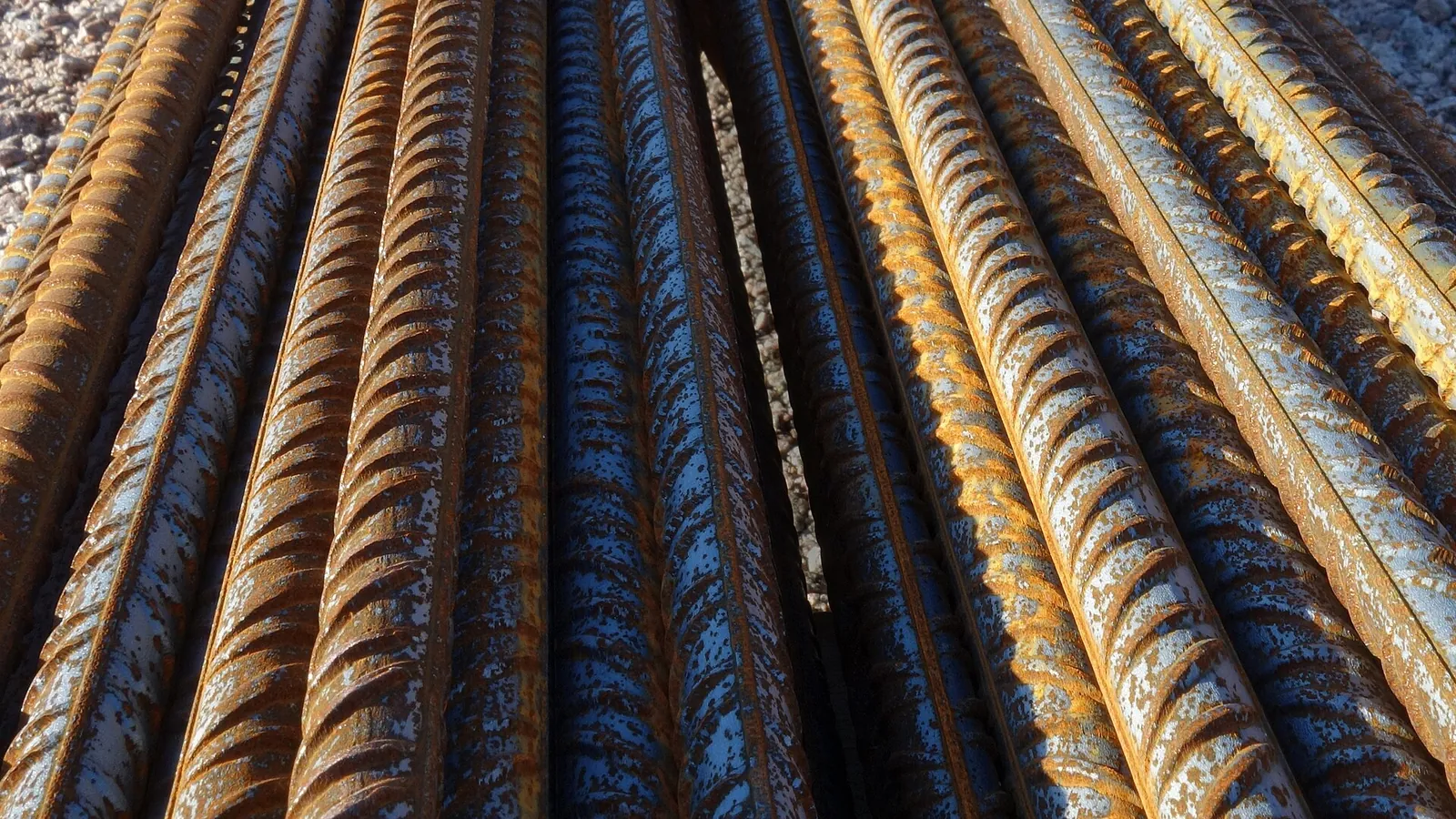
Bundled bars are groups of two to four parallel reinforcing bars placed in contact with each other so they act as one unit. Engineers bundle bars when a beam or column needs more steel than fits with normal spacing. ACI 318 limits a bundle to four bars, does not allow bars larger than #11 to be bundled in beams, and requires the bundle to be enclosed by stirrups or ties.
Why engineers bundle bars
A beam or column has a fixed width, and each bar needs clear space around it so concrete can flow between the bars and grip them. When the design needs a lot of steel, single bars at the minimum spacing can run out of room. Bundling puts two, three or four bars together in one spot, which frees up space between the groups for concrete and vibrators.
You will see bundled bars most often in:
- Heavily loaded columns in the lower floors of tall buildings, typically at the corners of the ties.
- Transfer beams and deep girders with large bottom steel.
- Bridge piers and other heavy members.
In most houses and light commercial work you will not see them at all. When you do, they are worth slowing down for, because they are easy to miscount. The rebar congestion and constructability article covers the wider problem bundling is trying to solve.
ACI 318 limits for bundled bars
These are typical ACI 318-19 provisions (Section 25.6). The project's general notes and the governing code always win.
| Rule | Typical ACI 318 requirement |
|---|---|
| Bars per bundle | Not more than 4 |
| Bar size in beams | Bars larger than #11 shall not be bundled in beams |
| Enclosure | Bundles shall be enclosed within stirrups or ties |
| Cut-offs in a span | Bars of a bundle that stop within the span of a flexural member terminate at different points, staggered at least 40db |
| Development length | Individual bar ld increased 20% for a 3-bar bundle and 33% for a 4-bar bundle |
| Spacing and cover | A bundle is treated as a single bar with the same total area |
Two of these rules matter directly for the estimator: the stagger (it creates several bar lengths inside one bundle) and the development length increase (it makes laps and anchorage of bundled bars longer than for the same bar alone).
The equivalent bar diameter
For spacing and cover, the code treats the bundle as one imaginary bar with the same total area. Its diameter is:
d equivalent = square root of (4 x total area / pi)
| Bundle | Total area (sq in) | Equivalent diameter (in) |
|---|---|---|
| 2-#9 | 2.00 | 1.60 |
| 2-#11 | 3.12 | 1.99 |
| 3-#11 | 4.68 | 2.44 |
| 4-#11 | 6.24 | 2.82 |
So a 3-#11 bundle needs spacing and cover as if it were a bar about 2.44 in across. The detailer handles this, but it explains why bundled members often have a larger cover dimension or wider spacing on the section than the bar size alone would suggest. See concrete cover for how cover is read on drawings.
What bundles look like
A two-bar bundle is two bars side by side or one on top of the other. Three-bar bundles are usually an L shape or a triangle. Four-bar bundles form a square. In every case the bars touch.
How bundled bars are shown on drawings
There is no single notation, so read the section and the general notes together. Common ways you will see them:
- On a section, bars drawn touching in pairs or groups at the corners, with a callout such as "2-#10 BUNDLED" or "(4) BUNDLES OF 3-#11."
- On a beam schedule, a column for bottom bars that reads "6-#10 (2 BUNDLES OF 3)" or a footnote saying bars are bundled.
- On a column schedule, a bar count with a note such as "BUNDLE IN 4 CORNERS." Count the total, not the number of corners. The column schedule article covers the rest of that table.
- On beam elevations, bars of one bundle drawn as several lines with different end points, each with its own length or cut-off dimension.
The one thing to settle before you count: does the number in the callout mean bars or bundles? "3 BUNDLES OF 2-#9" is 6 bars. "2-#9 BUNDLED" is 2 bars. When a callout is ambiguous, the section drawing usually settles it, and if it does not, ask.
Worked example: a beam with staggered bundles
Beam B-3 carries its bottom steel in 2 bundles of 3-#10, one at each bottom corner. The elevation shows, for each bundle:
- Bar 1: full length, 34'-0"
- Bar 2: centered, stopping 4'-0" short of bar 1 at each end
- Bar 3: centered, stopping a further 40db short of bar 2 at each end
Step 1: check the stagger. Bar 1 runs into the supports, so the 40db rule applies to the bars that stop within the span, bars 2 and 3. 40db for #10 = 40 x 1.27 = 50.8 in. The detailer rounds up to 4'-3" (51 in).
Step 2: bar lengths.
- Bar 1: 34'-0" = 34.0 ft
- Bar 2: 34 - 2 x 4 = 26.0 ft
- Bar 3: 26 - 2 x 4.25 = 17.5 ft
Step 3: length per bundle. 34.0 + 26.0 + 17.5 = 77.5 ft.
Step 4: both bundles. 2 x 77.5 = 155.0 ft.
Step 5: weight. #10 weighs 4.303 lb/ft: 155.0 x 4.303 = 667 lb (about 303 kg).
Step 6: bar marks. Three different lengths means three marks, each with a quantity of 2.
Two ways to get this wrong
- Counting bundles as bars: 2 bars x 34 ft = 68 ft, or 293 lb. That misses more than half the steel.
- Counting every bar full length: 6 x 34 ft = 204 ft, or 878 lb. That overstates the steel by 211 lb and ignores the stagger the engineer drew.
The right answer sits between them, and you only get it by reading the elevation, not the schedule alone. The same discipline is covered in the beam reinforcement article.
Takeoff checklist for bundled bars
- Total bars, not bundles. Multiply bundles by bars per bundle before anything else.
- One mark per length. Staggered cut-offs give different lengths inside the same bundle.
- Laps and anchorage. Development length of a bar in a 3-bar bundle is 20% longer and in a 4-bar bundle 33% longer than the single-bar value. If the lap lengths are tabulated on the drawings, use the drawing values; if you calculate them, apply the increase. See lap splice length.
- Ties at the bundle. Columns with corner bundles often have ties shaped to hold the group, sometimes with extra crossties. Count them from the tie detail, not from a standard tie pattern.
- Splices in columns. Laps in bundled column bars are often staggered so that not all bars in a bundle splice at the same level. Read the column elevation for the splice pattern.
Frequently asked questions
How many bars can be in a bundle?
ACI 318 allows up to four bars in one bundle. Two-bar and three-bar bundles are more common. A group of five or more bars in contact is not permitted as a bundle.
Can you bundle #14 or #18 bars?
ACI 318 does not allow bars larger than #11 to be bundled in beams. For other members, follow the code provisions and the engineer's details on the drawings; do not assume.
Why are bundled bars cut off at different points?
If all the bars in a bundle stopped at the same point, the bundle would lose its whole area at once and create a weak section with a concentration of stress. ACI 318 requires bars that stop within the span of a flexural member to be staggered at least 40 bar diameters.
Do bundled bars need longer laps?
Yes. ACI 318 increases the development length of each bar in a bundle by 20% for a three-bar bundle and 33% for a four-bar bundle. Laps are based on development length, so they grow too.
How do I count bundled bars in a takeoff?
Count individual bars: bundles times bars per bundle. Then take each length from the elevation, because staggered cut-offs make the bars of one bundle different lengths, each with its own bar mark.
This article explains general practice for learning purposes. On a real project, the drawings, the general notes and the governing code always win.