Forces Explained · No. 9
One-Way vs Two-Way Slabs
Where Does the Load Go?
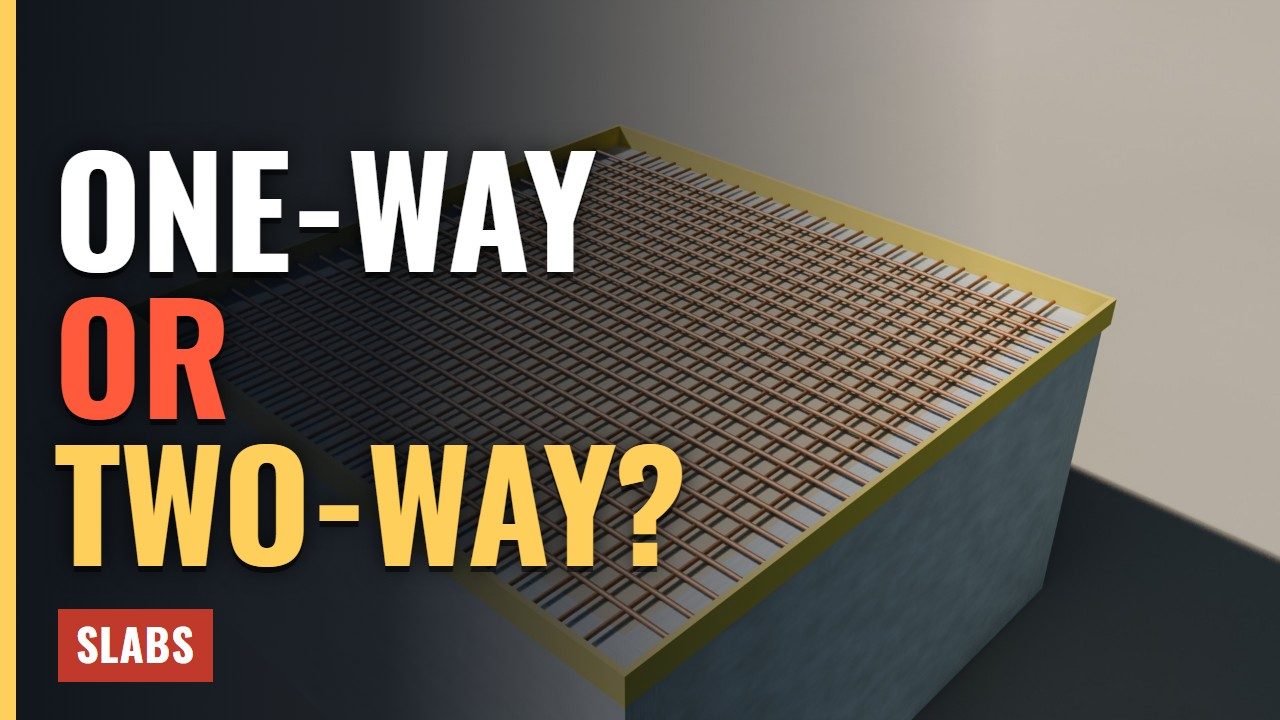 Video coming soon. Full article below
Before an engineer decides how much steel goes into a concrete slab, there is a simpler question: which way does the load go?
This video explains the difference between a one-way slab and a two-way slab, the rule of thumb of two to one and where it comes from, where the main bars and the distribution bars go, how the load is shared between the beams, and how ribbed, waffle, flat and precast slabs fit the same idea.
The full story
Look up at the ceiling of a car park. You see a flat plate of concrete. Inside it there are steel bars, and they do not run in just any direction. Before an engineer decides how much steel to put in a slab, there is a simpler question. Which way does the load go?
A slab has one job. It takes the weight of the floor, the people and the furniture, and it carries that weight sideways, to the beams or the walls that support it. And like water running downhill, the load takes the shortest and stiffest way out.
Start with a slab that rests on only two sides. It can bend in one direction only, like a row of planks lying side by side. All the load goes to those two supports. This is a one-way slab.
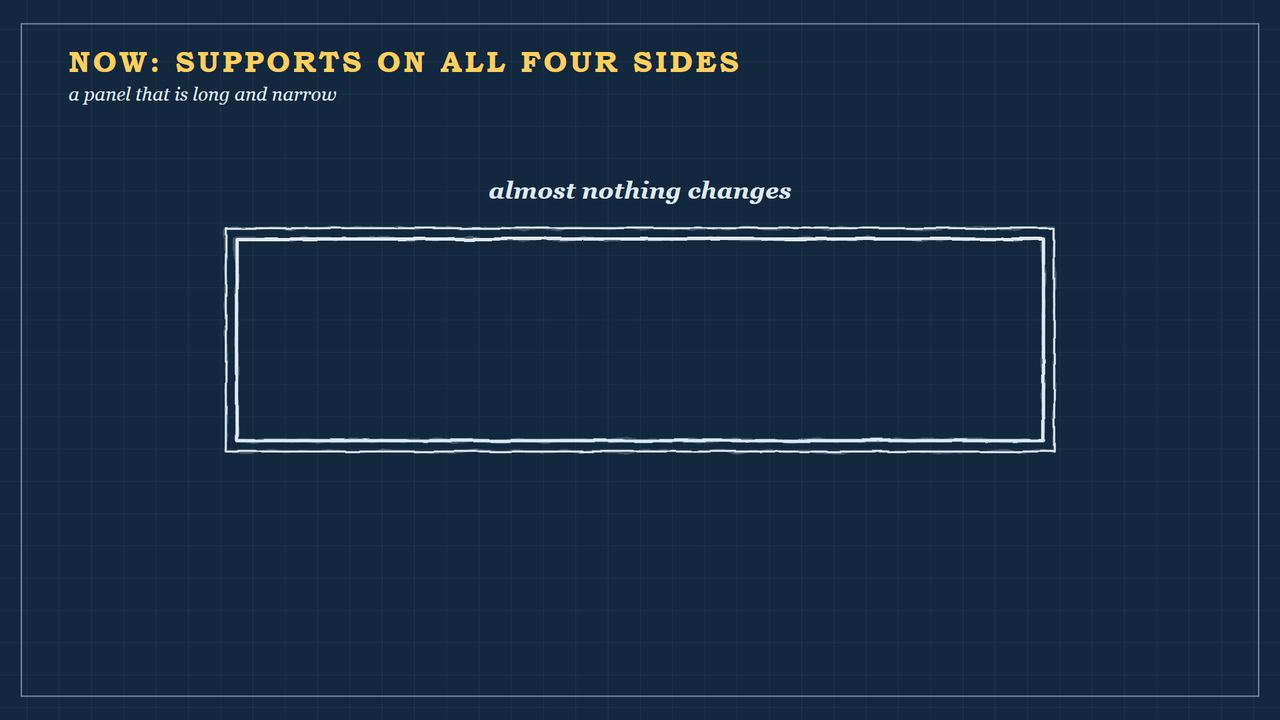
Now put supports on all four sides. If the panel is long and narrow, almost nothing changes. The short direction is so much stiffer than the long one that the load still goes the short way. The rule of thumb is simple. If the long side is more than twice the short side, treat it as a one-way slab.
Why twice? Imagine two strips of the slab that cross in the middle. They must go down by the same amount. But a strip that is twice as long is sixteen times softer. So at a ratio of two to one, the short strip carries about 94 percent of the load, and the long strip almost nothing.
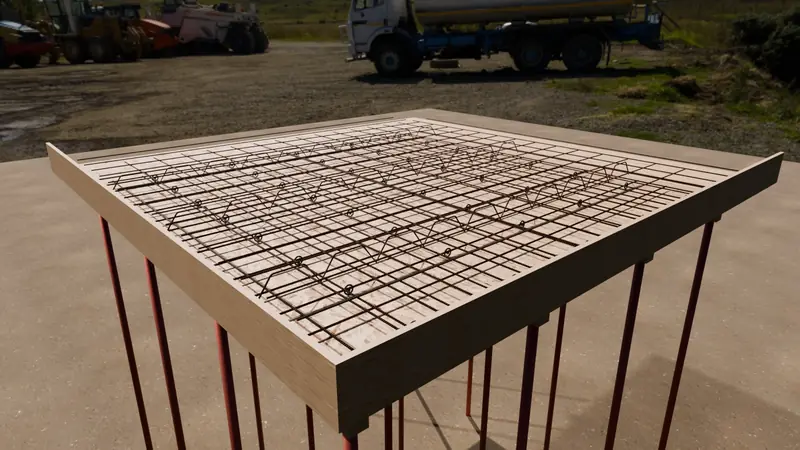
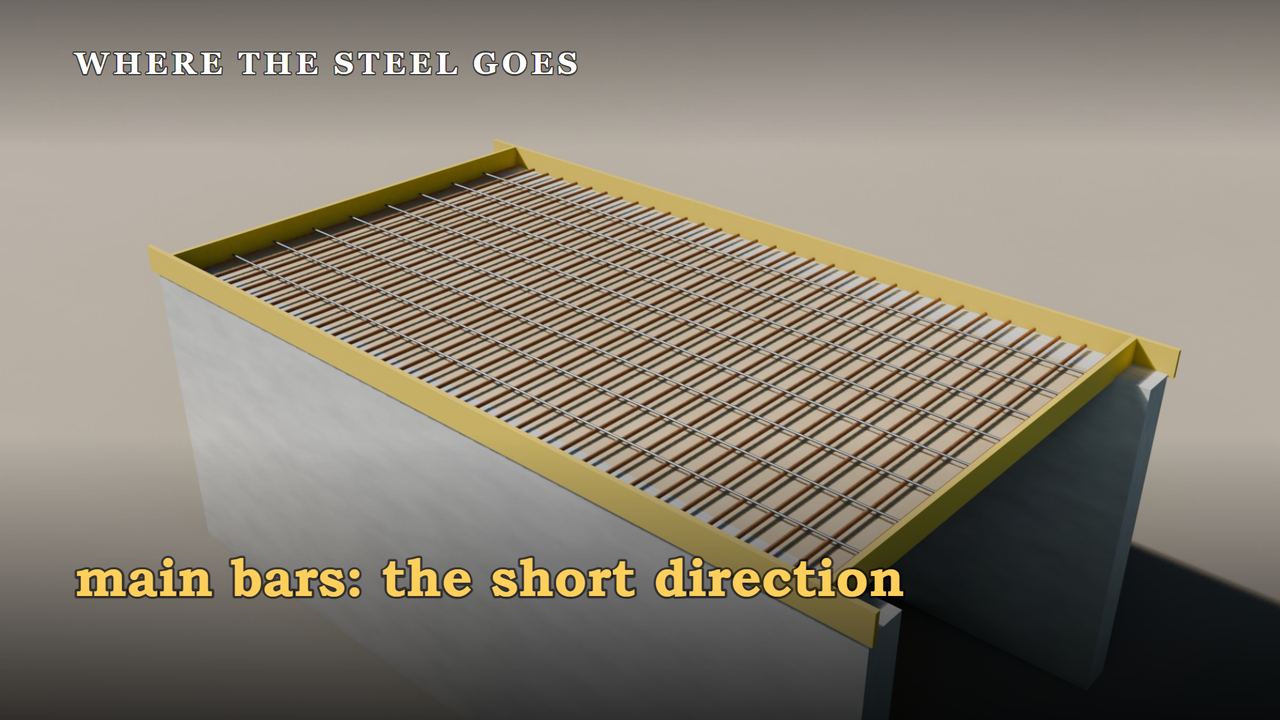
That tells you where the steel goes. In a one-way slab, the main bars run in the short direction, at the bottom, where the concrete is stretched. Over a support, where the slab bends the other way, the main bars are at the top. Across them runs a lighter set of bars. They carry no real load. They hold the main bars in place, spread the load, and control the cracks.
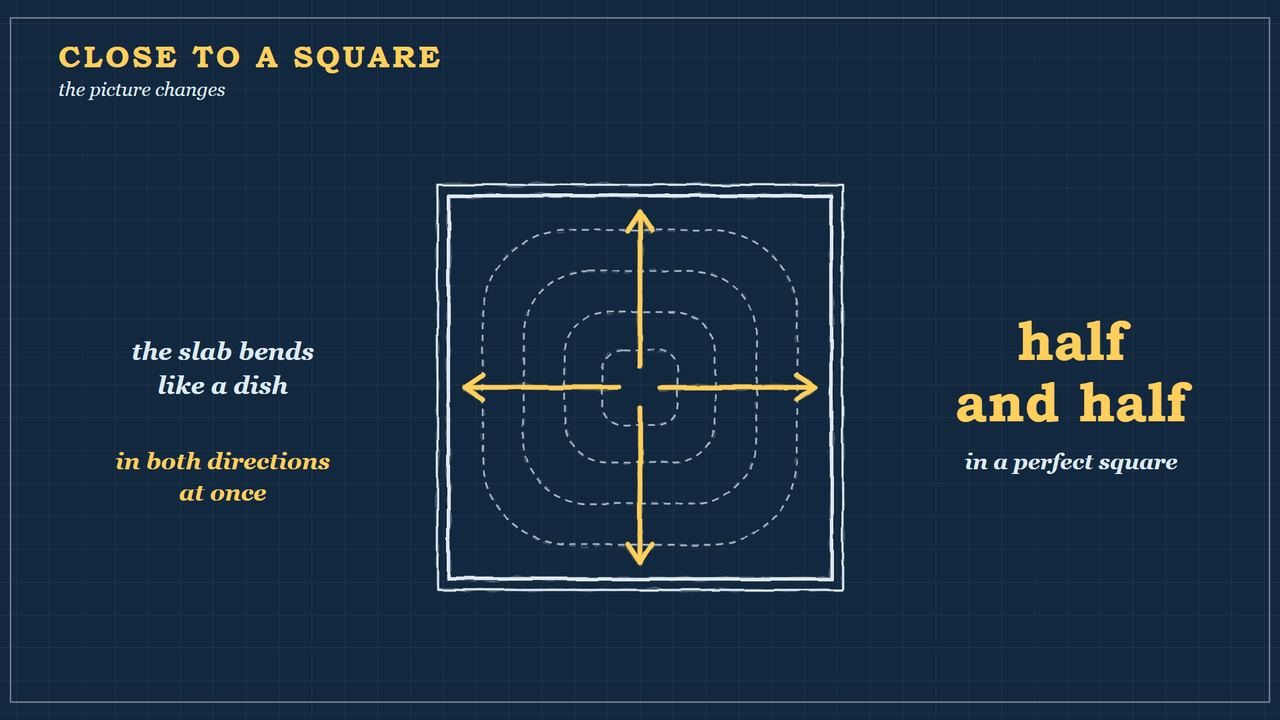
When the panel is close to a square, the picture changes. The slab bends like a dish, in both directions at once. Each direction carries part of the load. In a perfect square, they share it half and half. This is a two-way slab, and it has main bars in both directions. The bars of the shorter span go in the outer layer, closer to the bottom, because that direction works harder.
The load on the beams changes too. Under a one-way slab, each beam simply gets half of the panel: a long rectangle. Under a two-way slab, draw a line at 45 degrees from each corner. The short beams get a triangle. The long beams get a trapezoid. So the load on a beam is no longer even. It grows towards the middle.
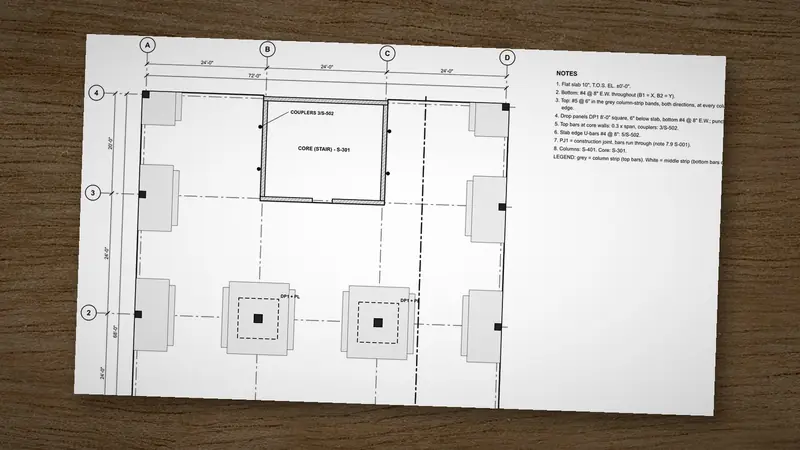
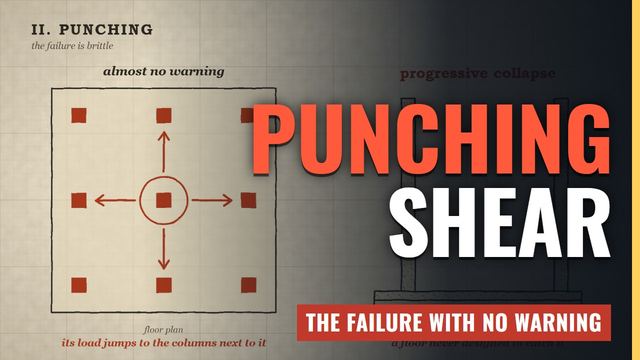
The same idea explains the different kinds of slabs. A ribbed slab is a row of small beams with light blocks between them: it works one way. A waffle slab has ribs in both directions: it works two ways. A flat slab has no beams at all, and rests directly on the columns: two ways again, with a special danger around each column. And the long precast planks you see on trucks work one way only.
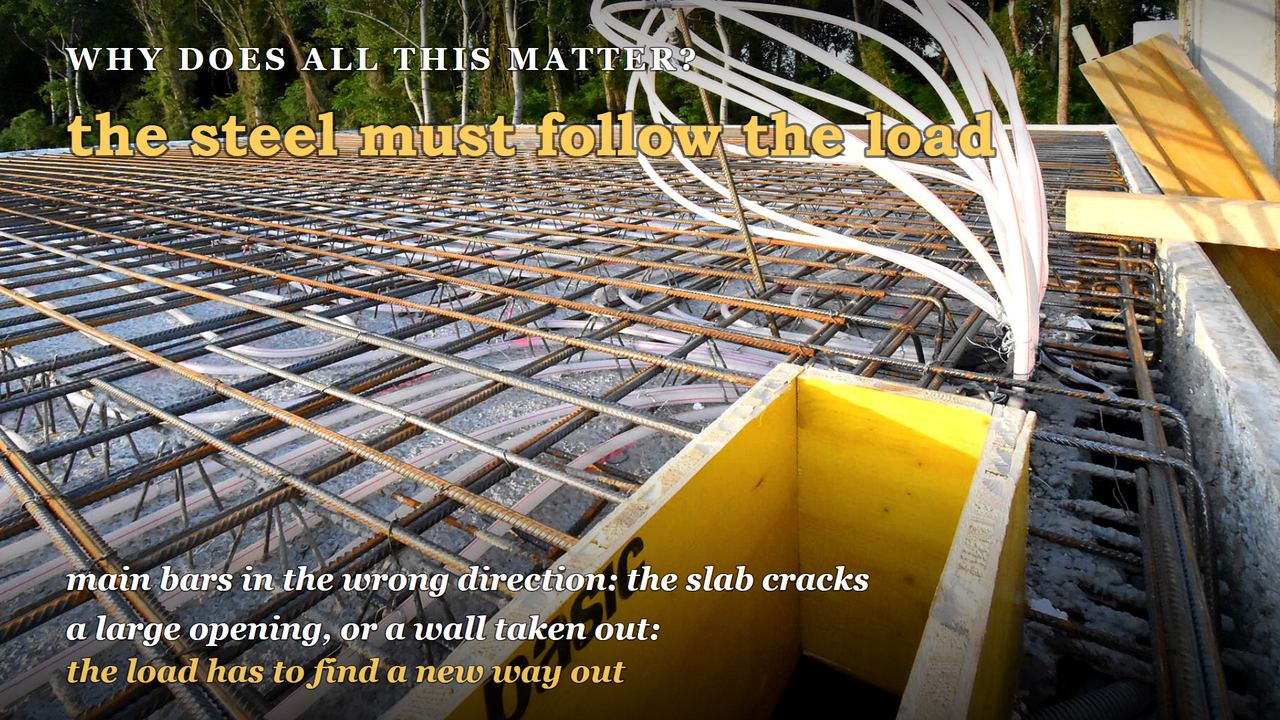
Why does all this matter? Because a slab only works if the steel follows the load. Put the main bars in the wrong direction, and the slab cracks. Cut a large opening, or take out a wall that was a support, and the load has to find a new way out.
So before you ask how much steel, ask which way the load goes. Everything else in the slab follows from that.
This is The Bending Moment. Thank you for watching.
The Guide
Handed a set of plans and no one to check your takeoff?
How to Read Structural Drawings follows one beam, B2, from the plan to the section, the schedule and the general notes, then decodes it in the six rebar notations you will meet on real sets. Plans, not slides. Takeoffs, not bid theory.
#5H1616ØT16Ø16N1661 pages · 12 exercises with answers · about 100 abbreviations · PDF · one payment
Photo credits
- Car park: OathOn, CC BY-SA 4.0
- Waffle slab: Images George Rex, CC BY-SA 2.0
- Slab reinforcement: Helyesen, CC BY 3.0
Photos from Wikimedia Commons under the licences listed. All drawings are original.
The narration uses an AI clone of the author's own voice. All drawings are original.