What Is a Standard Hook in Rebar? 90° and 180° Hooks
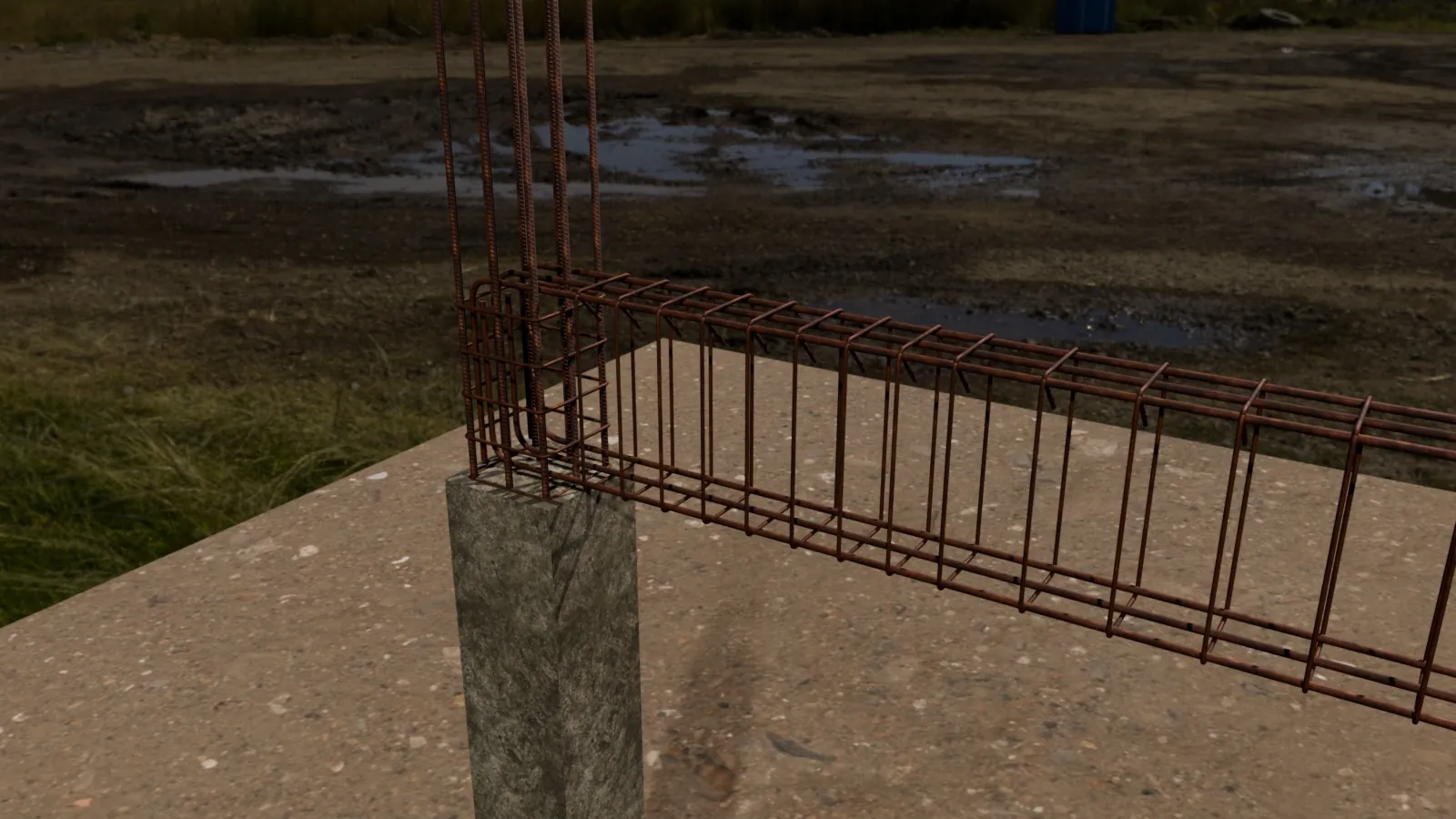
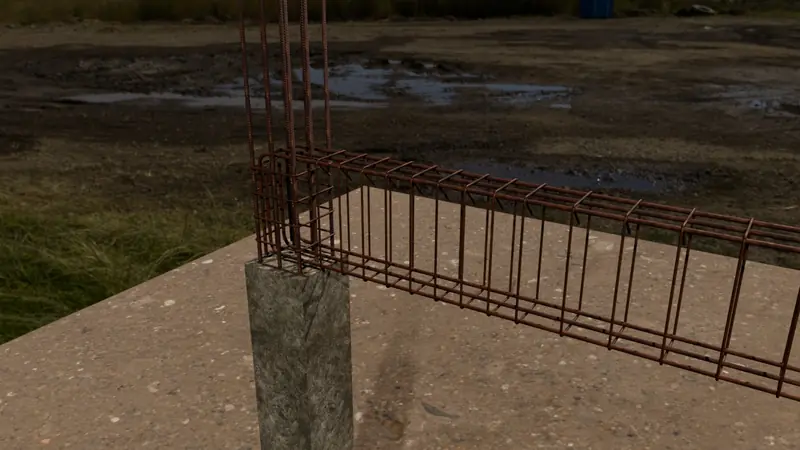
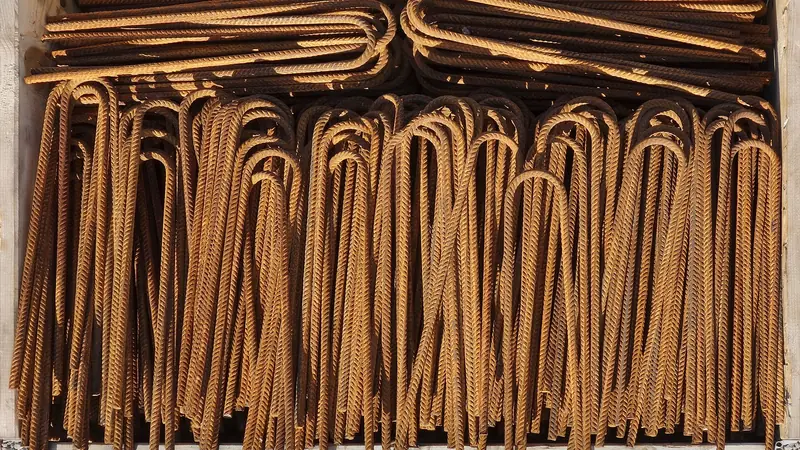
A standard hook is the end of a reinforcing bar bent to a 90° or 180° angle with a code-defined inside bend diameter and a straight extension past the bend. It anchors the bar where there is not enough straight length to develop it, for example at the end of a beam or the edge of a footing.
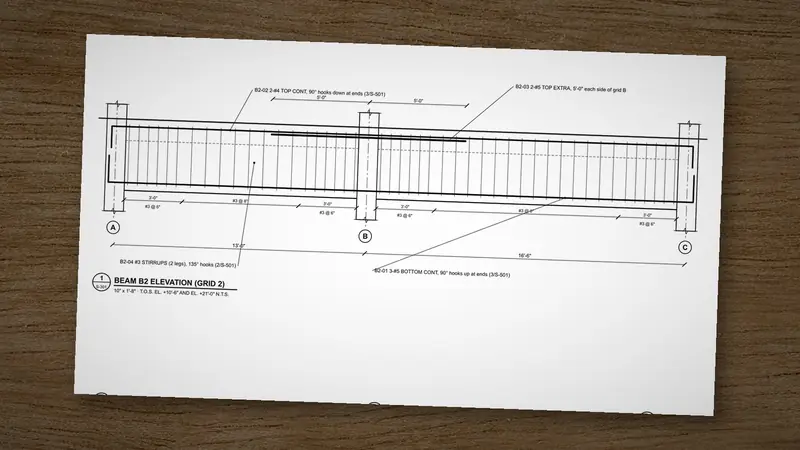
Where you see it on a drawing
On a section the hook is drawn as a short bent leg at the end of the bar line, often labelled "STD HK" or "STD 90° HK". On a typical detail sheet the engineer may write "provide standard hooks at discontinuous ends". In a bar bending schedule the hook shows up as a bent shape with the leg length listed. The rebar callouts article covers the abbreviations.
Typical ACI 318 dimensions
These are typical ACI 318 values for standard hooks in tension. The general notes and the governing code edition always win.
- 90° hook: inside bend diameter as below, then a straight extension of 12 db (db = bar diameter).
- 180° hook: inside bend diameter as below, then a straight extension of 4 db or 2.5 in, whichever is greater.
- Inside bend diameter: 6 db for #3 to #8, 8 db for #9 to #11, 10 db for #14 and #18.
| Bar size | db (in) | Bend diameter (in) | 90° extension, 12 db (in) | 180° extension (in) |
|---|---|---|---|---|
| #3 | 0.375 | 2.25 | 4.5 | 2.5 |
| #4 | 0.500 | 3.00 | 6.0 | 2.5 |
| #5 | 0.625 | 3.75 | 7.5 | 2.5 |
| #6 | 0.750 | 4.50 | 9.0 | 3.0 |
| #7 | 0.875 | 5.25 | 10.5 | 3.5 |
| #8 | 1.000 | 6.00 | 12.0 | 4.0 |
| #9 | 1.128 | 9.02 | 13.5 | 4.5 |
| #10 | 1.270 | 10.16 | 15.2 | 5.1 |
| #11 | 1.410 | 11.28 | 16.9 | 5.6 |
Stirrup and tie hooks follow different, smaller rules. See hooks and development length for those and for how a hook shortens the development length.
Worked example: a #6 hooked bar
A #6 top bar ends at a wall with a 90° standard hook.
- db = 0.75 in
- Bend diameter: 6 x 0.75 = 4.5 in
- Straight extension after the bend: 12 x 0.75 = 9.0 in
For estimating, many detailers add the hook as an extra leg length per your company's convention. Be consistent across the whole takeoff.
A common mistake
Confusing the hook extension with the development length. The 12 db extension only describes the shape of the hook. The length of bar needed before the hook to anchor it (ldh) is a separate calculation from the code and is often much longer.
Frequently asked questions
What is the difference between a 90° and a 180° hook?
A 90° hook turns the bar at a right angle and continues 12 db. A 180° hook turns it back on itself and continues 4 db or 2.5 in, whichever is greater. The drawing or the general notes say which one is required.
Does a standard hook replace development length?
No. A hook shortens the length needed to anchor the bar, but the bar still needs a computed hooked development length before the bend.
What does STD HK mean on a drawing?
It means standard hook. Unless the detail says otherwise, it is built to the standard hook dimensions of the governing code.
This article explains general practice for learning purposes. On a real project, the drawings, the general notes and the governing code always win.