Rebar Shape Codes: BS 8666 Codes and US Standard Bends Explained
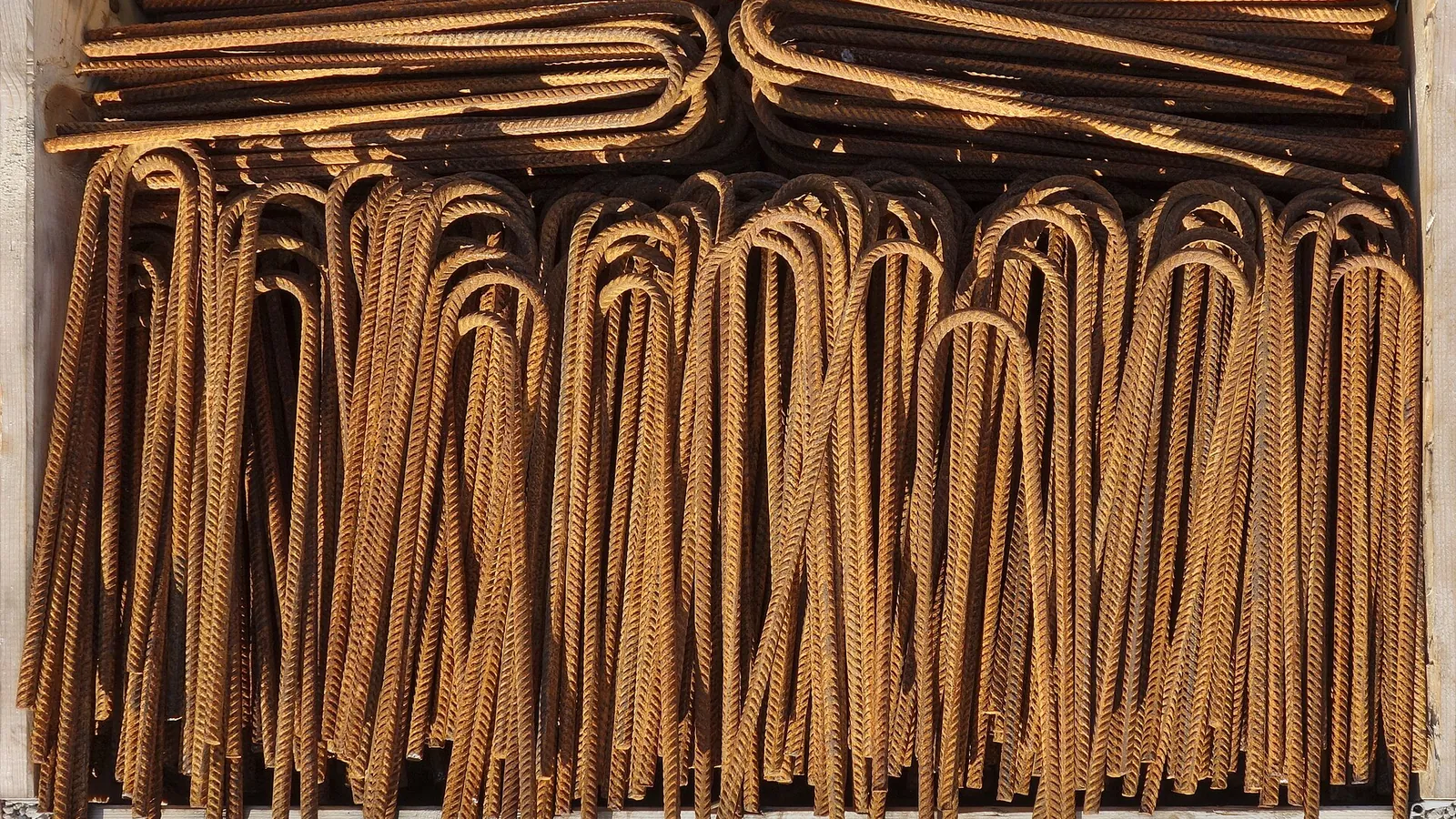
Rebar shape codes are short standard numbers that tell the fabricator how a bar is bent, so the schedule does not need a sketch for every bar. Under the British standard BS 8666, a two-digit code such as 00 (straight), 11 (one 90 degree bend) or 21 (a U shape) is combined with dimensions A, B, C to define the bar completely. In the US, bar lists use the bend types and standard hooks published by CRSI and ACI instead.
This guide covers the rebar shape codes you can rely on in both systems, how the dimensions are measured, and how to work out cut lengths from them.
Why rebar shape codes exist
A large project can have thousands of bar marks. Drawing each bent bar would be slow and error-prone, and every fabricator would interpret the sketches differently. Shape codes give a shared language: the designer or detailer writes a code and dimensions, and the bending machine operator knows exactly what to produce.
For an estimator, shape codes matter because they decide cut length and therefore weight. A U-bar and a straight bar with the same A dimension are very different quantities.
BS 8666 shape codes
BS 8666 is the UK specification for scheduling, dimensioning, bending and cutting reinforcement. It is used in the UK and on many projects in the Gulf, Asia and Africa that follow British practice. The 2005 edition is still widely referenced; the 2020 revision amended a number of shapes and length formulas and added new ones. Use the edition your project specifies.
How the numbering works
The first digit of a two-digit code broadly groups shapes by the number of bends: 0 for straight bars, 1 for one bend, 2 for two bends, and so on, with higher numbers for links, circles and special shapes. Do not guess a shape from the number alone, though. Always read the shape diagram on the schedule or in the standard.
Codes you will meet most
| Code | Shape | Dimensions | Total length L (BS 8666:2005) |
|---|---|---|---|
| 00 | Straight bar | A | L = A |
| 01 | Straight bar in stock lengths | A | L = A |
| 11 | One 90 degree bend (L-bar) | A, B | L = A + B - 0.5r - d |
| 12 | One 90 degree bend with a specified radius | A, B, R | See standard |
| 13 | One 180 degree bend (U-turn of specified diameter) | A, B, C | See standard |
| 21 | Two 90 degree bends (U-bar or trough) | A, B, C | L = A + B + C - r - 2d |
| 51 | Closed rectangular link | A, B, C, D | See standard |
| 63 | Closed rectangular link, ends closed differently from 51 | A, B, C, D | See standard |
| 75 | Circle with lapped ends | A (diameter), B (lap) | L = π(A - d) + B |
| 77 | Helix | A (diameter), B (pitch), C (turns) | See standard |
| 99 | Special shape, not covered by a standard code | Fully dimensioned sketch | Calculated for the shape |
Here d is the nominal bar diameter and r is the scheduling bend radius. In BS 8666:2005 the minimum scheduling radius for B500 bars is 2d for bars up to 16 mm and 3.5d for 20 mm and above: for example 24 mm for a 12 mm bar and 70 mm for a 20 mm bar.
Where a formula says "see standard", the length depends on hook and overlap rules that differ between editions. For those codes, take the length from the issued schedule or the standard itself rather than from memory.
How dimensions are measured
Dimensions on BS 8666 shapes are generally given to the outside of the bar. Because the bar curves at each bend, the cut length is less than A + B + C, which is why each formula subtracts something for every bend. One dimension in each shape diagram is usually shown in brackets: this is the free dimension, the one allowed to absorb small fabrication deviations. On the schedule it is still written as a normal number.
Worked example: cut lengths from BS 8666 codes
Three bars from a schedule:
Bar 1: H12, shape 11, A = 600, B = 250.
- d = 12 mm, r = 2 x 12 = 24 mm.
- L = 600 + 250 - 0.5 x 24 - 12 = 850 - 12 - 12 = 826 mm.
Bar 2: H20, shape 21, A = 400, B = 900, C = 400.
- d = 20 mm, r = 3.5 x 20 = 70 mm.
- L = 400 + 900 + 400 - 70 - 2 x 20 = 1700 - 70 - 40 = 1590 mm.
- The sum of the legs is 1700 mm, so ignoring the bends would overstate this bar by 110 mm, about 7 percent.
Bar 3: H10, shape 75, A = 500, B = 400.
- L = π x (500 - 10) + 400 = 1539.4 + 400 = 1939 mm.
Weights (metric mass = d² / 162 kg/m):
- Bar 1: 0.826 m x 0.889 kg/m = 0.73 kg.
- Bar 2: 1.590 m x 2.469 kg/m = 3.93 kg.
- Bar 3: 1.939 m x 0.617 kg/m = 1.20 kg.
How these lines sit in a full schedule is shown in the bar bending schedule guide. You can check bar masses with the rebar weight calculator.
US practice: bend types and standard hooks
US bar lists do not use BS 8666 codes. The rebar detailer shows each bent bar with a bend type from the typical bar bends chart in the CRSI Manual of Standard Practice, which the ACI Detailing Manual also reproduces in its own form, with dimensions given out-to-out. Bend type numbering is not the same in every edition and office, so read the bend type together with the sketch on the bar list or placing drawing, and do not translate one system into the other by number.
What is fixed by the code, and what most US bends are built from, is the standard hook. Typical ACI 318 values are:
| Hook | Used for | Extension past the bend | Minimum inside bend diameter |
|---|---|---|---|
| 90 degree | Main bars | 12db | 6db for #3 to #8 |
| 180 degree | Main bars | 4db, not less than 2 1/2 in | 6db for #3 to #8 |
| 90 degree | Stirrups and ties, #3 to #5 | 6db, not less than 3 in | 4db |
| 90 degree | Stirrups and ties, #6 to #8 | 12db | 6db |
| 135 degree | Stirrups and ties, #3 to #8 | 6db, not less than 3 in | 4db for #3 to #5, 6db for #6 to #8 |
Larger bars need a larger bend diameter: 8db for #9 to #11 and 10db for #14 and #18. These are typical values only; the project's general notes and governing code win. How hooks feed into anchorage is covered in rebar hooks and development length.
Worked example: a #5 bar with a 90 degree hook
A #5 bar (db = 0.625 in) is detailed 8'-0" (96 in) out-to-out with a standard 90 degree hook at one end.
- Inside bend diameter: 6 x 0.625 = 3.75 in.
- Out-to-out hook dimension: extension 12db = 7.5 in, plus half the bend diameter and one bar diameter (1.875 + 0.625 = 2.5 in) = 10 in.
- Straight part along the 96 in leg: 96 - 2.5 = 93.5 in.
- Arc along the bar centerline: radius 1.875 + 0.3125 = 2.1875 in. Quarter circle = 3.1416 x 2.1875 / 2 = 3.44 in.
- Cut length: 93.5 + 3.44 + 7.5 = 104.4 in, about 8'-8 1/2".
Adding the out-to-out dimensions (96 + 10 = 106 in) would overstate this bar by about 1.6 in. A fabricator's software may round slightly differently, but the method is the same: straight parts plus arcs along the centerline.
Reading shape codes on a takeoff
- Weight follows cut length, not the sum of the legs. For estimating, small bend deductions are often within waste allowance, but on bars with many bends they add up.
- Links and stirrups are the busiest marks. A beam can have hundreds of identical links, so check their dimensions carefully.
- Special shapes cost more to bend. A code 99 or any non-standard sketch means custom work.
- Know which system the drawings use. A US set and a UK set describe the same bar in completely different ways; see international rebar notation.
Frequently asked questions
What is a shape code in rebar?
A shape code is a standard number that tells the fabricator the bent shape of a bar. Combined with dimensions A, B, C and so on, it defines the bar completely without a drawing. BS 8666 is the most widely used shape code system outside the US.
What is shape code 00?
Shape code 00 in BS 8666 is a straight bar. Its cut length equals dimension A, so there is no bend deduction.
What is shape code 21?
Shape code 21 is a bar with two 90 degree bends, forming a U or trough shape, with legs A and C and base B. In BS 8666:2005 its length is A + B + C - r - 2d, where r is the bend radius and d the bar diameter.
What is shape code 99?
Shape code 99 covers any shape that does not match a standard code. It must be shown with a fully dimensioned sketch on the schedule, and its length is calculated for that specific shape.
Does the US use BS 8666 shape codes?
No. US bar lists use the bend types from the CRSI Manual of Standard Practice and the ACI Detailing Manual, with dimensions out-to-out and hooks to ACI 318. The concepts are similar, but the numbers do not match.
This article explains general practice for learning purposes. On a real project, the drawings, the general notes and the governing code always win.