What Does O.C. Mean on Structural Drawings?

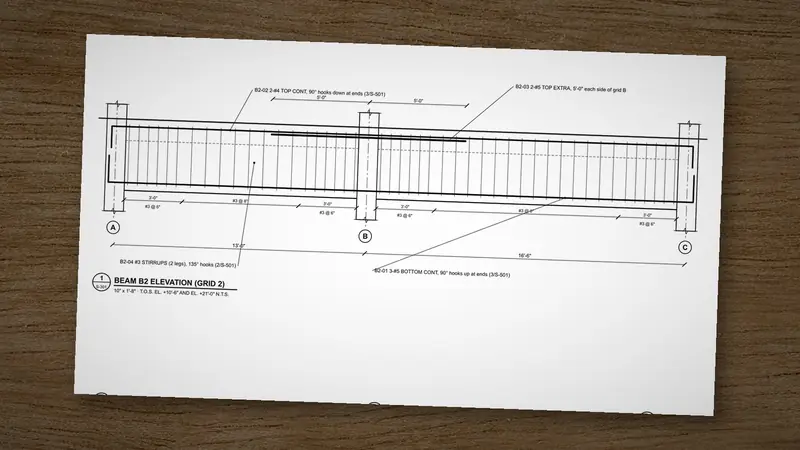
O.C. means on center. A callout like #4 @ 12" O.C. tells you that the bars are spaced 12 inches apart, measured from the center of one bar to the center of the next bar.
Where you see O.C. on a drawing
On the drawing you will see O.C. after almost every spacing: slab bars (#4 @ 16" O.C. EW), wall bars (#5 @ 12" O.C. VERT), stirrups (#3 STIRRUPS @ 8" O.C.), and also anchor bolts, studs and joists. Many sets drop the O.C. and simply write #4 @ 12"; the @ spacing is on center unless the drawing says otherwise. Metric drawings say the same thing as H12-200 or T12 @ 200 c/c, where c/c means centre to centre (see international rebar notation).
O.C. is different from clear spacing, which is the gap between the surfaces of two bars. Clear spacing equals the on-center spacing minus one bar diameter. Codes set minimum clear spacing so concrete can flow between bars; more on that in rebar spacing.
What O.C. changes in a takeoff
O.C. spacing is how you turn a dimension into a bar count. The basic formula is:
Number of bars = (distance / spacing) + 1, rounded up.
The "+1" is there because a run of bars has a bar at both ends. A 10 ft run at 12 in O.C. needs 11 bars, not 10. Think of fence posts.
Worked example
A slab edge is 26 ft 6 in long, with #4 @ 12" O.C. across it and 3 in cover at each end.
- Distance the bars spread over: 26.5 ft - 2 x 0.25 ft = 26.0 ft = 312 in
- Spaces: 312 / 12 = 26
- Bars: 26 + 1 = 27 bars
| Distance | Spacing | Spaces | Bars |
|---|---|---|---|
| 10 ft | 12 in | 10 | 11 |
| 10 ft | 16 in | 7.5, round up to 8 | 9 |
| 20 ft | 18 in | 13.3, round up to 14 | 15 |
| 26 ft | 12 in | 26 | 27 |
When the division does not come out even, round the number of spaces up. Rounding down would leave a gap wider than the specified spacing, which the placer cannot do. The full counting method is in how to do a rebar takeoff step by step.
A common mistake
The most common mistake is forgetting the +1, which loses one bar on every run. On a single footing it hardly matters; across hundreds of slab runs and wall panels it adds up. The opposite mistake is adding the +1 twice where two runs meet at a shared bar, for example at a construction joint where the bar is already counted on one side.
A second mistake is confusing O.C. with clear spacing on a detail that gives clear distances. If a note says 1" CLR BETWEEN BARS, that is not the bar spacing.
Frequently asked questions
Is O.C. the same as c/c?
Yes. O.C. (on center) is the US term; c/c or "centres" is the term on British, Australian, Indian and many other metric drawings. Both measure center of bar to center of bar.
How many bars are in 10 feet at 12 inches on center?
Eleven. Ten spaces of 12 inches need eleven bars, one at each end. If cover is deducted at both ends first, check the count again, since a shorter distance can drop a bar.
Does #4 @ 12" mean 12 inches on center?
Yes. Unless the drawing says clear spacing, any @ spacing on a rebar callout is on center.
This article explains general practice for learning purposes. On a real project, the drawings, the general notes and the governing code always win.