Fiber Reinforced Concrete: Steel vs Synthetic Fibers and What They Replace
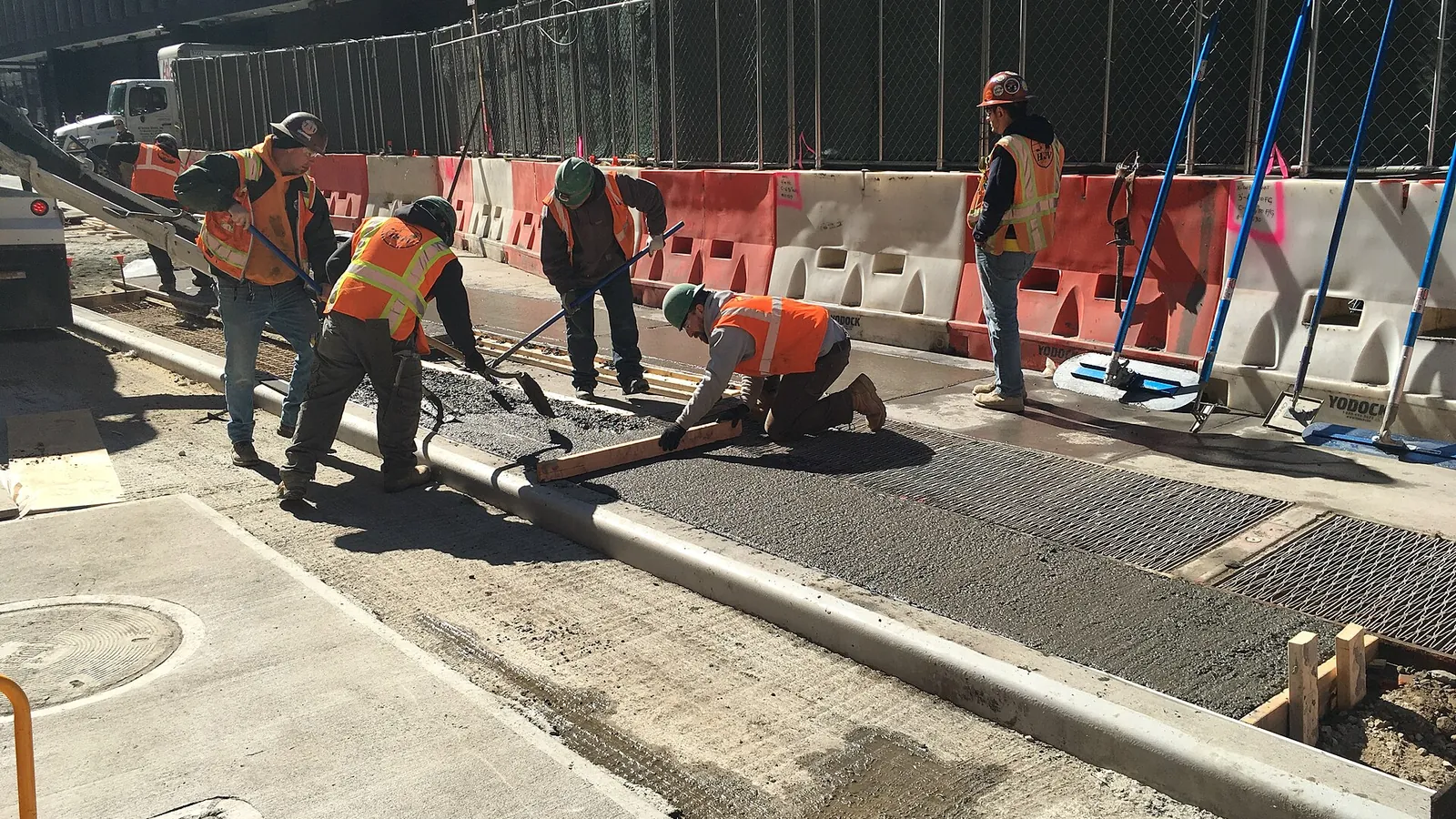
Fiber reinforced concrete is concrete with short, discrete fibers of steel, synthetic material, glass or cellulose mixed in at the batch plant, so the reinforcement is spread through the whole volume. Fine (micro) synthetic fibers mainly control early plastic shrinkage cracking, while steel and macro synthetic fibers hold cracks together after the concrete has cracked, which is why they can replace welded wire or light shrinkage steel in some slabs on grade. Fibers do not replace the main reinforcement in beams, columns, walls or suspended slabs, except in the narrow cases a code or evaluation report allows and the engineer accepts.
For the rebar estimator this changes what is in the field of the slab and what is not. The thickened edges, dowels and bars at openings are usually still there. The slab on grade reinforcement article shows the bar and mesh options fibers are compared with.
What fibers do
Plain concrete cracks and, once cracked, carries almost no tension across the crack. Conventional reinforcement solves that with continuous bars placed where the tension is. Fibers solve part of it differently: a large number of short pieces bridge small cracks in every direction.
Two stages matter:
- Before and at first cracking. In the first hours, while the concrete is still plastic, the surface can crack as water evaporates. Micro fibers resist that plastic shrinkage cracking. They have little effect on the strength of hardened concrete.
- After cracking. Once a hardened slab cracks from drying shrinkage or load, longer, stiffer fibers (steel or macro synthetic) pull out slowly across the crack and keep carrying some load. This residual strength is what lets them stand in for light shrinkage and temperature reinforcement. It is measured by beam tests such as ASTM C1609.
Fibers do not stop the concrete from shrinking. Joints are still needed, although some fiber-reinforced floor designs use wider joint spacing; see concrete control joints.
Types of fibers
ASTM C1116, the specification for fiber-reinforced concrete, classifies it by fiber type:
| C1116 type | Fiber | Typical use | Product standard |
|---|---|---|---|
| Type I | Steel | Industrial floors, pavements, shotcrete, precast | ASTM A820 |
| Type II | Alkali-resistant glass | Glass fiber reinforced concrete (GFRC) panels and thin products | Per specification |
| Type III | Synthetic (polypropylene, polyolefin, nylon and others) | Slabs on grade, toppings, shotcrete; micro and macro forms | ASTM D7508 for polyolefin |
| Type IV | Natural cellulose | Mostly plastic shrinkage control | Per specification |
Micro synthetic fibers
Very fine, short fibers, often polypropylene. They are sold mainly for plastic shrinkage crack control and are dosed in small amounts. A common mistake in the field is to treat them as a replacement for mesh. On their own they give little residual strength after the slab has cracked.
Macro synthetic fibers
Thicker and longer synthetic fibers, usually polyolefin blends. They are designed to give post-crack residual strength, and they are the usual choice where a specification replaces welded wire in a slab on grade with fibers. They do not rust, which matters for exposed surfaces and for slabs where corrosion stains are a concern.
Steel fibers
Short steel pieces, usually with hooked or deformed ends to anchor them in the concrete, conforming to ASTM A820. They give high residual strength and are common in heavy industrial floors and shotcrete. They can show at the surface if the floor is not finished with that in mind, and fibers near the surface can rust in wet exposure.
What fibers replace, and what they do not
| Reinforcement | Can fibers replace it? | Comment |
|---|---|---|
| Welded wire or light bars for shrinkage and temperature in a slab on grade | Often, when the engineer designs or approves it | Usually steel or macro synthetic fibers at a specified dosage |
| Shrinkage mesh in a topping or slab on metal deck | Sometimes | Some fiber products have evaluation reports for this use; the engineer and building official decide |
| Main flexural bars in beams, suspended slabs, walls, columns | No, in ordinary design | Fibers can be added, but the bars stay |
| Stirrups in beams | Only in a narrow case | ACI 318 permits deformed steel fibers in place of minimum shear reinforcement in some beams, within strict limits in the code |
| Bars at thickened edges, re-entrant corners, openings | Usually not | The details normally keep these bars |
| Dowels at construction or expansion joints | No | Load transfer across a joint needs dowels |
The pattern is simple: fibers can take over the job of light, distributed steel whose purpose is crack control. Where a member needs a known area of steel at a known depth to carry bending, that steel is still bars.
How fiber reinforced concrete shows up in specs and drawings
Fibers are a concrete mix item, so most of the information is in the specification, not on the plans. On the drawings you will see:
- A slab note: for example "6" SLAB ON GRADE WITH MACRO SYNTHETIC FIBERS PER SPECIFICATION, NO WWR". The words "no WWR" or "in lieu of WWR" tell you the mesh is gone.
- A typical slab section that shows no mesh in the field, but still shows the thickened edge bars and joint dowels.
- General notes that reference the concrete specification.
In the specification (usually the cast-in-place concrete section) you will find:
- Fiber type and the product standard (ASTM A820 for steel, ASTM D7508 for polyolefin, ASTM C1116 for the concrete).
- Dosage, in lb/yd³ or kg/m³, or a required residual strength from a beam test with the dosage left to the supplier.
- Mixing requirements and who adds the fibers (batch plant or truck).
- Finishing requirements, since fibers affect how the surface is finished.
If a drawing just says "fiber mesh" with no type or dosage, that is an RFI. "Fiber mesh" is a loose trade phrase, and it often means micro fibers, which do not do the job of welded wire.
Fiber vs rebar: comparing the systems
| Item | Rebar or welded wire | Fibers |
|---|---|---|
| Where the steel is | At a set depth, on chairs | Throughout the volume |
| Who supplies and places it | Rebar or mesh crew | Concrete supplier, mixed in |
| Placement risk | Mesh walked down to the bottom of the slab | Uneven mixing or balling if not mixed properly |
| What is inspected | Bar size, spacing, cover, laps | Dosage on delivery tickets, mixing |
| What the estimator counts | Bars, laps, chairs, sheets | Dosage x volume, priced by the concrete trade |
The choice depends on the slab, the loads and the specification. The rebar vs wire mesh article covers the other comparison that comes up on slabs.
Worked example: a fiber slab on grade
This is an invented example. A slab on grade is 80'-0" x 120'-0" (24.4 m x 36.6 m), 6 in (150 mm) thick. The drawing note reads "MACRO SYNTHETIC FIBERS IN LIEU OF WWR". The details still show a thickened edge with 2-#5 CONT. all around, and one construction joint across the 80 ft width with smooth dowels 3/4" DIA x 16" @ 12" O.C., first dowel 6 in from each end. The specification in this example gives a fiber dosage of 5 lb/yd³; that is this example's number, and the real dosage always comes from the project specification. Stock length 20 ft, lap for #5 of 2'-6" (example value).
Step 1: slab volume for the fiber quantity
Volume of the slab field = 80 x 120 x 0.5 = 4,800 ft³. 4,800 / 27 = 177.8 yd³ (about 136 m³).
Fibers = 177.8 x 5 = 889 lb, ordered with the concrete. This quantity belongs to the concrete supplier's ticket, not to the rebar takeoff. (The extra concrete in the thickened edge would also carry fibers if the whole pour is the fiber mix; add that volume from the edge section.)
Step 2: what leaves the rebar takeoff
No mesh in the field of the slab: no sheets, no laps, no mesh chairs. On a 9,600 ft² slab that is a whole line of work gone; the welded wire reinforcement article shows how that line would have been counted.
Step 3: the thickened edge bars, which stay
Perimeter = 2 x (80 + 120) = 400 ft. Closed loop with 20 ft bars and 2.5 ft laps: each bar adds 20 − 2.5 = 17.5 ft. 400 / 17.5 = 22.9, so 23 bars and 23 laps. Length per line = 400 + 23 x 2.5 = 457.5 ft. Two lines = 915 ft. Weight = 915 x 1.043 lb/ft = 954 lb of #5 (about 433 kg).
Step 4: the dowels, which stay
Joint length = 80 ft = 960 in. Spacing length = 960 − 6 − 6 = 948 in. 948 / 12 = 79 spaces, so 80 dowels. Length = 80 x 16 in = 1,280 in = 106.7 ft of 3/4 in smooth bar, at about 1.502 lb/ft = 160 lb.
Step 5: what to report
Rebar for this slab: 954 lb of #5 in the thickened edge, plus 80 smooth dowels (160 lb) priced as their own item, plus waste and corner bars from the details. Fibers: 889 lb, carried by the concrete trade. A common mistake is to read "fibers" and drop the whole slab from the rebar bid, losing the edge bars and dowels. Bar weights are ASTM A615 values; the rebar weight calculator and the concrete calculator check the numbers.
Frequently asked questions
Can fiber replace rebar in concrete?
In some slabs on grade, steel or macro synthetic fibers can replace welded wire or light shrinkage bars, when the engineer designs or approves it. They do not replace the main bars in beams, columns, walls or suspended slabs in ordinary design. Thickened edges, dowels and bars at openings usually remain.
What is the difference between steel fibers and synthetic fibers?
Steel fibers are short hooked or deformed steel pieces that give high post-crack strength and are common in heavy industrial floors. Synthetic fibers come in micro form, mainly for plastic shrinkage cracking, and macro form, which gives post-crack strength and does not rust. The specification names the type and the product standard.
Does fiber reinforced concrete still need control joints?
Yes. Fibers do not stop concrete from shrinking, so the slab still needs joints to control where it cracks. Some fiber floor designs allow wider joint spacing, but that is set by the engineer and shown on the drawings.
Is "fiber mesh" the same as wire mesh?
No. "Fiber mesh" is a trade name often used for micro synthetic fibers, which control early plastic shrinkage cracking but give little strength after the slab cracks. Welded wire mesh is a sheet of steel wires placed at a set depth. If the drawing says "fiber mesh" with no type or dosage, ask.
How is fiber dosage specified?
Usually as a weight per volume of concrete, in lb/yd³ or kg/m³, for a named product, or as a required residual strength from a beam test such as ASTM C1609. The dosage comes from the engineer or the specification, never from a rule of thumb.
This article explains general practice for learning purposes. On a real project, the drawings, the general notes and the governing code always win.